In a simple two-mirror oscillator, laser threshold is the small-signal optical gain at which a resonant optical normal mode exactly replaces its round-trip intensity loss. Assume constant intensity coefficients and throughout a one-way distance , and mirror intensity reflectivities . One round trip has multiplierTwo traversals give the distance ; multiplying the two mirror factors completes the bookkeeping. Setting and taking a logarithm givesThe reflectivities here are intensity fractions, not field-amplitude reflectivities. A shorter gain region or nonuniform loss requires replacing the path exponent by the appropriate path integral. The balance also presumes a permitted resonant optical normal mode. [ref]
https://ocw.mit.edu/courses/6-974-fundamentals-of-photonics-quantum-electronics-spring-2006/18f30fad63a62ef4dd894d3752b55a60_chapter7.pdf. Franz Kärtner, MIT 6.974, §§7.1 and 7.5: round-trip balance and steady state; intensity convention specified here
.For , , and , the threshold is . At , : a small circulating signal decays even though the material has positive optical gain. At , : the signal initially grows. Raising passive loss or lowering mirror reflectivity raises laser threshold.
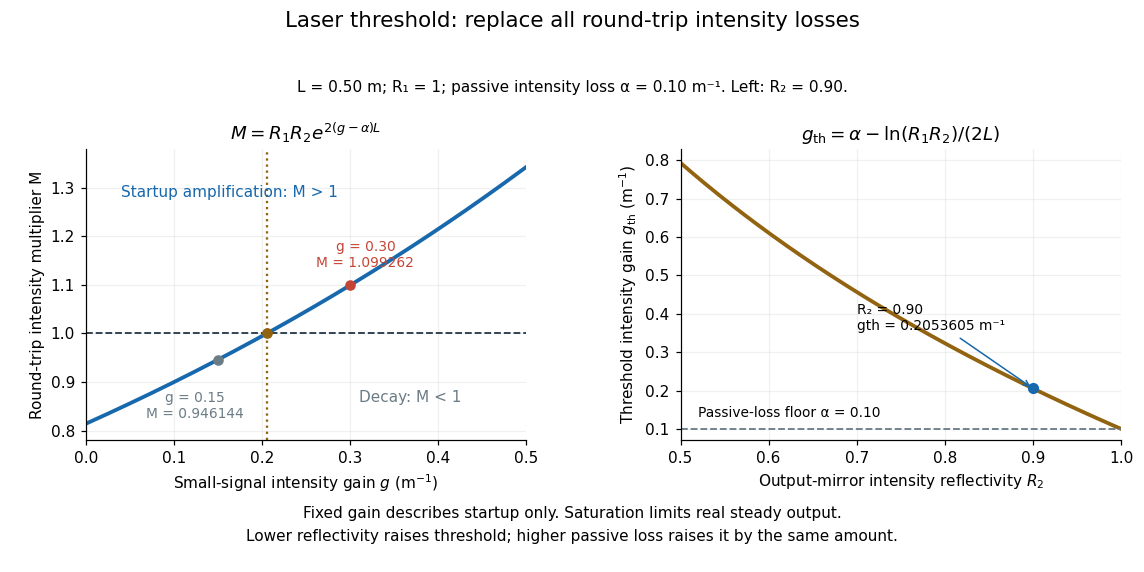

For , the fixed-gain recurrence predicts startup amplification, not infinite actual output. Growing light intensity depletes the available population inversion, reducing optical gain through saturation. In the simplest steady oscillator, the saturated round-trip gain balances loss and pumping supplies the outgoing power and dissipated energy. The small-signal model locates the onset; it does not determine the final output power. [ref]
https://ocw.mit.edu/courses/6-974-fundamentals-of-photonics-quantum-electronics-spring-2006/18f30fad63a62ef4dd894d3752b55a60_chapter7.pdf. Franz Kärtner, MIT 6.974, §7.5: gain saturation and steady output
. Articles by others on the same topic
There are currently no matching articles.