Draining tank with constant cross-sectional area
ID: draining-tank-with-constant-cross-sectional-area

Take a reservoir with constant horizontal cross-sectional area , one small orifice of area , no inflow, and constant stipulated discharge coefficient . Let the initial head be . For constant mass density , the stored mass above the outlet level is and outgoing mass flow rate is . Mass conservation cancels and gives the initial value problemThe downward speed of the free surface is , smaller than the ideal jet speed by the factor . Thus a small opening relative to the reservoir supports the negligible-surface-velocity assumption.
For , separation of variables or the chain rule gives . Integrating yieldsThe model reaches zero head in finite time even though volumetric flow rate tends to zero. Extending the squared expression beyond would make head grow again and violate the original ordinary differential equation. The zero-head continuation enforces no further outflow. For an elevated side opening, zero head means the surface has reached that opening, leaving fluid below it; is not the time to remove every drop from such a tank.
For an original synthetic example, stipulateThe initial volume above outlet level is . The initial ideal jet speed is , the initial volumetric flow rate is , and the predicted zero-head time is . These are consequences of stipulated parameters, not experimental measurements. At , head is , stored volume is , and volumetric flow rate is . Half the initial volume has already left at .
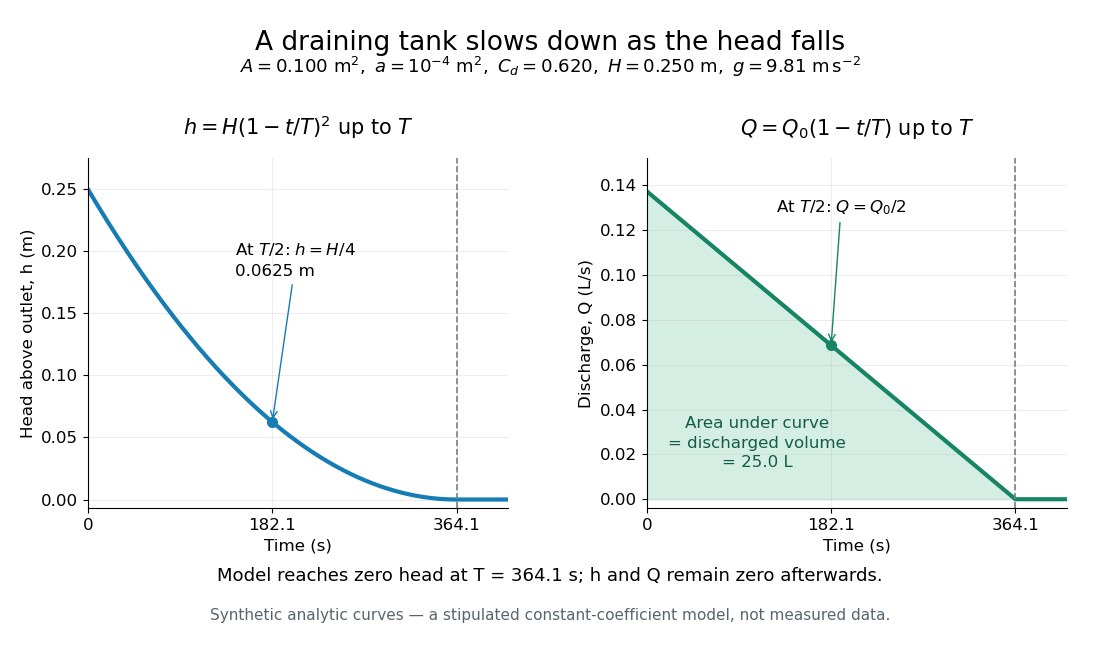
Constant-area drainage: quadratic head and linearly declining discharge
. Original synthetic trajectories for the stipulated draining tank with constant cross-sectional area, with , , , and . The model remains at zero head and zero volumetric flow rate after . The shaded area under the flow curve represents . Details.
An independent mass conservation check integrates the outgoing volumetric flow rate:Multiply both sides by mass density to obtain discharged mass. A dimensional analysis check gives , and . The triangular area under explains why the initial-rate estimate is only half the actual model time. Doubling doubles ; doubling or halves , within the same assumptions.
This finite-time result is an idealized prediction. The constant and quasi-steady approximation need not survive very small head or the initial startup. Appreciable viscosity in a narrow outlet tube requires a different pressure balance, as in Poiseuille flow; appreciable surface tension can prevent zero head altogether.
New to topics? Read the docs here!