
An entire function is a holomorphic function whose domain of a function is the whole complex plane. Its derivative exists at every . Every polynomial, the complex exponential function , the product , and the complex sine function are entire functions. The Taylor series of an entire function about any finite centre converges throughout the complex plane.
The complex exponential function is a particularly revealing entire function. Writing , Euler's formula givesThus the complex exponential function never takes the value zero. Conversely, for any , choose an argument of . All its preimages under the complex exponential function areHere is the real natural logarithm, and ranges over the integers. Substitution gives ; equality of moduli and arguments shows these are all the solutions. The complex exponential function therefore has image exactly , with infinitely many preimages for each nonzero value.
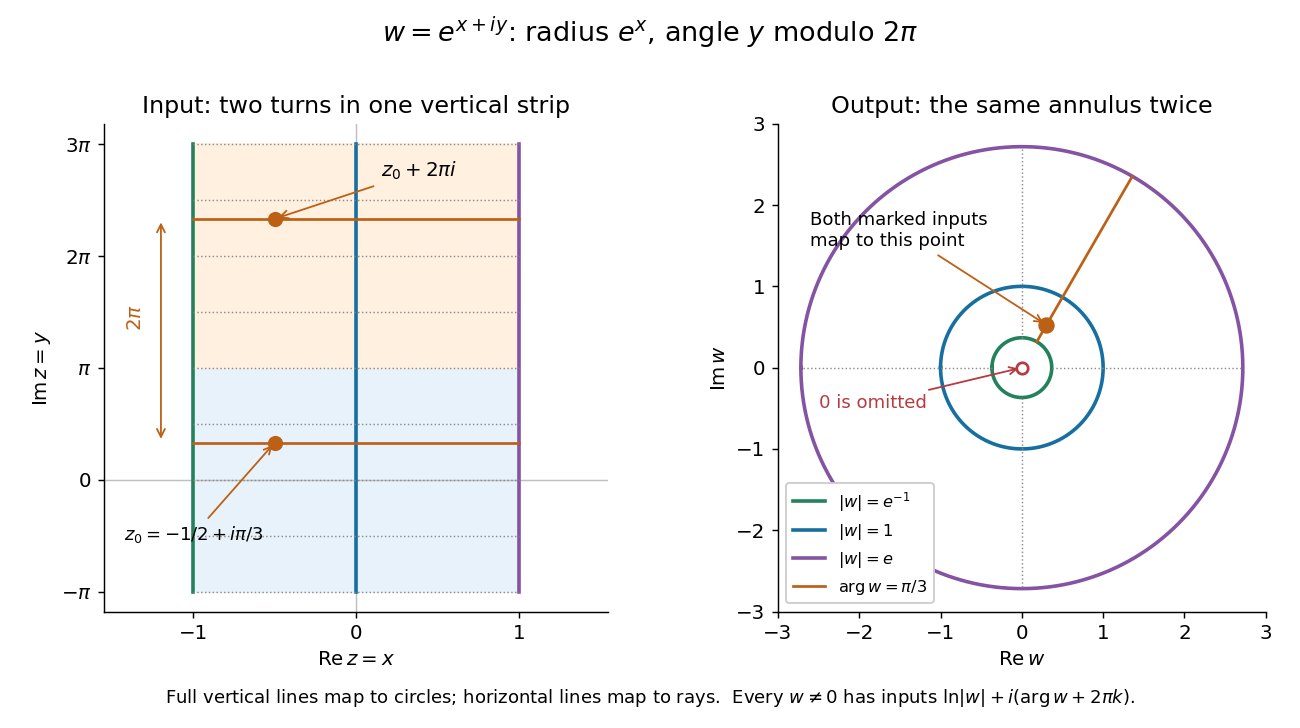
Under the complex exponential, vertical lines become circles, horizontal lines become rays, and inputs separated by 2 pi i have the same image
. Details. In the pictured vertical strip , the real part sets the modulus between and , while the imaginary part sets the argument modulo . The two drawn bands each make one full turn around the same annulus; their corresponding points differ by and have identical images. Allowing all real gives every positive modulus, so the whole complex plane covers every nonzero output.
An entire function has exceptionally strong global constraints. The Liouville theorem says that a bounded function which is also an entire function must be a constant function. Accordingly, the nonconstant entire functions above are unbounded somewhere in the complex plane, even when their restrictions to the real axis are bounded: the complex sine function satisfies , growing through the hyperbolic sine. The Little Picard theorem adds a different constraint: an unbounded nonconstant entire function still cannot leave two distinct complex values out of its image. These results make entire functions useful when global bounds or restrictions on the image can establish rigidity without solving for the function explicitly.
In the opening of his 1880 memoir, Émile Picard credits Karl Weierstrass with the terminology of entire functions and describes them by everywhere-convergent power series. [ref]
https://numdam.org/articles/10.24033/asens.187/. Picard, Mémoire sur les fonctions entières (1880), p. 145


An entire function is a complex function that is holomorphic (i.e., complex differentiable) at all points in the complex plane. In simpler terms, an entire function is a function that can be represented by a power series that converges everywhere in the complex plane. ### Characteristics of Entire Functions: 1. **Holomorphic Everywhere**: Entire functions are differentiable in the complex sense at every point in the complex plane.
New to topics? Read the docs here!