Equal interaction forces and unequal accelerations
ID: equal-interaction-forces-and-unequal-accelerations

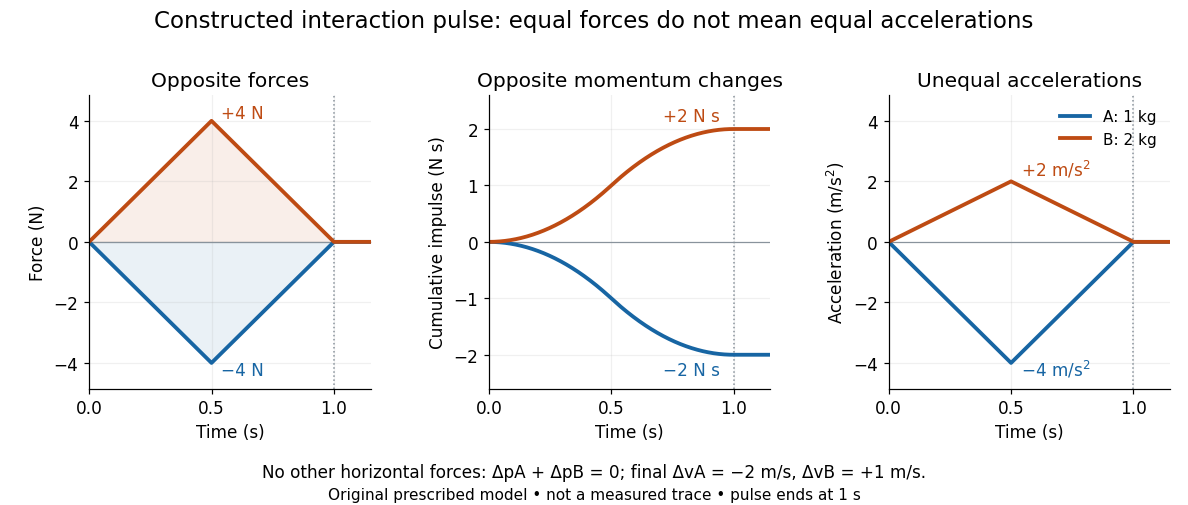
Choose right as positive and let two carts have total moving masses and , including any attached apparatus. At an instant when their repulsive interaction has magnitude , assume no other horizontal forces. Then Newton's third law gives and , while Newton's second law givesThe smaller mass has the larger acceleration magnitude. For a nonzero interaction and zero other horizontal forces, . Meanwhile in force units. The two carts' velocities change while total momentum stays constant.
To distinguish an instantaneous force from its accumulated impulse, prescribe an original triangular interaction pulse lasting :This chosen pulse reaches at ; it is a constructed model, not an experimental trace or a claim about a particular bumper's material response. Its positive area is . The impulse-momentum theorem therefore givesOpposite impulses give opposite momentum changes, while the velocity changes differ because of the unequal masses. The cumulative positive impulse is during the first half and during the second half. Thus and cancel throughout the pulse, not merely at its endpoint.

New to topics? Read the docs here!