Faraday induction-ring experiment
ID: faraday-induction-ring-experiment

Michael Faraday's induction ring separates two questions: can one electrical circuit affect another without an electrical connection, and does that effect continue under steady conditions? The surviving apparatus uses insulated copper windings around an iron ring; the Royal Institution dates the successful experiment to 29 August 1831.[ref]
Michael Faraday's ring-coil apparatus by Royal Institution. Collection record, date, materials and Description
Faraday connected one winding group to a battery, the other to a galvanometer. Making battery contact deflected the needle; maintaining contact let it return to rest; breaking contact reversed the response. Reversing the battery reversed the deflections. His separate cylinder comparison enhanced induction with iron, whereas replacing it with copper gave no enhancement over the windings alone.[ref]
Experimental Researches in Electricity, Volume 1 by Michael Faraday. First Series, §§27–30, ring, connections and reversal; §§34–35, distinct cylinder comparison
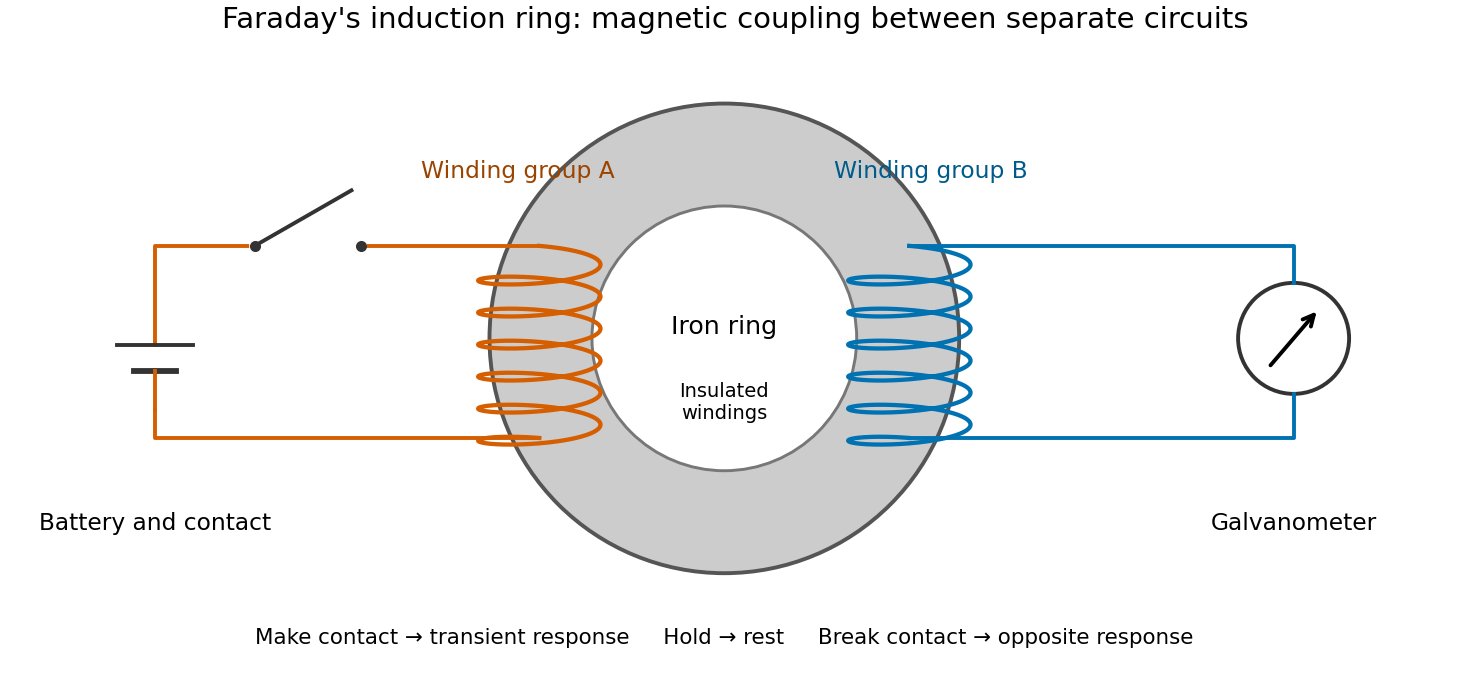

The contrast between a switching response and a quiet steady state makes mutual induction tangible. A steady primary electric current can maintain magnetic flux without sustaining a secondary electromotive force. Changes in magnetic flux linkage matter, as expressed by Faraday's law of induction. This is why a driven electrical transformer uses repeated changes in magnetic flux to supply secondary power.
The galvanometer readout of an induction pulse also separates the measured motion from the inferred electric current. Its moment of inertia and damping mean that a deflection is not an instantaneous trace of electric current. The following coupled RL induction model calculates currents in a stipulated circuit, rather than fitting Faraday's needle motion or reconstructing his switching times.
New to topics? Read the docs here!