
The field of view is the region of object directions sampled by an optical instrument in one pointing. State whether it is horizontal, vertical or diagonal, and whether it is a full angle or a half-angle. An object-plane width in millimetres also describes a field of view, but requires a specified object distance. Neither that width nor the angular field of view is the aperture diameter or the diffraction-limited resolution.
For a centred flat rectangular photodetector of width in the focal plane, with positive effective focal length , infinity focus and ideal rectilinear imaging without optical distortion, the full horizontal field of view isThe model maps an object direction to image height of magnitude ; set and use the inverse tangent. This retains exact right triangle geometry within the stipulated imaging model; a paraxial focal length alone does not guarantee that a real wide-field optical lens obeys it. With detector height , replace by for the vertical field of view, and by for the diagonal field of view. The small-angle approximation gives in radians. [ref]
https://www.edmundoptics.com/knowledge-center/application-notes/imaging/understanding-focal-length-and-field-of-view/. Gregory Hollows and Nicholas James, Edmund Optics, Understanding Focal Length and Field of View
.For an original worked example, a detector width gives at , and at . Keeping makes these f/2 and f/4 respectively: the field of view changes because changes. By contrast, closing from to at changes f/4 to f/8 while retaining in this model. The clean separation is useful: entrance pupil area controls collection, focal ratio controls the paraxial cone, and controls angular image coverage. Edge clipping, optical distortion, field curvature and optical aberrations can restrict the practically usable field of view.
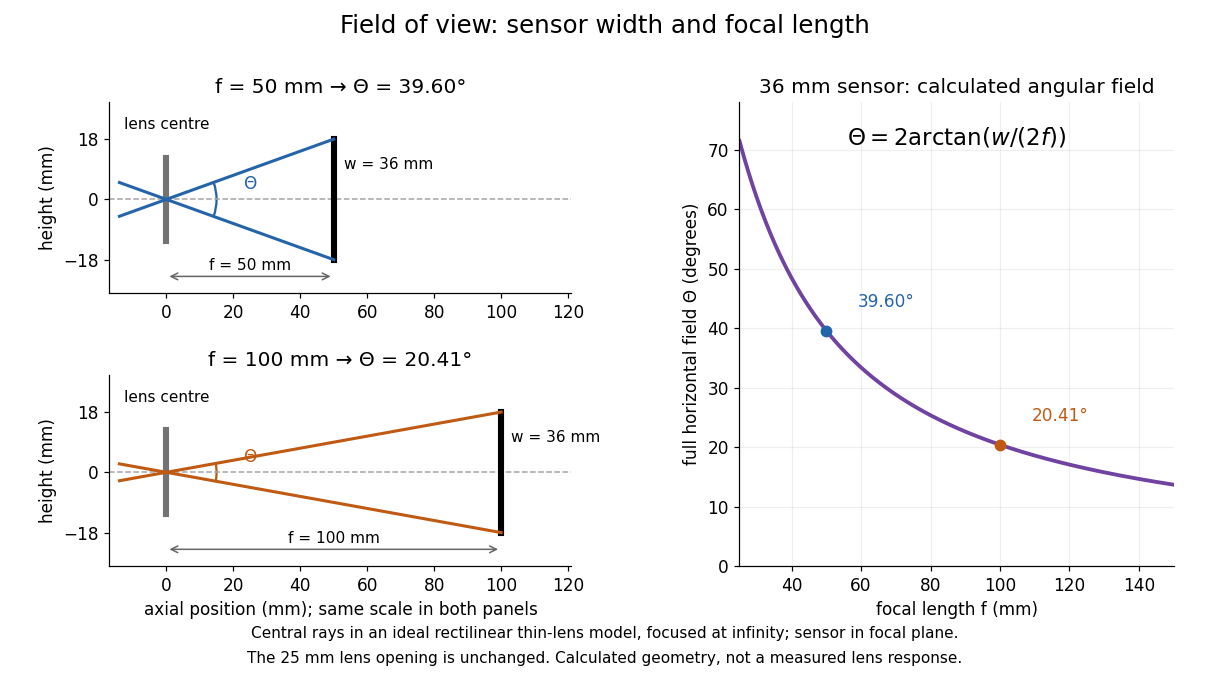

A proposed angular readout on an optical bench illuminates a small asymmetric target at the optical focus of a collimator, providing a bundle with a known direction. Rotate the optical camera about the centre of its entrance pupil, reading a graduated rotation stage, and record the target image position on its fixed photodetector. Centre the target to establish zero; turn left and right until its centre reaches each detector edge. The difference between stage readings measures the full horizontal field of view. Repeat with a smaller aperture stop: unchanged edge directions but reduced signal support the distinction between collection and angular coverage. Keep the same active detector width, infinity focus, illumination, integration time and gain; approach each reading from the same direction to check mechanical backlash. A finite target blurs the edge criterion, detector thresholds can imitate lost coverage, and a wide bundle must illuminate the whole entrance pupil at every tested angle. These checks distinguish a geometrical boundary from insufficient signal. The analytical diagram is the prediction for this protocol, not a record of its execution.
New to topics? Read the docs here!