Finite-dimensional spectral theorem
ID: finite-dimensional-spectral-theorem

Every self-adjoint operator on a finite-dimensional real or complex inner product space has an orthonormal eigenbasis, and all its eigenvalues are real. In orthonormal coordinates, a real symmetric matrix has the form , with an orthogonal matrix and a real diagonal matrix. A complex Hermitian matrix instead has , with a unitary matrix and its conjugate transpose. These are the self-adjoint cases of the spectral theorem; Axler gives the real and complex finite-dimensional statements in Section 7B.[ref]
https://linear.axler.net/LADR4e.pdf. Sheldon Axler, Linear Algebra Done Right, fourth edition, Section 7B, Theorems 7.29 and 7.31; accessed 2026-10-11
An orthonormal eigenbasis turns a seemingly coupled linear map into independent scalar multiplications while preserving lengths and angles. If and , thenThe last identity removes every cross term from the quadratic form. The eigenvalues tell us whether it is positive, negative, or mixed in sign, and the eigenvectors identify the corresponding directions. This connects positive-definite matrices, quadratic forms, and the Hermitian Rayleigh quotient range.
For a fully computed example, takeDirect multiplication gives and . Their dot product is zero and each has norm one. ThusWriting changes into . Its level set is therefore an ellipse with semiaxis lengths and , along and . The coordinates change, but the ellipse does not: orthogonal diagonalization reveals its existing geometry.
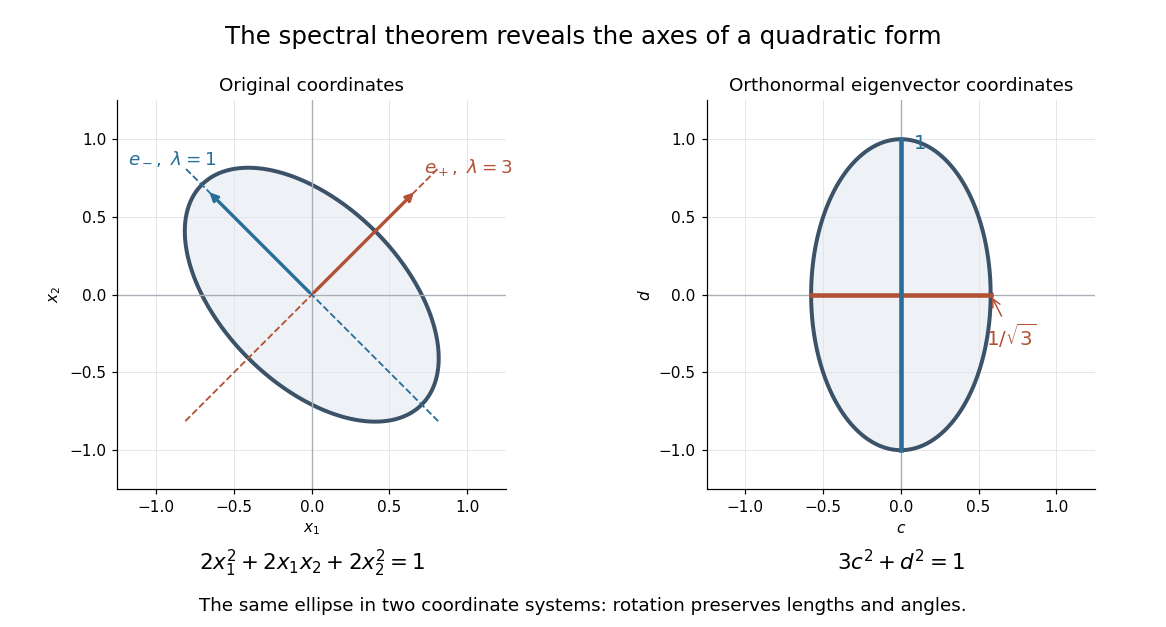
An orthonormal eigenbasis removes the cross term from a quadratic form and reveals the axes of its ellipse
. Details. 
For distinct eigenvalues, orthogonality follows at once from self-adjointness: . Within a repeated eigenspace, choose an orthonormal basis; arbitrarily chosen eigenvectors of the same eigenvalue need not be orthogonal. One outline of the full argument finds an eigenvector, observes that its orthogonal complement is invariant, and repeats in that smaller space. Merely having real eigenvalues is weaker: has two real eigenvalues, but its eigenvectors and are not orthogonal.
New to topics? Read the docs here!