Finite-rate isothermal piston model
ID: finite-rate-isothermal-piston-model

Why must a conducting piston move slowly? A simple model couples the first law of thermodynamics to Newton's law of cooling. Assume a fixed amount of ideal gas with uniform temperature and constant whole-sample heat capacity at constant volume , a heat bath maintained at , negligible friction, and mechanically slow motion. Let be the effective thermal conductance, the reciprocal of the thermal resistance, in . ThenPositive heat transfer must offset expansion work to keep near . A finite and nonzero piston speed therefore require a temperature difference. This uniform-temperature model neglects spatial temperature gradients, sensor response, cylinder heat capacity and any change of with piston position; it is an illustrative calculation, not a fit to the isothermal gas syringe experiment.
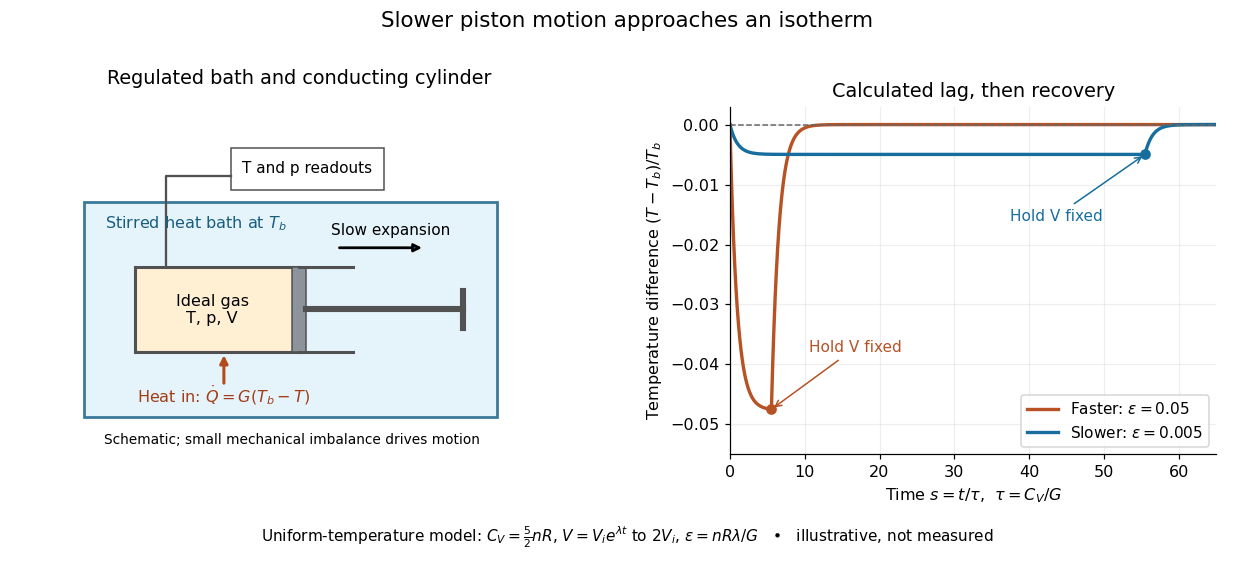
Conducting piston in a thermal bath and modeled temperature lag during expansion
. Details. 
For a prescribed exponential volume change , define , and . The dimensionless temperature obeys a linear ordinary differential equation with initial value :The plotted expansion uses stipulated and stops at , at . During expansion, the larger produces the larger temperature deficit; once the piston is held fixed, the deficit undergoes exponential decay as . Reducing makes the path more nearly an isothermal process, while increasing its duration. Reversing the piston with produces a temperature excess and outward heat transfer; the small- regime is the intended near-isothermal approximation. Mechanical slowness alone does not ensure sufficient heat transfer.
New to topics? Read the docs here!