
A flow cytometer is an instrument that measures optical signals as suspended particles pass through an illuminated observation region. Its fluidics positions the sample stream, its optical system excites and collects light, and its electronics converts detector pulses into recorded events. Flow cytometry is the measurement technique; a flow cytometer is the apparatus implementing it.
In a common design, hydrodynamic focusing narrows the sample stream within surrounding fluid so particles encounter a more reproducible region of a laser beam. Collected fluorescence and scattered light reach photodetectors through optical selection elements. A pulse can be summarized by its height, integrated area and width. The FACSCelesta manual distinguishes the maximum digitized intensity from the integral over the electronic acquisition window.[ref]
BD FACSCelesta Flow Cytometer User’s Guide by BD Biosciences. Chapter 7, Technical overview, printed p. 115
Signal area and peak height are different measurements even when both increase with the brightness of a selected particle population.For an original ideal pulse model,Two pulses with the same height but widths and have areas in ratio 1:2. Conversely, equal areas can arise from different heights and durations.
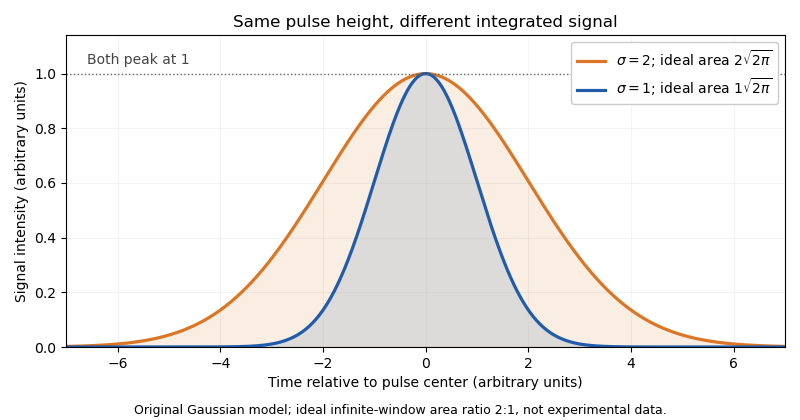

Real acquisition windows and thresholding modify the infinite-window model. Pulse-shape comparisons can help identify coincident particles, but no one pulse parameter guarantees a single intact biological cell.
A primary experimental example measured green fluorescent protein expression in a genetic toggle switch with a FACSCalibur instrument. It used 488 nm excitation, a 515–545 nm emission filter and separately acquired cultures; single-cell distributions distinguished alternative expression populations.[ref]
Construction of a genetic toggle switch in Escherichia coli by Timothy S. Gardner and others. p. 342, Methods, Assay of gene expression; Figure 5
That experiment illustrates the chain from biological reporter to photons, detector signal and population interpretation.A flow cytometric DNA-content assay similarly requires controlled staining, a suitable event-selection rule and detector operation within its quantitative range. Adjusting detector gain changes recorded signal without changing cellular DNA. Instrument response, sample preparation and biological interpretation therefore require distinct controls.
New to topics? Read the docs here!