
Gene expression uses a gene's information to produce functional RNA or a protein. Transcription makes RNA from a DNA template; for a protein-coding gene, biological translation then uses messenger RNA to specify an amino acid chain. Many genes instead produce functional RNA, including transfer RNA and ribosomal RNA, without a translated protein product. See Alberts et al., Molecular Biology of the Cell, 4th edition (2002): from DNA to RNA.
Follow the chosen coding strand : transcription of its complementary template gives in messenger RNA. In the stated reading frame, its three codons are AUG, GCU and UAA: methionine, alanine and a stop codon. Thus nine nucleotides specify two amino acid residues followed by termination, not three residues. This is an illustrative coding segment embedded in suitable expression and initiation context, not a claim that an isolated nine-nucleotide RNA is sufficient to initiate biological translation.
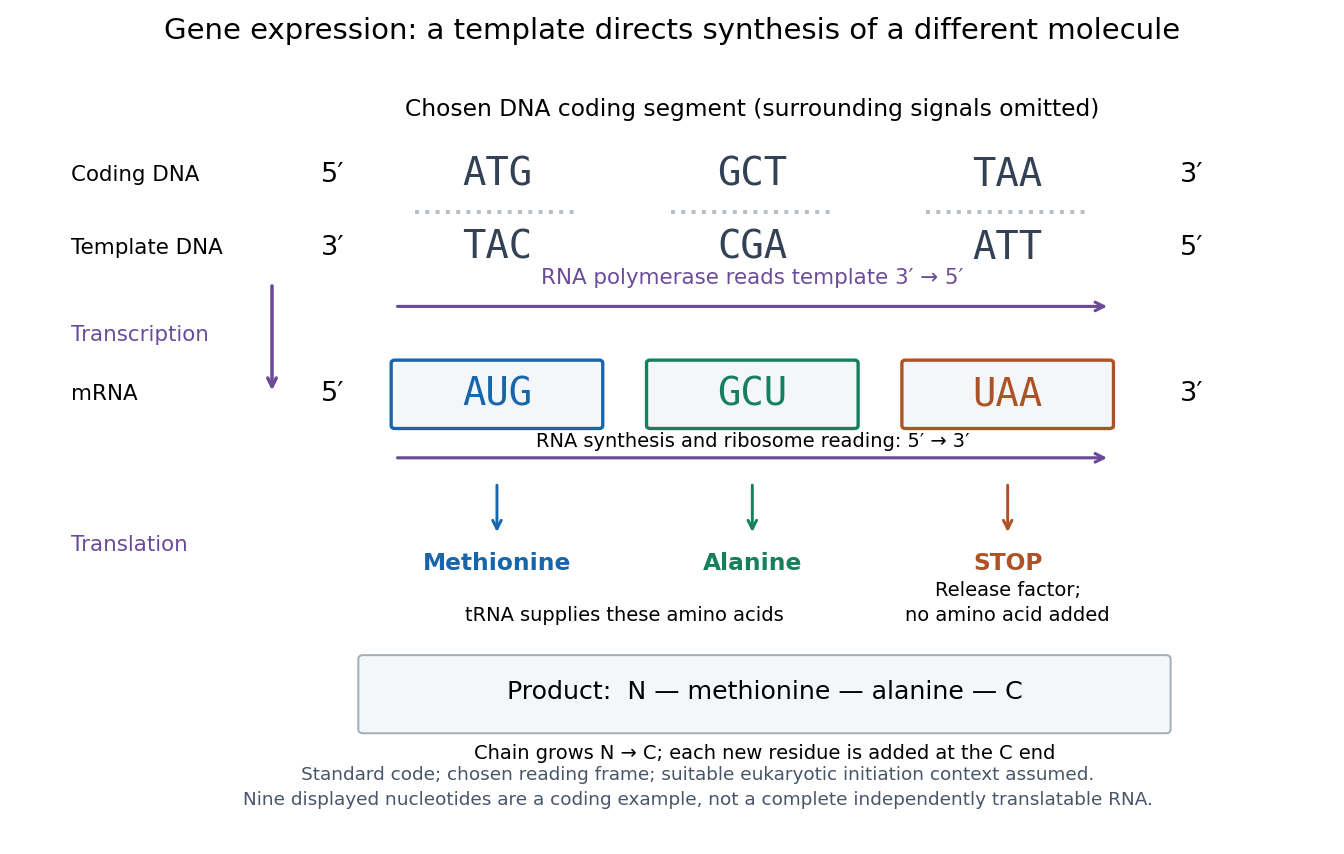
The distinction between copying and use explains how biological cells can preserve the same DNA yet produce different products. DNA replication duplicates the record; gene expression selects and uses parts of it. Transcription does not use all DNA at once, and gene expression can be controlled at several steps, including transcription, RNA processing and biological translation. See Clark, Douglas and Choi, Biology 2e: regulation of gene expression. The arrows describe template-directed synthesis: the DNA does not physically turn into a protein, and the messenger RNA does not supply the amino acids from which that protein is assembled.


Gene expression is the biological process through which the information encoded in a gene is used to produce a functional gene product, usually a protein, but it can also refer to the production of non-coding RNA molecules such as rRNA, tRNA, or microRNA. This process involves several key steps: 1. **Transcription**: The DNA sequence of a gene is transcribed into messenger RNA (mRNA) by RNA polymerase.
New to topics? Read the docs here!