Galton-Watson process
ID: galton-watson-process

A Galton-Watson process is a branching process that counts individuals by generation. Start with one ancestor, , and let all offspring counts be independent and identically distributed random variables taking nonnegative integer values with a common offspring distribution. ThenThe empty sum is zero: zero is an absorbing state, so once a generation is empty every later generation is empty. The same offspring distribution applies to every individual in every generation. [ref]
https://ocw.mit.edu/courses/18-445-introduction-to-stochastic-processes-spring-2015/27aaeb9eb9a9cecce93d9ad74413ddf5_MIT18_445S15_lecture19.pdf. Hao Wu, MIT 18.445, Lecture 19, slides 3–4
For a concrete offspring distribution, take , , , and for . An individual has no children with probability , one with probability , and two with probability . The offspring expected value is . A possible sequence of generation sizes is : two children need not lead to a permanently growing family.
The probability generating function gives the exact generation probability distributions through branching-process generating-function iteration. With and , the second generation hasThus and . The figure shows full generation probability mass functions, computed by polynomial function composition, through generation six; no simulated frequencies are used.
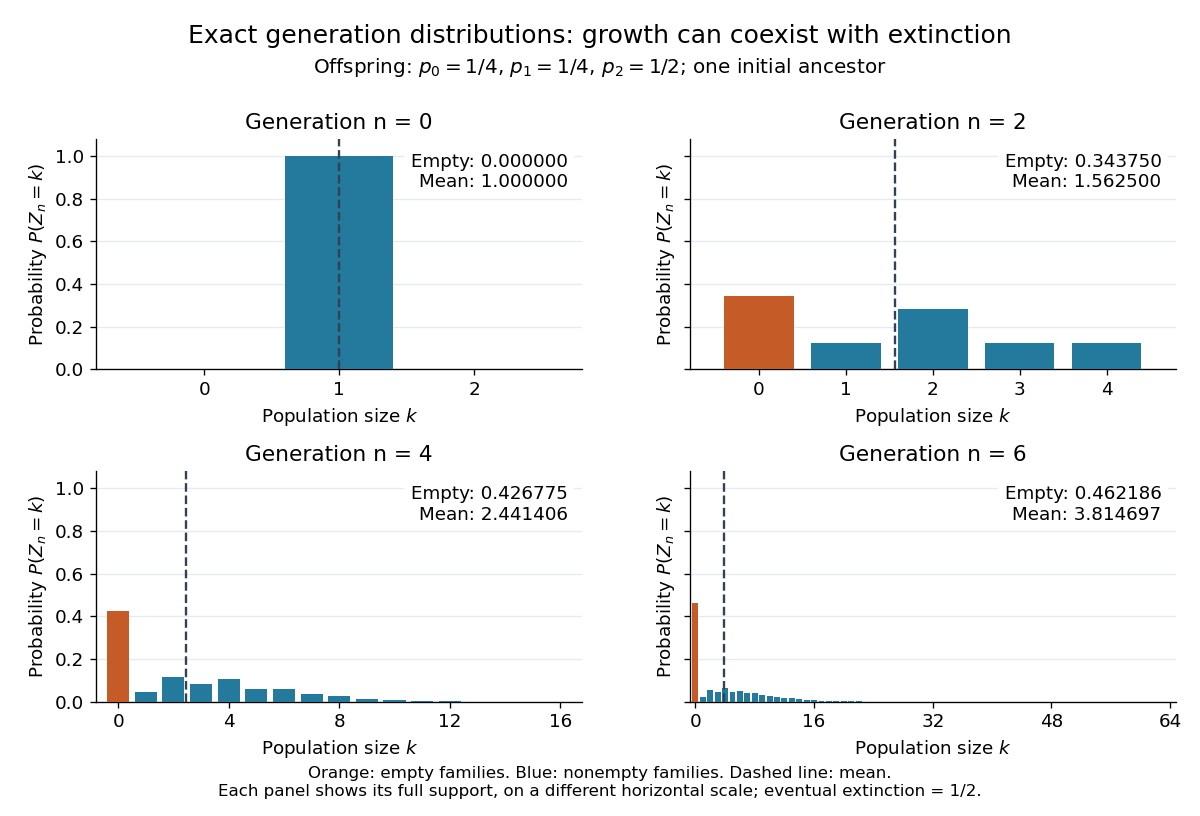

The contrast is striking: the expected generation size in a Galton-Watson process grows as , while the branching extinction probability is . By generation six, although . Larger surviving families carry the rising expected value; that mean is an average over possible families, not a forecast of one family's path. The Galton-Watson extinction fixed point turns an unbounded number of future generations into a single equation for this probability.
The historical question was the disappearance of surnames passed through male descendants. In Watson and Galton, On the Probability of the Extinction of Families, pages 139–140, Francis Galton formulates a constant-law model counting sons who reach adulthood, and Watson computes later generation probability distributions by composing generating functions. Those are assumptions of their model, rather than a claim that actual human reproduction follows this offspring distribution.
New to topics? Read the docs here!