
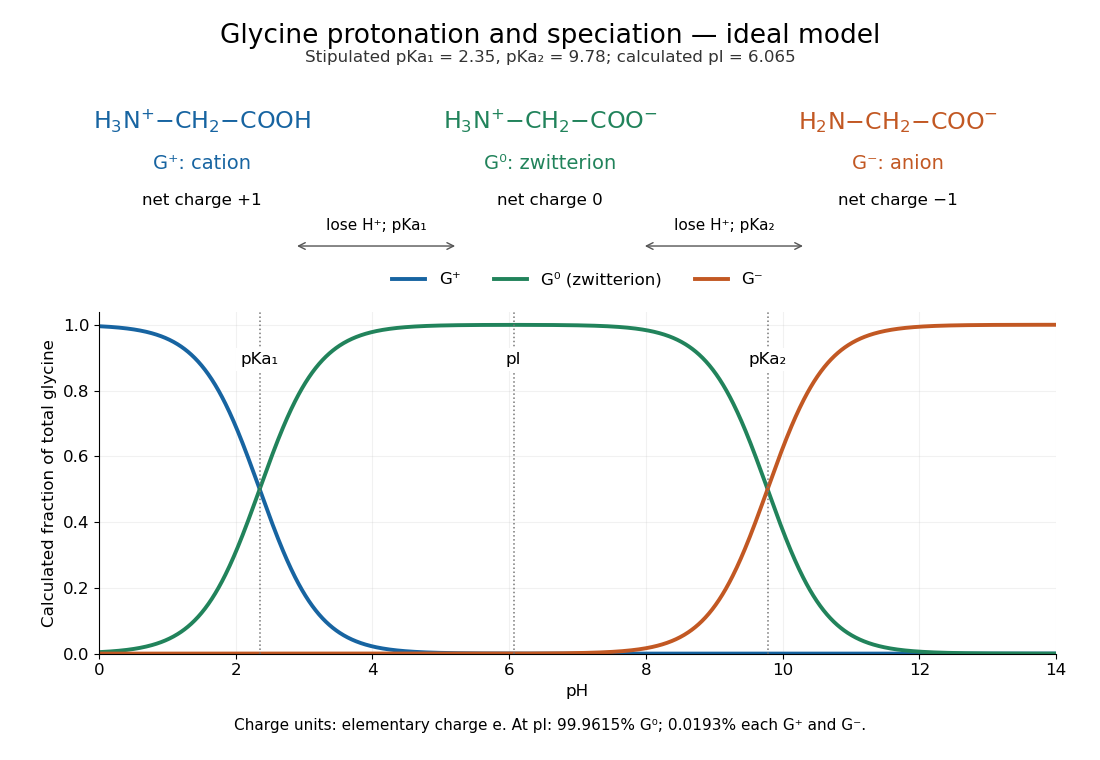
The three principal aqueous glycine forms differ by loss of one proton at each step:Call these glycine forms , and , respectively: a cation, a zwitterion and an anion, with net electric charges , and , where is the elementary charge. specifically denotes the zwitterion, not an uncharged amino/carboxyl drawing. The first dissociation removes the carboxyl proton; the second removes a proton from the positively charged nitrogen. The chemical equilibrium changes are reversible, not three permanently separate kinds of glycine. [ref]
Organic Chemistry by John McMurry. §26.1, aqueous zwitterion protonation/deprotonation; §26.2, two successive amino-acid dissociations
For all calculations and both diagrams here, explicitly stipulate the pKa values and . These are illustrative model inputs, not measurements from the glycine titration experiment or a claim of universal constants. Actual acid dissociation constants depend on temperature and on the convention used for thermodynamic activity; apparent concentration-based values also depend on ionic strength. For comparison, the inspected textbook tabulates and for glycine, which would give a different isoelectric point. [ref]

New to topics? Read the docs here!