Glycolysis carbon and ATP ledger
ID: glycolysis-carbon-and-atp-ledger

Follow one glucose through canonical glycolysis, with no diversion of intermediates into other metabolic pathways. The investment stage uses two ATP to prepare the six-carbon substrate. Cleavage and rearrangement provide two glyceraldehyde 3-phosphate molecules, each containing three carbon chemical atoms. Each then yields one three-carbon pyruvate, one NADH, and two ATP in the payoff stage.[ref]
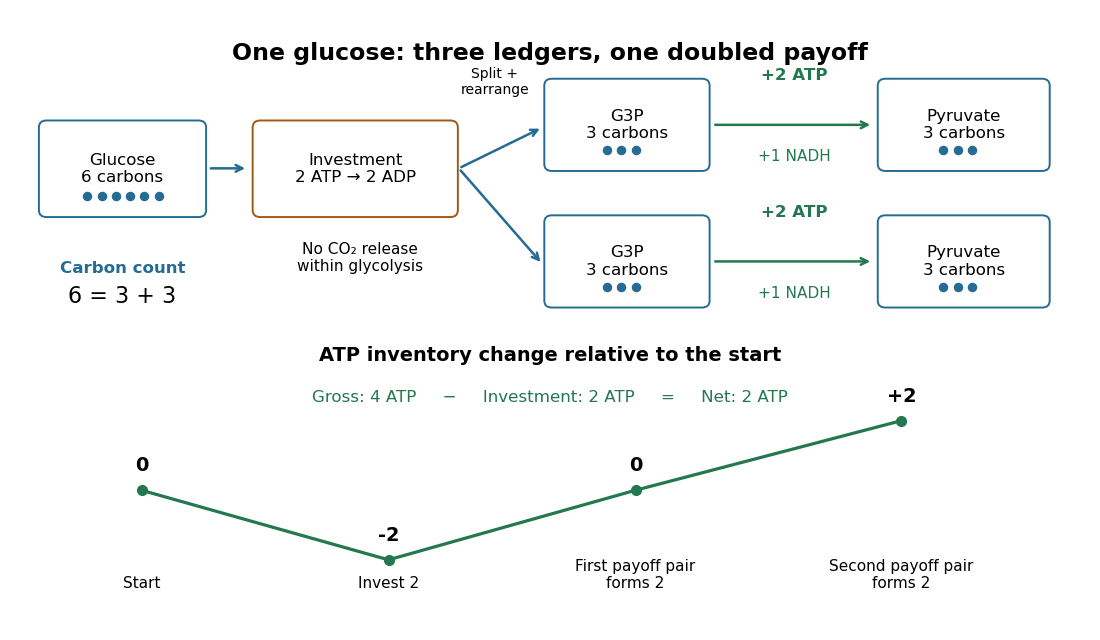

The material check is : all six carbon chemical atoms remain in the two pyruvates. No carbon dioxide has been released within this boundary. In the ATP ledger, each three-carbon route contains two ATP-forming transfers, soThe first pair of payoff transfers only restores the initial ATP inventory; the second pair creates the net gain. Four newly formed ATP is therefore compatible with only two additional ATP remaining.
For an original scaled example, stipulate complete conversion of of glucose. The initial of carbon chemical atoms becomes of pyruvate, still containing of carbon chemical atoms. The pathway spends of ATP, forms of ATP, and adds to the ATP inventory before any other ATP use. It also reduces of NAD+. These are calculated ideal amounts, not observed yields; side routes or incomplete conversion change the outcome.
A common biochemical net chemical equation isHere is inorganic phosphate. The names group biochemical protonation and metal-binding states; the displayed proton and water terms use a common shorthand rather than a unique specification of every chemical species. The robust ledger records two net ADP-to-ATP conversions and two NAD+-to-NADH conversions. Summing the individual chemical equations cancels two invested ATP against four formed ATP and cancels the internal substrates, giving those coefficients.
New to topics? Read the docs here!