A metabolic pathway is a connected sequence of enzyme-catalyzed chemical reactions in metabolism, with a reaction product of one step serving as a substrate for another. A pathway boundary is a choice about which transformations to count: glycolysis ends at pyruvate, whereas subsequent fermentation or cellular respiration changes the final material balance. Adding the individual chemical equations cancels internal intermediates and exposes the net stoichiometry; it does not determine the reaction rate.
carbon-13 metabolic flux analysis infers pathway flows from isotope-labeling patterns and a specified metabolic model. A valid inference needs distinguishable routes, appropriate pool and growth assumptions, and uncertainty assessment.
type II fatty acid synthesis distributes successive biosynthetic steps among separate enzyme components. Its requirement in a parasite depends on species and life-cycle stage, and should not be inferred solely from pathway retention.
isoprenoid precursor biosynthesis supplies activated building blocks for diverse isoprenoid products. In blood-stage Plasmodium falciparum culture, supplementation with IPP can bypass the essential output of the apicoplast under the tested conditions.
The acyl-CoA pool is the set of acyl groups carried by coenzyme A in a specified compartment and condition. Carrier-bound intermediates must be distinguished from the same acyl chains esterified in membrane or storage lipids.
A metabolic flux is the rate of material flow through a specified reaction or pathway. Pool size, transcript abundance and maximal enzyme activity do not individually determine it.
Glycolysis converts one glucose into two pyruvates, yielding two net ATP and reducing two NAD+ to two NADH in the canonical pathway. It first spends two ATP, then produces four by substrate-level phosphorylation. The pathway itself consumes no molecular oxygen; sustained operation nevertheless requires regeneration of NAD+.[ref]
Biology 2e by Mary Ann Clark and others. §7.2, First Half of Glycolysis, step 5; Second Half of Glycolysis, steps 6–10; Outcomes of Glycolysis
The useful organizing idea is three separate ledgers: carbon chemical atoms, transfers between ADP and ATP, and redox transfers between NAD+ and NADH. Splitting the carbon skeleton doubles the number of downstream conversions; recycling a cofactor permits repeated operation. These counts explain the yield without memorizing a drawing of every enzyme. The two net ATP belong to glycolysis alone, not to complete cellular respiration.
Follow one glucose through canonical glycolysis, with no diversion of intermediates into other metabolic pathways. The investment stage uses two ATP to prepare the six-carbon substrate. Cleavage and rearrangement provide two glyceraldehyde 3-phosphate molecules, each containing three carbon chemical atoms. Each then yields one three-carbon pyruvate, one NADH, and two ATP in the payoff stage.[ref]
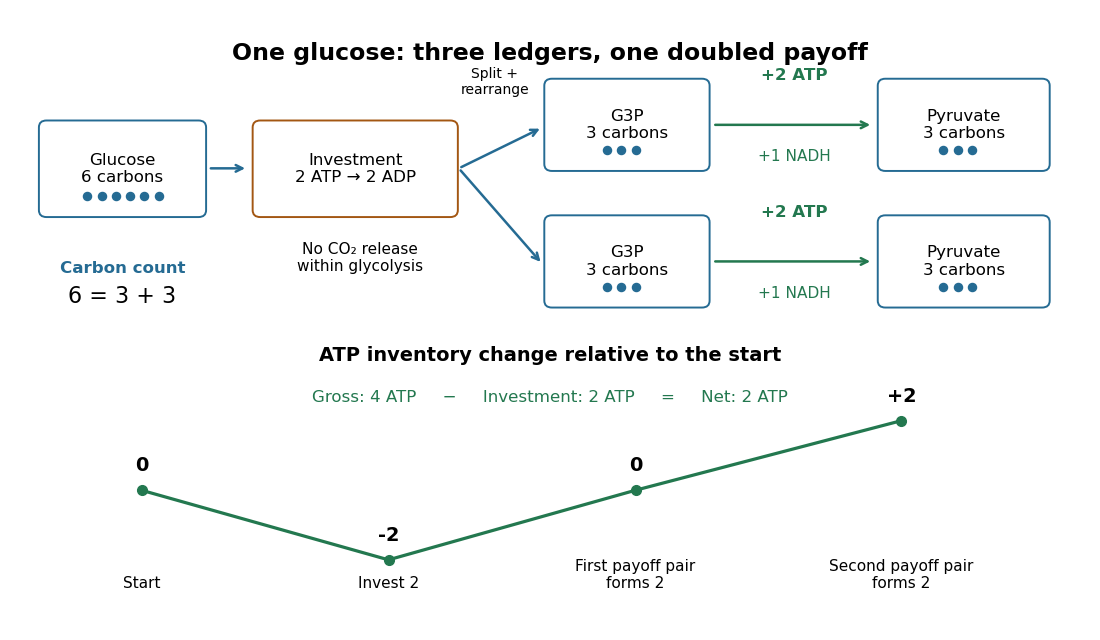
The material check is : all six carbon chemical atoms remain in the two pyruvates. No carbon dioxide has been released within this boundary. In the ATP ledger, each three-carbon route contains two ATP-forming transfers, soThe first pair of payoff transfers only restores the initial ATP inventory; the second pair creates the net gain. Four newly formed ATP is therefore compatible with only two additional ATP remaining.
For an original scaled example, stipulate complete conversion of of glucose. The initial of carbon chemical atoms becomes of pyruvate, still containing of carbon chemical atoms. The pathway spends of ATP, forms of ATP, and adds to the ATP inventory before any other ATP use. It also reduces of NAD+. These are calculated ideal amounts, not observed yields; side routes or incomplete conversion change the outcome.
A common biochemical net chemical equation isHere is inorganic phosphate. The names group biochemical protonation and metal-binding states; the displayed proton and water terms use a common shorthand rather than a unique specification of every chemical species. The robust ledger records two net ADP-to-ATP conversions and two NAD+-to-NADH conversions. Summing the individual chemical equations cancels two invested ATP against four formed ATP and cancels the internal substrates, giving those coefficients.
In the payoff stage of glycolysis, oxidation of glyceraldehyde 3-phosphate is coupled to reduction of NAD+. Each NADH carries a two-electron reducing equivalent. The formal half-chemical equationmakes the electron count explicit: two NADH per glucose carry four electrons. This is redox bookkeeping, not a claim that free electrons travel through the chemical solution or that NADH is itself ATP.
Fermentation can return NADH to NAD+ by reducing an organic substrate; reduction of pyruvate to lactate is one example. In aerobic cellular respiration, reducing equivalents reach an electron transport chain, reducing molecular oxygen. Other forms of cellular respiration use other electron acceptors, so absence of oxygen does not uniquely imply fermentation.[ref]
Biology 2e by Mary Ann Clark and others. §7.2, step 6 and its NAD+ regeneration paragraph; §7.5, opening comparison of fermentation and anaerobic respiration, Lactic Acid Fermentation and Figure 7.16 caption
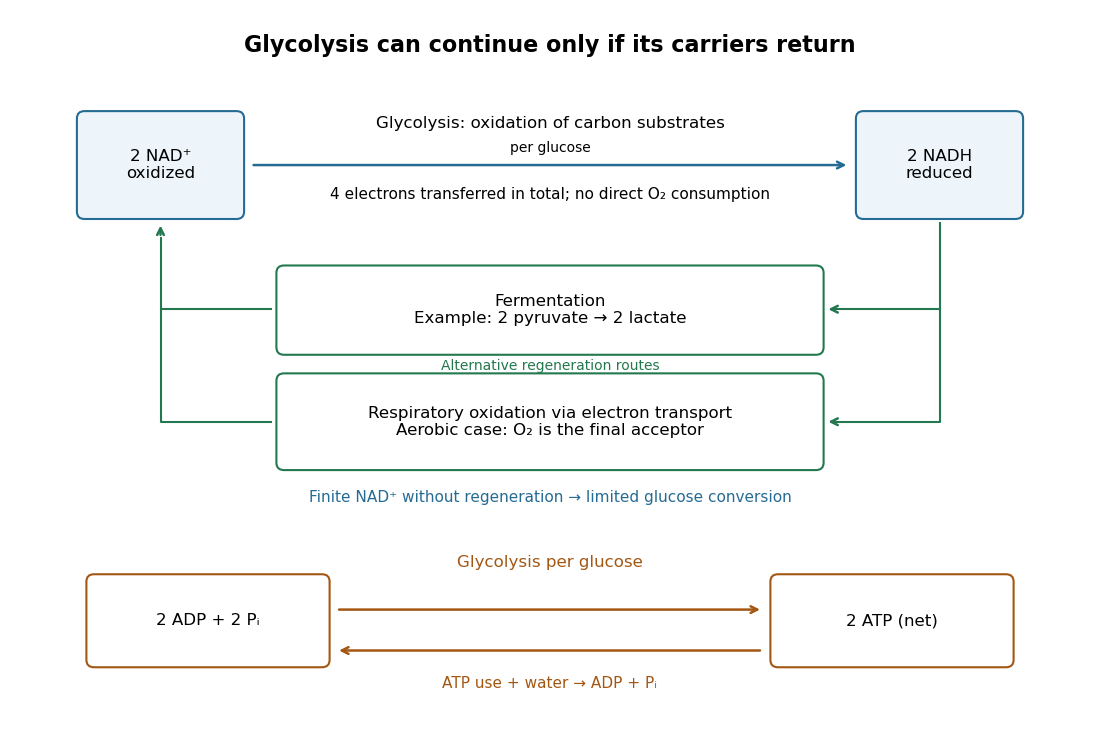
The need for NAD+ regeneration follows from a finite-pool argument. In a hypothetical closed preparation with of initially oxidized NAD+ and no regeneration, at most of glucose can complete the two NAD+-consuming conversions per glucose. This is an upper bound even with excess glucose, not a predicted stopping time: other limitations can stop the preparation earlier. With an intact fixed nicotinamide adenine dinucleotide pool and no side reactions, converting NAD+ into NADH preserves their sum but depletes the usable oxidized form.
ATP recycling imposes a second condition. Glycolysis needs some initial ATP for investment and consumes two net ADP and two inorganic phosphate per completed glucose. In a closed ideal preparation with only of initial ADP, no other source of ADP, and enough initial ATP and inorganic phosphate, at most of glucose can finish. This bound follows from the net ADP consumption, even though investment temporarily produces additional ADP. Initial investment also means that adequate final inventories alone cannot guarantee the route can start.
For continued operation at fixed carrier inventories, other chemical reactions must match the two net ATP formed per glucose with ATP use that restores ADP and inorganic phosphate, or exchange must supply those reactants. ATP hydrolysis coupled to cellular work is one route. Thus glycolysis can sustain useful energy coupling while neither its ATP inventory nor its NADH inventory grows indefinitely; matter cycles while glucose supplies fresh chemical free energy.
The final substrate-level phosphorylation in glycolysis provides a useful experimental handle: pyruvate kinase transfers a phosphate group from phosphoenolpyruvate to ADP, producing pyruvate and ATP. Adding lactate dehydrogenase couples each pyruvate formed to consumption of one NADH:These equations select free ionic forms consistently: phosphoenolpyruvate has charge , ADP , ATP , and pyruvate and lactate each ; NAD+ has one more positive charge than NADH. Each line conserves charge. Cancelling pyruvate gives one NADH consumed per ATP formed in this coupled system. A whole-pathway NADH measurement has a different meaning, because the earlier glycolysis redox step produces NADH.
The published An Optimized Enzyme-Coupled Spectrophotometric Method for Measuring Pyruvate Kinase Kinetics reports recombinant pyruvate kinase prepared in Escherichia coli, purified by chromatography and size-exclusion chromatography. UV-transparent microplate wells contained ADP, phosphoenolpyruvate, NADH, lactate dehydrogenase and a buffer solution with magnesium ions. An Epoch plate reader used spectrophotometry to follow absorbance at every five to ten seconds for one minute at . Its Figure 2 presents , increasing as NADH is consumed. Heat-inactivated pyruvate kinase gave minimal background; a validated active preparation was the positive control. These comparisons support an enzyme-dependent readout in the prepared system, rather than a whole-biological cell glycolysis measurement.[ref]
The same report uses for optical path length in Procedure B.2.i, but approximately in Data analysis §3. An absolute conversion requires the actual path length and sufficient coupling enzyme activity; no measured ATP rate is inferred here.[ref]
An Optimized Enzyme-Coupled Spectrophotometric Method for Measuring Pyruvate Kinase Kinetics by Saurabh Upadhyay. Procedure B.2.i; Data analysis §3; General notes, items 4 and 6: path-length inconsistency and linear-range conditions
For an original dimensional example, stipulate a blank-corrected absorbance decline , a calibrated path length and a chosen calibration coefficient . These are invented teaching inputs, not the protocol's measurements or its quoted coefficient. The Beer-Lambert law givesIn a stipulated reaction volume, this is of NADH consumed and, conditionally, of ATP formed. The conditional inference requires rapid pyruvate consumption by the coupling enzyme, no other NADH-consuming chemical reactions, and a linear, correctly calibrated optical response. The readout measures this last glycolysis step; it cannot establish the full two-net-ATP-per-glucose balance by itself.
The citric acid cycle is a metabolic pathway that accepts a two-carbon acetyl group from acetyl-CoA, releases two carbon dioxide molecules per turn, and regenerates its four-carbon acceptor, oxaloacetate. Its oxidation steps load electron carriers; oxidative phosphorylation subsequently uses their electrons to support ATP production. In mitochondria, most steps occur in the mitochondrial matrix, while succinate dehydrogenase lies in the inner mitochondrial membrane.[ref]
How Cells Obtain Energy from Food. Molecular Biology of the Cell, 4th edition by Bruce Alberts and others; Chapter 2, How Cells Obtain Energy from Food, The Citric Acid Cycle Generates NADH by Oxidizing Acetyl Groups to CO2; Figure 2-79 and Panel 2-9
The economy is striking: the acceptor is rebuilt rather than supplied anew for every incoming acetyl group. Regeneration does not create extra oxaloacetate. Withdrawal of intermediates for amino acid synthesis must be balanced by replenishment if the available pool is to remain steady. Thus the citric acid cycle connects energy metabolism to synthesis as well as to breakdown.[ref]
How Cells Obtain Energy from Food. Molecular Biology of the Cell, 4th edition by Bruce Alberts and others; Chapter 2, How Cells Obtain Energy from Food, final paragraph of The Citric Acid Cycle Generates NADH by Oxidizing Acetyl Groups to CO2: oxaloacetate and alpha-ketoglutarate as biosynthetic precursors
The glyoxylate shunt bypasses oxidative decarboxylations using isocitrate lyase and malate synthase. It permits net conservation of acetyl-unit carbon in four-carbon precursors, at a different balance of reducing-equivalent production from the oxidative route.
The carbon sequence is oxaloacetate plus an acetyl group to citrate , then isocitrate , alpha-ketoglutarate , succinyl-CoA , succinate , fumarate , malate and back to oxaloacetate . The numbers count the cycling carbon skeleton, excluding coenzyme A. Two carbon dioxide releases accompany the changes .[ref]
Biology 2e by Mary Ann Clark and others. §7.3, Steps in the Citric Acid Cycle, steps 1–8 and Figure 7.11
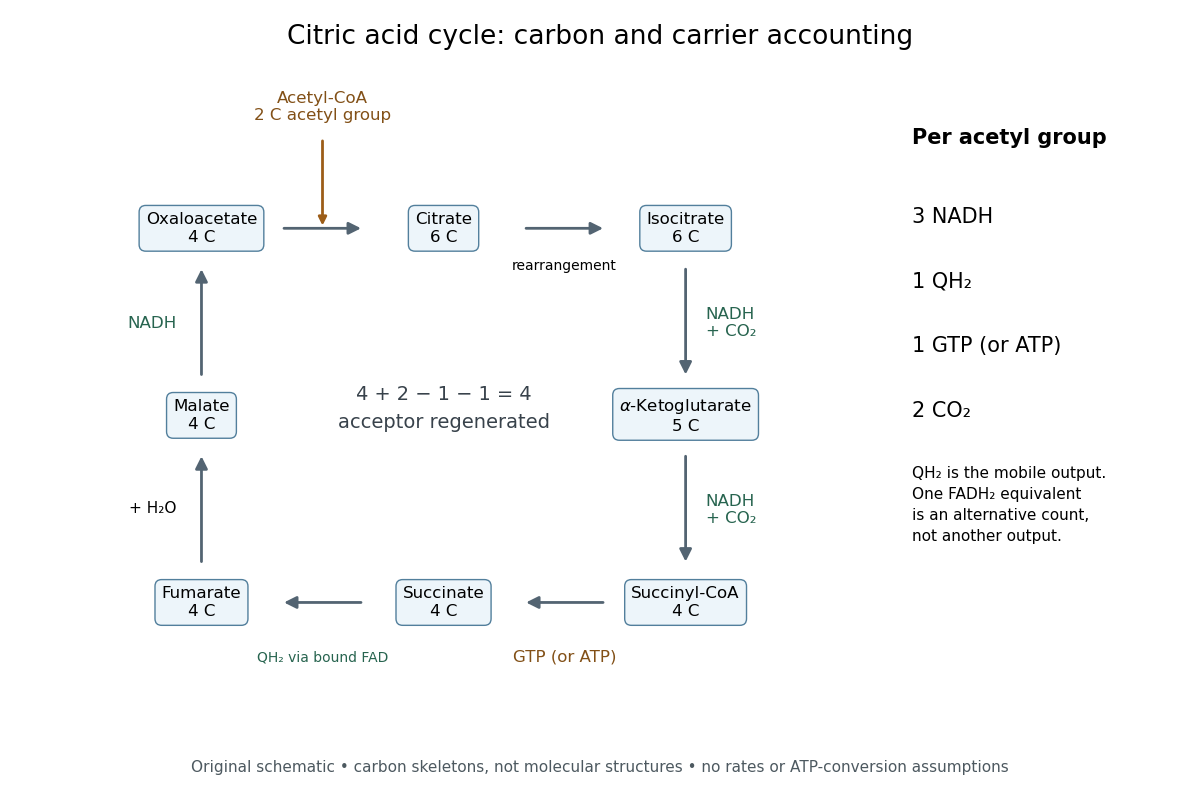
Per acetyl group: three NADH, one FADH2 equivalent, one GTP or ATP by substrate-level phosphorylation, and two carbon dioxide. Succinate dehydrogenase retains FADH2 and transfers its electrons to ubiquinone, forming ubiquinol. The FADH2 equivalent and ubiquinol count the same electron pair.[ref]
Biology 2e by Mary Ann Clark and others. §7.3, Citric Acid Cycle and Steps in the Citric Acid Cycle, steps 3–8, especially step 6, enzyme-bound reduced carrier; §7.4, Q and Complex II: ubiquinone reduction to QH2
A useful check adds the stepwise changes. The carbon count is ; the NADH count is . Each NADH carries two electrons, and the succinate dehydrogenase route supplies another pair, so one turn exports electrons. This arithmetic is an accounting identity, not an ATP yield calculation. Converting it to ATP requires the separate energy coupling and transport assumptions discussed under oxidative phosphorylation.
For a chosen ideal conversion of of acetyl groups, multiplication gives of NADH, of ubiquinol, of GTP and of carbon dioxide. The electron output is . If all these electrons subsequently reach oxygen with no competing sinks, four electrons per oxygen molecule require of oxygen. That is consumption by the connected electron transport chain; it is not an oxygen term in the cycle's own substrate ledger.
No cycle step directly consumes molecular oxygen. In ordinary aerobic mitochondrial operation, however, the mitochondrial respiratory chain must reoxidize NADH and ubiquinol to restore the oxidized electron carriers. Without that outlet, a finite oxidized-carrier pool cannot sustain continued turnover. Other electron acceptors and other forms of metabolism require their own analysis.[ref]
How Cells Obtain Energy from Food. Molecular Biology of the Cell, 4th edition by Bruce Alberts and others; Chapter 2, How Cells Obtain Energy from Food, The Citric Acid Cycle Generates NADH by Oxidizing Acetyl Groups to CO2: lack of direct O2 consumption and need to regenerate NAD+
The pyruvate dehydrogenase complex acts upstream: one three-carbon pyruvate gives one two-carbon acetyl group, one carbon dioxide and one NADH. These are additional to the cycle ledger.[ref] Consequently, processing one pyruvate through both stages gives three carbon dioxide and four NADH, while the succinate dehydrogenase contribution and the substrate-level phosphorylation contribution each remain one. Counting the upstream step inside the cycle would obscure where the extra carbon dioxide and NADH arise.
Net stoichiometry does not identify individual chemical atoms. In the ordinary forward citric acid cycle, neither entering acetyl group carbon is released in that same first turn: both released carbon dioxide carbon chemical atoms came from the starting oxaloacetate. The entering carbon remains in regenerated intermediates.[ref]
The Citric Acid Cycle (Boston University lecture slides). The Citric Acid Cycle, slide numbered 4, Origin of C-Atoms in CO2: entering acetyl carbons retained and released carbons from starting oxaloacetate
Consider a chosen ideal first-turn experiment, with negligible natural carbon-13 abundance and no exchange, side pathways, repeated turns or isotope effects. Supply of initially unlabelled oxaloacetate and of acetyl-CoA, of which has both acetyl group carbon positions labelled with carbon-13. The other has neither position labelled. The label refers only to the acetyl group, not to coenzyme A.
The input contains of labelled carbon chemical atoms. The of citrate initially formed contains of carbon chemical atoms, so its labelled-carbon fraction is . After exactly one forward traversal per starting oxaloacetate, the of released carbon dioxide has zero label, while the regenerated of oxaloacetate contains all of labelled carbon chemical atoms among total: .
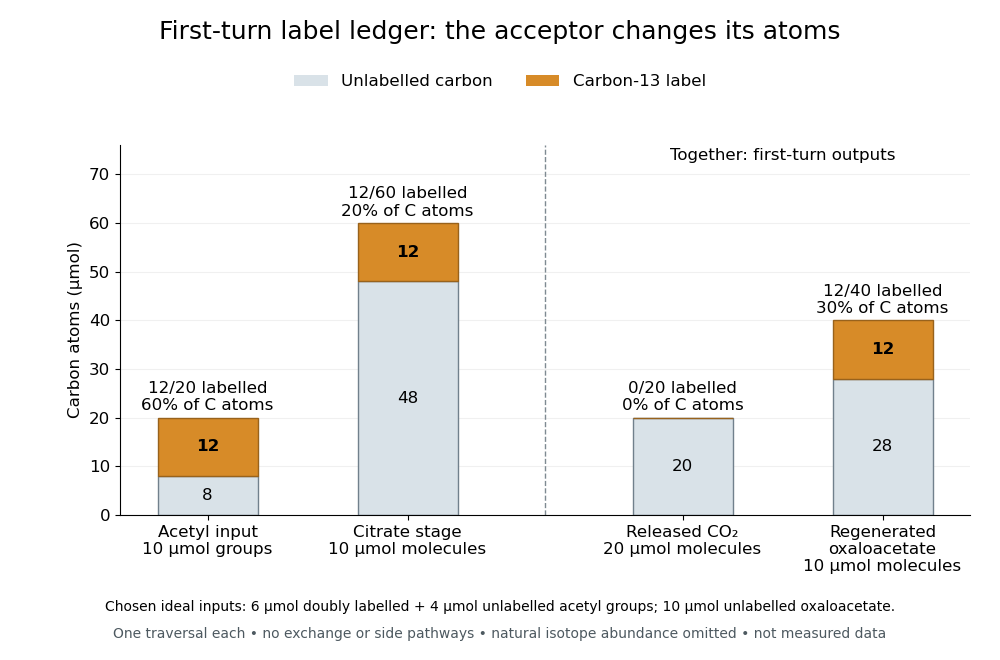
The conservation check is for total carbon and for label. In this model, of regenerated oxaloacetate molecules carry label, distinct from the labelled-carbon fraction. The regenerated oxaloacetate is the same chemical species and the same amount of substance as the initial acceptor pool, but its chemical atom identities have changed. Saying that the cycle oxidizes an acetyl group to two carbon dioxide is a net ledger, not a claim that those exact two incoming chemical atoms immediately leave. Later-turn label release requires positional tracking and mixing assumptions; the first-turn balance alone does not determine it.
Hans Adolf Krebs described the experimental reasoning in his 1953 Nobel lecture. Pigeon breast skeletal muscle retained strong oxidative activity after preparation in a Latapie mincing mill and suspension in aqueous medium. Small fumarate additions increased oxygen uptake by more than complete oxidation of the added fumarate could explain; added four-carbon acids could still be detected afterward. His Table 1 compares the increase in uptake with that calculated from complete consumption of the addition. These comparisons challenge the interpretation that the addition merely supplied extra fuel.[ref]
The citric acid cycle by Hans Adolf Krebs. The citric acid cycle, Nobel Lecture, 11 December 1953, printed pp. 400–401 and Table 1: minced-muscle preparation, uptake comparison and retained acid; authored transcript also available at studyres.com/doc/1333386/hans-a.-krebs---nobel-lecture
The lecture identifies the preparation apparatus but does not describe the gas-measuring instrument behind Table 1. The result supports regeneration, not a unique complete reaction mechanism. Its later discussion combines citrate formation from oxaloacetate with breakdown back toward the four-carbon intermediates to close the cycle. Competitive inhibition supplies another comparison: malonate inhibits succinate dehydrogenase, and succinate accumulates. Such evidence links a blocked step to the surrounding metabolic pathway; damaged tissue and restricted inhibitor access can complicate interpretation.[ref]
The citric acid cycle by Hans Adolf Krebs. The citric acid cycle, printed pp. 401–404, Figures 1–2 and malonate discussion: cyclic interpretation and inhibitor-access limitation; p. 399, preparation damage
An increase above the added fuel's own oxygen demand is a particularly revealing control on the explanation: it compares the proposed cause with the largest effect that simple consumption could produce. The modern mitochondrial oxygen electrode assay asks a different question about a prepared mitochondrion, testing respiratory control through ADP additions. Neither an oxygen uptake signal nor an accumulating intermediate is by itself a direct measurement of ATP production.
Articles by others on the same topic



Some notable examples: