
The Golgi apparatus modifies and sorts cargo arriving from the endoplasmic reticulum for delivery to other cellular destinations. The eponym refers to Camillo Golgi.
Its usual stacked organization is polarized: cargo enters on the cis side, encounters medial processing regions, and leaves through the trans side and trans-Golgi network. Golgi cisternae enclose a Golgi lumen separated from the surrounding cytosol. Processing changes cargo; sorting selects its destination.[ref]
The Golgi Apparatus. The Cell: A Molecular Approach, 2nd edition by Geoffrey M. Cooper; Organization of the Golgi, Figures 9.22–9.23; Protein Sorting and Export from the Golgi Apparatus
This division of labor explains why reaching the Golgi apparatus does not imply being secreted: cargo can take different onward routes, while resident enzymes continue working there. The conventional route discussed here is part of secretory protein routing; many cytosol proteins never enter it.
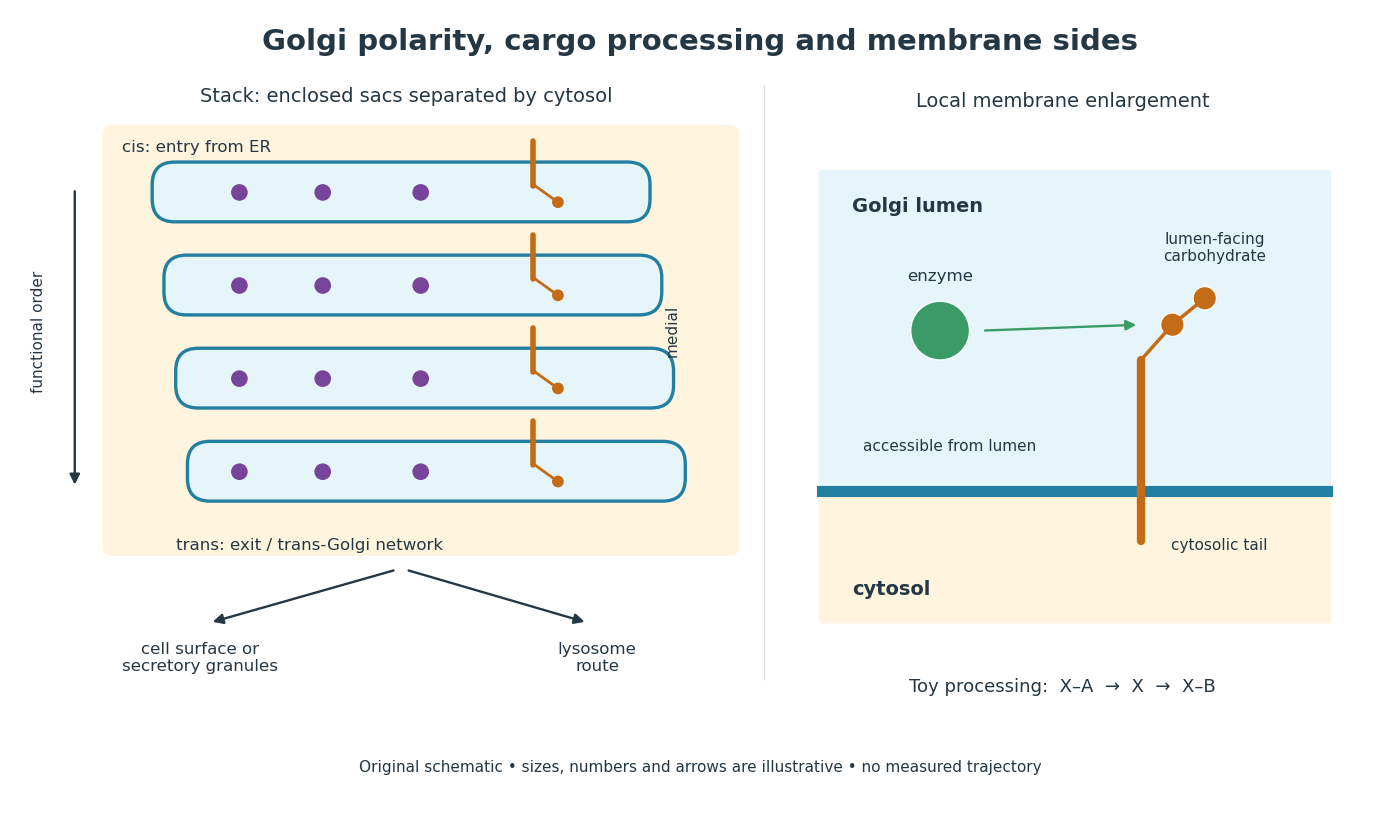
Golgi apparatus polarity, processing and membrane sides
. Original schematic of a stack and a local membrane enlargement. The spaces between Golgi cisternae contain cytosol, while each enclosed sac contains Golgi lumen. Purple cargo is soluble; the orange membrane protein has a lumen-facing carbohydrate chain and a cytosolic tail. Arrows show functional ordering, not a measured trajectory or a universal carrier mechanism. The chain-processing symbols are a constructed example. Details.
New to topics? Read the docs here!