Gravity components on an inclined plane
ID: gravity-components-on-an-inclined-plane

Choose a unit vector pointing downhill and a perpendicular unit vector pointing outward from the inclined plane. The gravitational weight points vertically downward. Its scalar projections onto these directions giveThe angle between the downward vertical and the inward normal is : the inward component uses cosine, and the downhill component uses sine. These are two components of one force. They replace its vertical arrow in a component calculation; adding them to that same arrow would count gravitational weight twice.
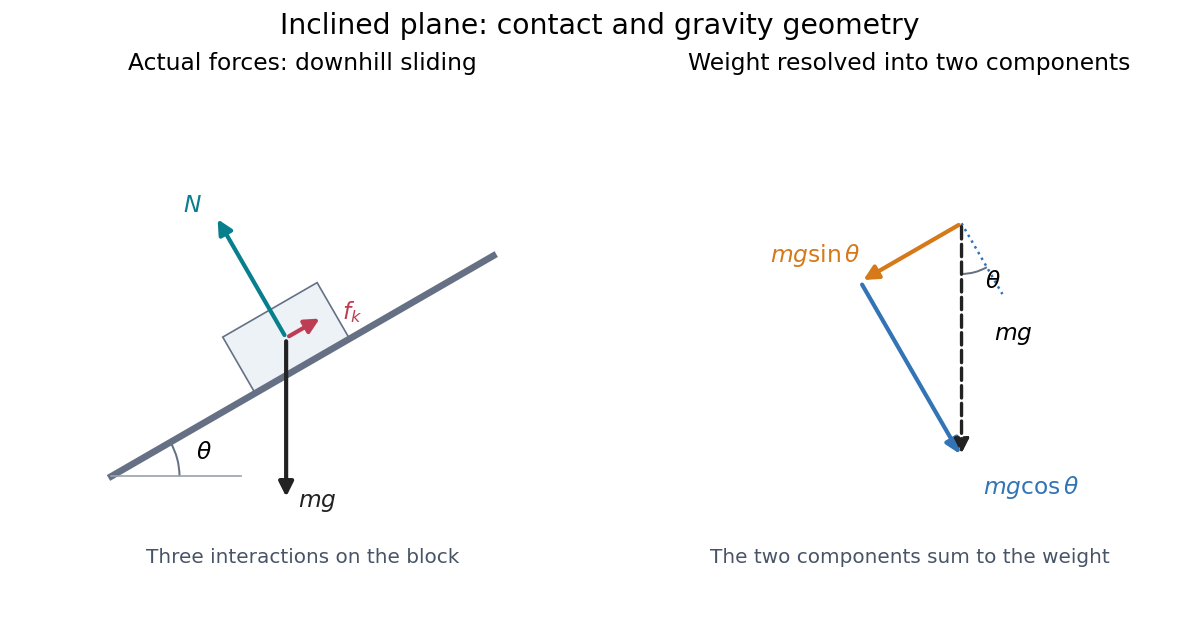

Continued contact with a stationary straight inclined plane gives zero perpendicular acceleration. The perpendicular component of Newton's second law therefore givesThis is why the normal force generally differs from : it balances the inward component, rather than the whole gravitational weight. An extra lifting force, a curved surface, or motion of the support would require a new perpendicular balance.[ref]
6.2 Friction. University Physics Volume 1 by William Moebs and others; “Friction and the Inclined Plane”, Example 6.11 strategy and Figure 6.14; perpendicular balance and
The same geometry explains the ramp's usefulness. A frictionless block pulled uphill at constant velocity needs a parallel force . Travelling a distance raises it through height , so the pulling work is , its gain in gravitational potential energy. The smaller force costs a larger displacement; the work-energy theorem keeps the accounting consistent.
New to topics? Read the docs here!