An inclined plane is a flat surface tilted through an angle above horizontal. A ramp exchanges a smaller lifting force for a longer travel distance; for a released body, it reduces the downhill component of gravitational weight and makes the resulting acceleration easier to measure. Its simplest dynamical model is a nonrotating block on a stationary, rigid surface, with constant mass , uniform gravitational acceleration of magnitude , and . Assume continued contact, negligible drag force, no tipping, and no applied pull. The only forces are gravitational weight, the normal force, and any tangential friction.
The central distinction is between a block resting on the inclined plane and one already sliding. Static friction supplies the force needed to maintain rest, up to its bound; kinetic friction has a prescribed magnitude in the ideal constant-coefficient model. These laws are empirical approximations whose range depends on the contacting surfaces.[ref]
6.2 Friction. University Physics Volume 1 by William Moebs and others; “Magnitude of Static Friction” and “Magnitude of Kinetic Friction”, equations 6.1–6.2; empirical-law limitations before Example 6.10
Choose a unit vector pointing downhill and a perpendicular unit vector pointing outward from the inclined plane. The gravitational weight points vertically downward. Its scalar projections onto these directions giveThe angle between the downward vertical and the inward normal is : the inward component uses cosine, and the downhill component uses sine. These are two components of one force. They replace its vertical arrow in a component calculation; adding them to that same arrow would count gravitational weight twice.
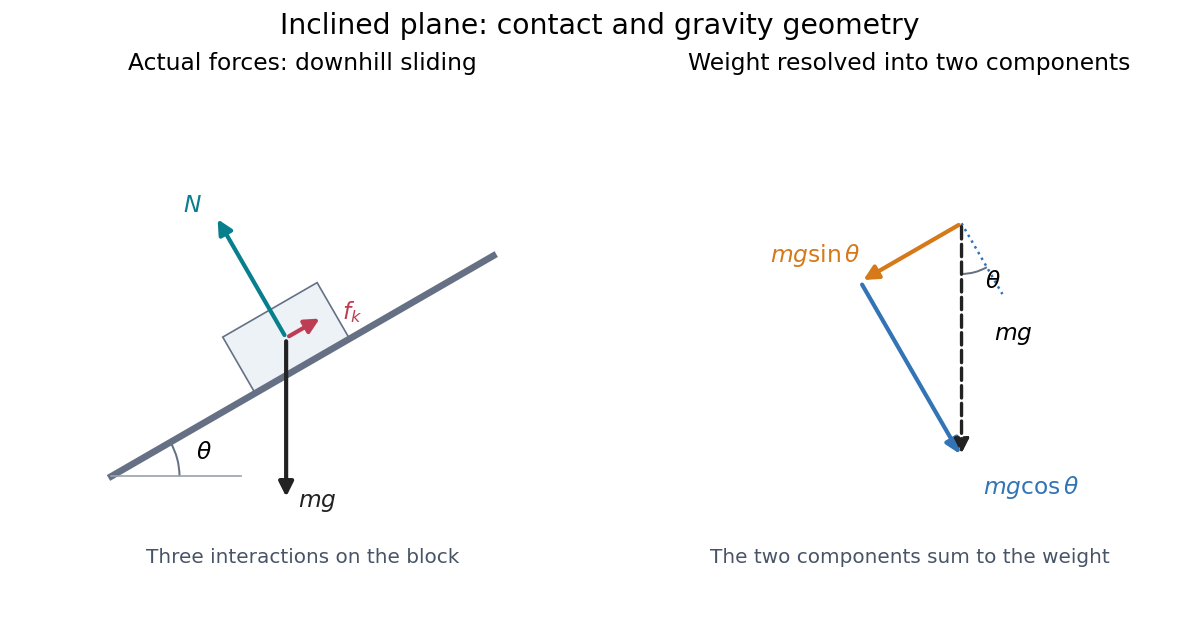
Continued contact with a stationary straight inclined plane gives zero perpendicular acceleration. The perpendicular component of Newton's second law therefore givesThis is why the normal force generally differs from : it balances the inward component, rather than the whole gravitational weight. An extra lifting force, a curved surface, or motion of the support would require a new perpendicular balance.[ref]
6.2 Friction. University Physics Volume 1 by William Moebs and others; “Friction and the Inclined Plane”, Example 6.11 strategy and Figure 6.14; perpendicular balance and
The same geometry explains the ramp's usefulness. A frictionless block pulled uphill at constant velocity needs a parallel force . Travelling a distance raises it through height , so the pulling work is , its gain in gravitational potential energy. The smaller force costs a larger displacement; the work-energy theorem keeps the accounting consistent.
First test rest. With no other tangential forces, the required uphill static friction is . Its maximum is , where is the coefficient of static friction. ThusThe tangent function is increasing on this angle range, and its inverse tangent determines the last permitted resting angle . At equality, the ideal model still permits limiting rest; a larger angle excludes it. Below the threshold, setting would incorrectly impose the maximum static friction even when less is required. Static friction on an inclined plane and inclined-plane measurement of static friction develop this onset criterion further.
For a block already sliding downhill, uphill kinetic friction has magnitude , where is the coefficient of kinetic friction. Taking downhill as positive, Newton's second law becomesEvery term in the force balance scales with mass; division by removes it. Doubling mass doubles both gravitational weight and the contact forces, while leaving this acceleration unchanged if the coefficients remain unchanged. A mass-independent result is a prediction of these assumptions, rather than a universal property of every ramp.
For an original numerical model, stipulate , , and . The critical angle is . At , the normal force is ; rest requires of uphill static friction, below its bound. A resting block can stay there. If it is already sliding downhill, however, the kinetic friction is only , giving downhill acceleration . Specifying the initial state matters.
At , the downhill component of gravitational weight is , while and the static friction bound is only . Rest is impossible. During downhill sliding,Released from rest on a sufficiently long ramp, this ideal block covers its first in , reaching speed . As an independent energy calculation, the lost gravitational potential energy is and kinetic friction removes of mechanical energy. The remaining equals by the work-energy theorem.
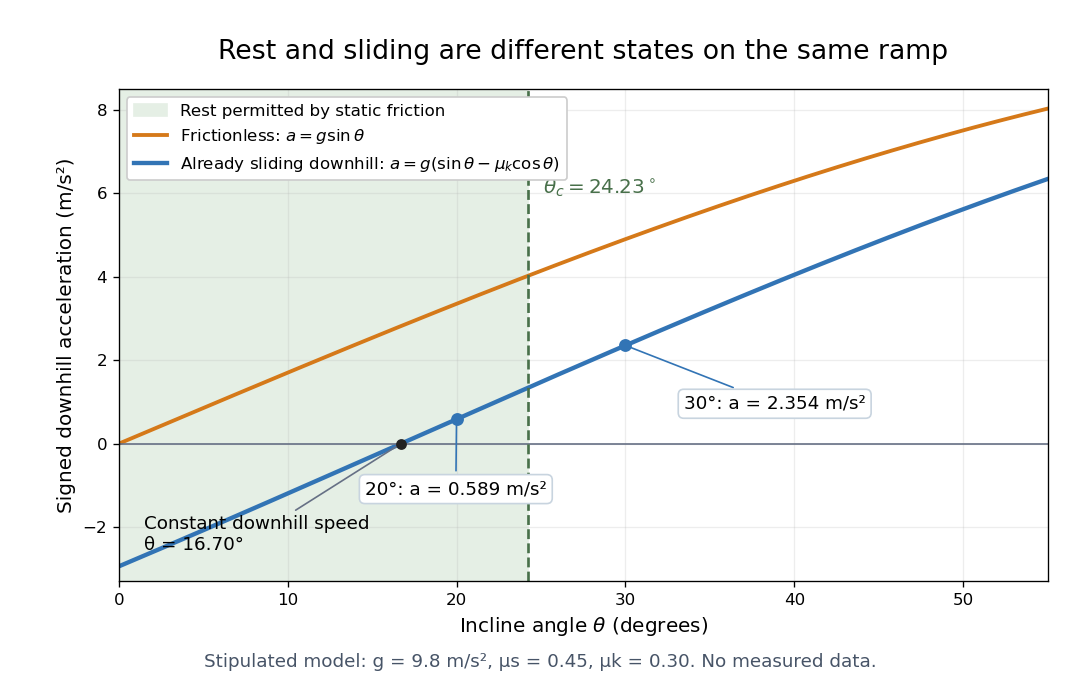
At , downhill sliding has zero acceleration and therefore constant velocity. Below that angle, a downhill-moving block slows; when it stops, test the static friction bound again. For uphill sliding, kinetic friction points downhill, so the signed downhill acceleration instead is . The sign follows contact slip, and the downhill formula cannot be used unchanged after a reversal.
A modern teaching experiment slows gravity-driven motion enough to resolve it with a photogate. PASCO scientific's Inclined Plane Dynamics Set, ME-6966, Instruction Manual 012-10874A describes “Acceleration Down an Incline” on printed pages 15–16. Its apparatus is a GOcar on a PAStrack with an adjustable incline support, a bracket-mounted photogate, a cart-mounted picket fence, and an interface with recording software. For the interface method, the fence's pattern is aligned to interrupt the beam. Recording starts before release from rest; the cart is caught at the bottom bumper. The procedure specifies three runs per angle, starting at and reducing by , with the release position fixed. The readout is velocity against time; its slope estimates acceleration. Mean accelerations are plotted against , testing the ideal slope . An added-mass comparison is also requested. These are protocol settings, not observed results.[ref]
The cart undergoes rolling without slipping at its wheels, whereas the worked block undergoes contact slip. Even ideal wheel moment of inertia changes the cart prediction. For total cart mass , wheel radii and axial moments of inertia , rigid wheels with fixed axles and no losses giveTo derive it, combine translational kinetic energy with wheel rotational kinetic energy , then equate their rate of change to the release of gravitational potential energy . This is the multiwheel counterpart of rolling acceleration with rotational inertia. Neglecting wheel moment of inertia yields ; treating a cart as a solid rolling cylinder would give a different correction.
Useful additional controls are repeated releases without a push, checking the fence alignment and spacing, and checking that the recorded velocity trace is straight over the fitted interval. A gently moving cart on a level track can expose losses or unintended tilt. These checks help distinguish an angle or timing error from neglected wheel moment of inertia, bearing friction, or drag force. The three-run spread measures repeatability but cannot by itself reveal a shared calibration error. The inspected protocol makes the gravity component measurable; it does not measure the sliding block's coefficient of kinetic friction.
Articles by others on the same topic



An inclined plane is a flat surface that is tilted at an angle to the horizontal. It is one of the simplest types of machines and is used to lift or lower objects with less effort than lifting them straight up. The primary function of an inclined plane is to provide a mechanical advantage by allowing the force to be applied over a greater distance at a reduced angle.