
A heat pump uses work to deliver heat to the region we want to keep warm. Its useful output is the hot-side delivery . The same operating machine can be described as a refrigerator when the cold-side extraction is the objective: which output is useful changes the coefficient of performance, while the energy balance stays . Heating a water bath by taking heat from a colder water bath makes this distinction visible in the heat-pump calorimetry experiment below. [ref]
https://labs.phys.utk.edu/mbreinig/phys136core/modules/m3/refrigerators.html. University of Tennessee, Refrigerators, air conditioners, and heat pumps: heating objective
In the illustrative budget from refrigerator, supplying of work delivers of useful heat, giving a heating coefficient of performance of . The additional came from the colder region. Compare an ideal electrical heater whose entire input work becomes heat in the target region: it delivers for that input. The appeal of a heat pump is this ability to move existing energy, while the Second law of thermodynamics limits the work saving for a given pair of temperatures.
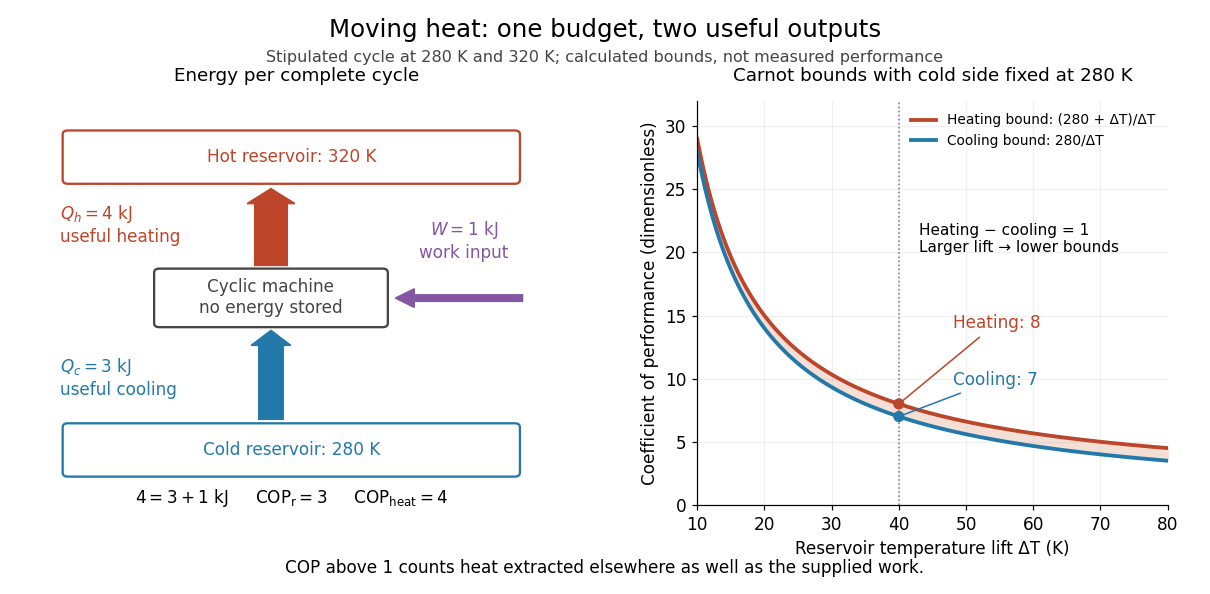
One energy budget, two useful outputs, and Carnot's theorem bounds on the coefficient of performance
. Original quantitative diagram, with stipulated , and . Arrow widths follow the transfer magnitudes. The curves are reversible bounds for fixed cold temperature and varying hot temperature ; they are not measured performance. At , the bounds are for cooling and for heating, above the illustrative machine's and . Details.
New to topics? Read the docs here!