
A hydrogen bond donor is the group supplying the attached hydrogen in a hydrogen bond . The donor atom , or the whole molecule containing it, may also be called the donor. The terminology does not imply transfer of a free proton: in the ordinary water pair, the O–H covalent bond remains. Familiar donors include O–H groups in water and N–H groups in ammonia. See Andrew Glasfeld, Intermolecular Attraction, pp. 12–13: donor and acceptor roles.
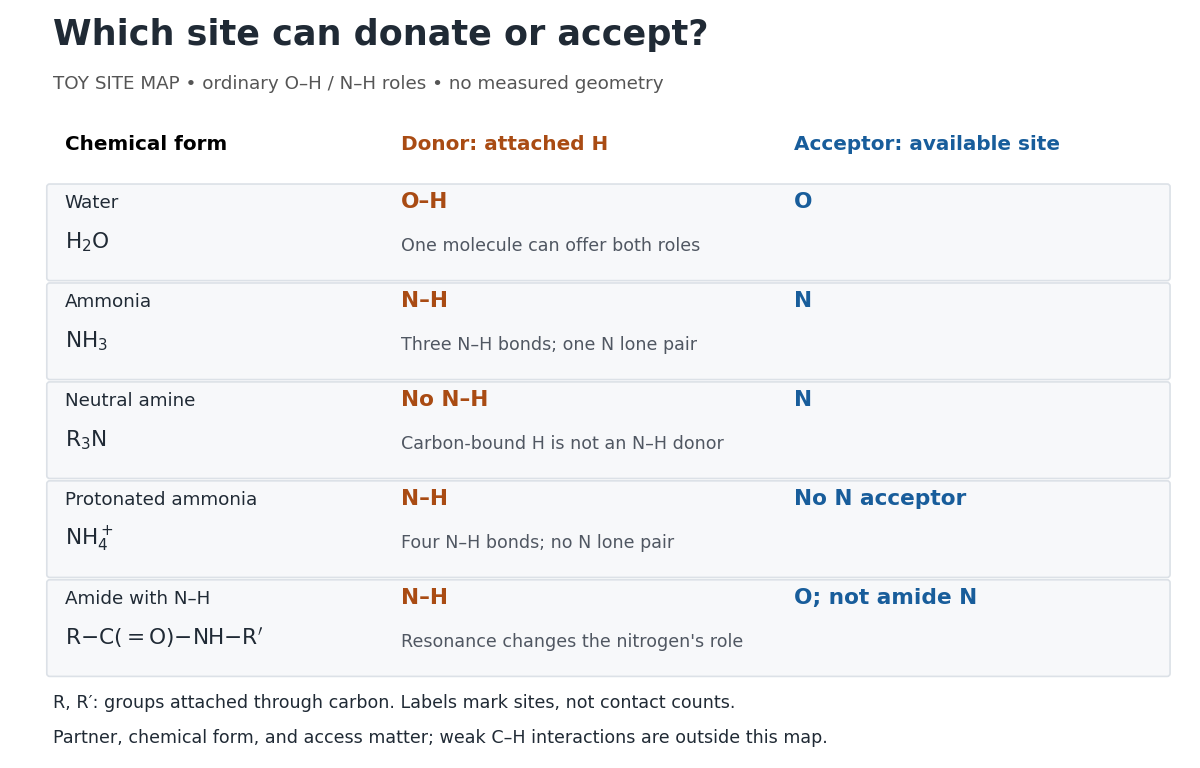
Hydrogen bond donor and hydrogen bond acceptor roles depend on attached hydrogen, protonation, and chemical resonance
. Toy site map for ordinary O–H and N–H associations, not measured geometry or an exhaustive list of hydrogen bonds. and denote groups attached through carbon. Coloured labels identify possible sites, rather than count the number of simultaneous contacts. Details.
The attached hydrogen is essential to this role. At the nitrogen site, an unprotonated amine can be a hydrogen bond acceptor, but has no N–H hydrogen bond donor. Protonation gives : the new N–H group can donate, while that nitrogen no longer has the accepting lone pair. This is a change of chemical form, not a permanent label attached to a chemical element. Here denotes a group attached through carbon; the statement concerns the nitrogen site and does not rule out weaker C–H associations elsewhere. See McMurry, Organic Chemistry, 24.3: amine protonation and Glasfeld: protonated amines as donors.
An amide with an N–H covalent bond can donate even though its nitrogen is ordinarily not an accepting site. For example, in , N–H is a hydrogen bond donor and the carbonyl group's oxygen is a hydrogen bond acceptor. Replacing the remaining N–H by another group attached through carbon removes this N–H donor without removing the accepting oxygen. The analogous division of roles in a peptide bond helps explain protein structure. See Glasfeld: amide roles and biological interactions. The useful question is therefore which site supplies the hydrogen, rather than whether the whole substance is simply “hydrogen bonding”.
New to topics? Read the docs here!