Implicit function theorem
ID: implicit-function-theorem

An equation can define a function without giving an explicit formula for it. The implicit function theorem tells us when the constraint determines uniquely from nearby , and makes the resulting function continuously differentiable. It is useful when solving an equation explicitly is cumbersome or impossible: the partial derivatives already reveal whether local recovery is possible.
Let be a continuously differentiable map from an open subset of to . Suppose and the partial derivative is an invertible linear map. There are open neighbourhoods of and of and a unique continuously differentiable function such that, for ,Thus the nearby level set is a graph of a function. The derivative of this graph isThe matrix inverse acts on the left; the order matters in several dimensions.
For example, take the unit circle, written as the level set . At , , so the local upper branch is . Implicit differentiation givesThis tangent line slope is available directly from the constraint. The negative square root branch is elsewhere on the same circle; it does not destroy uniqueness near the selected upper point.
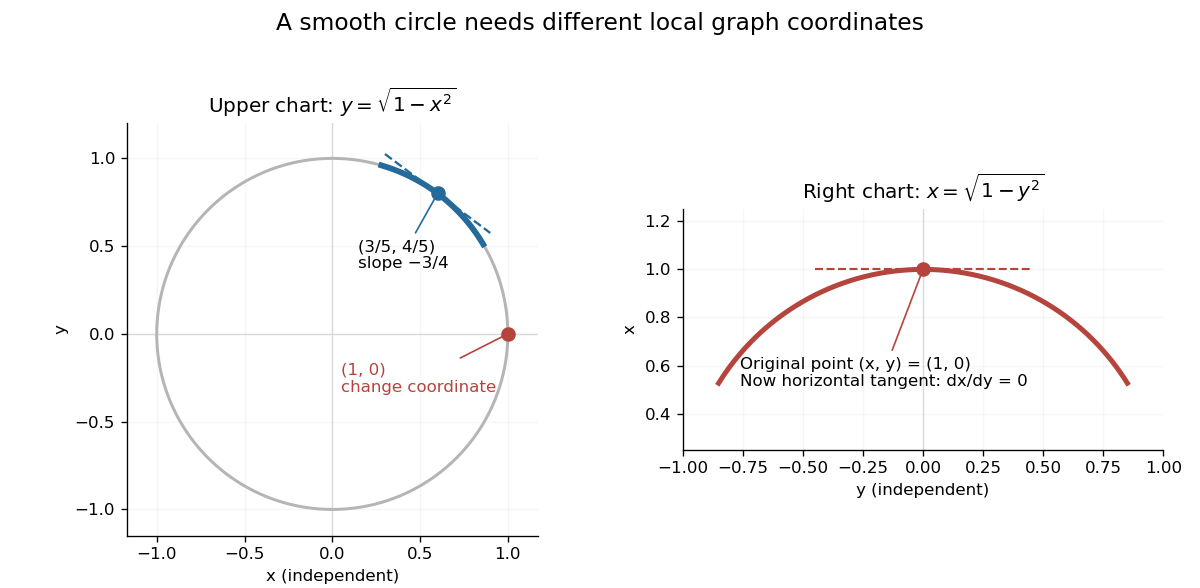
The same circle uses y as a function of x near its upper arc and x as a function of y near its rightmost point
. Details. At , however, and the circle cannot be represented locally as one function : just to the left of there are two nearby values of . The circle is still smooth there. Since , use the other coordinate instead: , with . A failed coordinate choice is different from a geometric singularity.
The derivative condition is sufficient, not necessary for every possible implicit graph. For , the entire zero set is the smooth graph , even though vanishes there. In this case the defining equation itself has a degenerate derivative; the theorem's test gives no conclusion.
The connection to the inverse function theorem is particularly elegant. Augment the constraint to the map , whose Jacobian matrix isIts determinant is . When this is nonzero, locally invert and set its second output to zero. The recovered second input is . In this way an implicit constraint becomes an ordinary inverse function problem. [ref]
https://www.math.utoronto.ca/courses/mat237y1/20199/notes/Chapter3/S3.3.html. University of Toronto MAT237: the implicit theorem as a corollary of the inverse theorem


The Implicit Function Theorem is a fundamental result in calculus and differential topology that provides conditions under which a relation defines a function implicitly.
New to topics? Read the docs here!