Independent revelation of a binary variable
ID: independent-revelation-of-a-binary-variable

Let be a Bernoulli random variable with . Independently of , a Bernoulli random variable with decides whether to reveal it:The symbol means “hidden” and is distinct from both binary states. This is a binary erasure channel with erasure probability . The hidden report leaves the posterior distribution equal to the prior distribution, because hiding is independent of the state. Either visible report determines . Weighting these three reports gives the exact conditional entropy and mutual information:For and , bits, while bits. With the report tells us nothing; with it reveals the state completely. If , every positive reveal probability makes the conditioning inequality strict. At or , the state was already known and every value of gives equality.
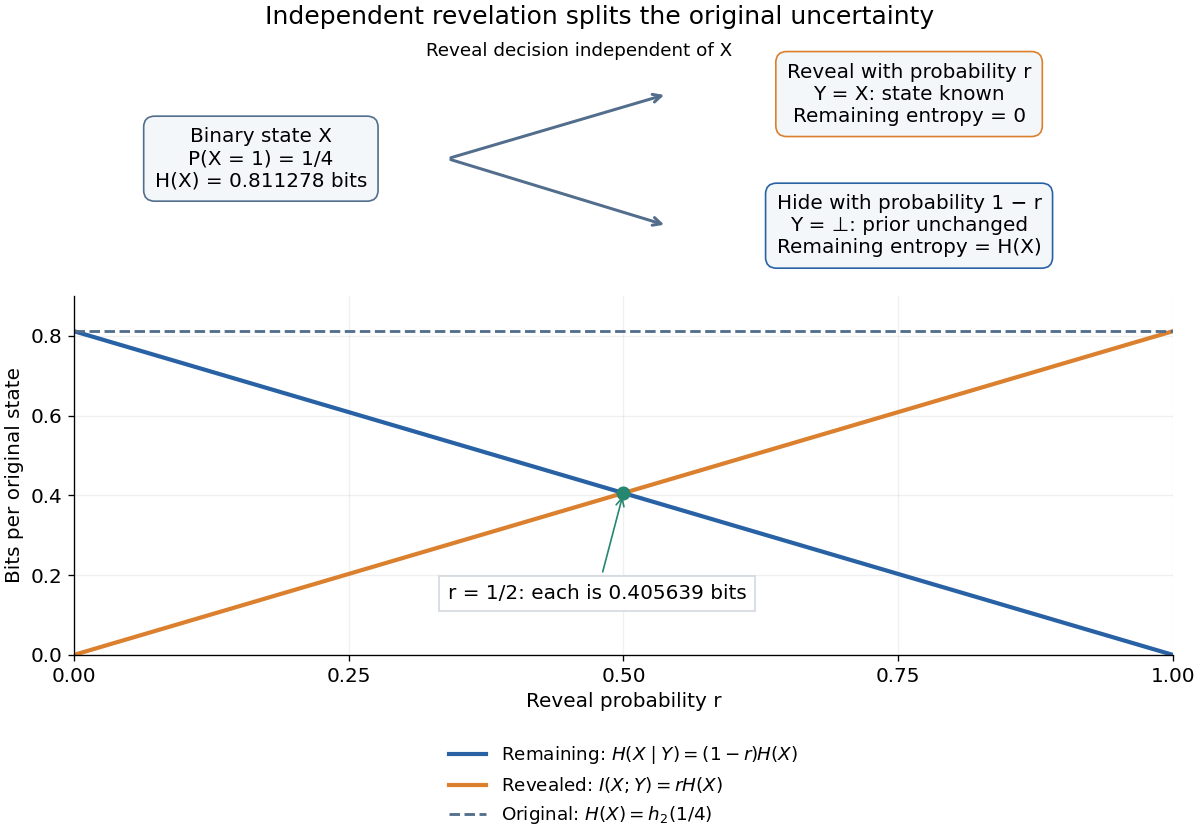

For a Bayesian inference problem, this model distinguishes an uninformative missing report from a decisive observed state. If hiding depended on , even could carry mutual information, and the displayed calculation would change. In lossless source coding, suppose both encoder and decoder already know the reveal pattern for repeated independent and identically distributed pairs. Only the hidden states require descriptions. Applying Shannon's source coding theorem to those states gives an asymptotic average rate bits per original state. A single hidden state need not have a codeword of that fractional length.
The reveal pattern itself has information entropy . If that pattern must also be sent, the chain rule for information entropy gives , since and are independent random variables. Equivalently, and . Thus a saving in the description of given assumes that is already available; it is not a free saving in the description of the whole pair.
New to topics? Read the docs here!