Keplerian radial-velocity curve
ID: keplerian-radial-velocity-curve

A repeating Doppler shift contains more than an amplitude. For an isolated two-body problem, let be the true anomaly, the stellar argument of periapsis, the periapsis time and the constant system line-of-sight velocity. The companion's argument of periapsis differs by from , so mixing the two conventions reverses the orbital signal. With positive velocity for recession, choose the stellar line-of-sight coordinate positive away from the observer. Kepler's equation supplies the clock:Here is the mean anomaly and the eccentric anomaly. The time coordinate is uniform in , not in : an eccentric Kepler orbit runs fastest near periapsis.
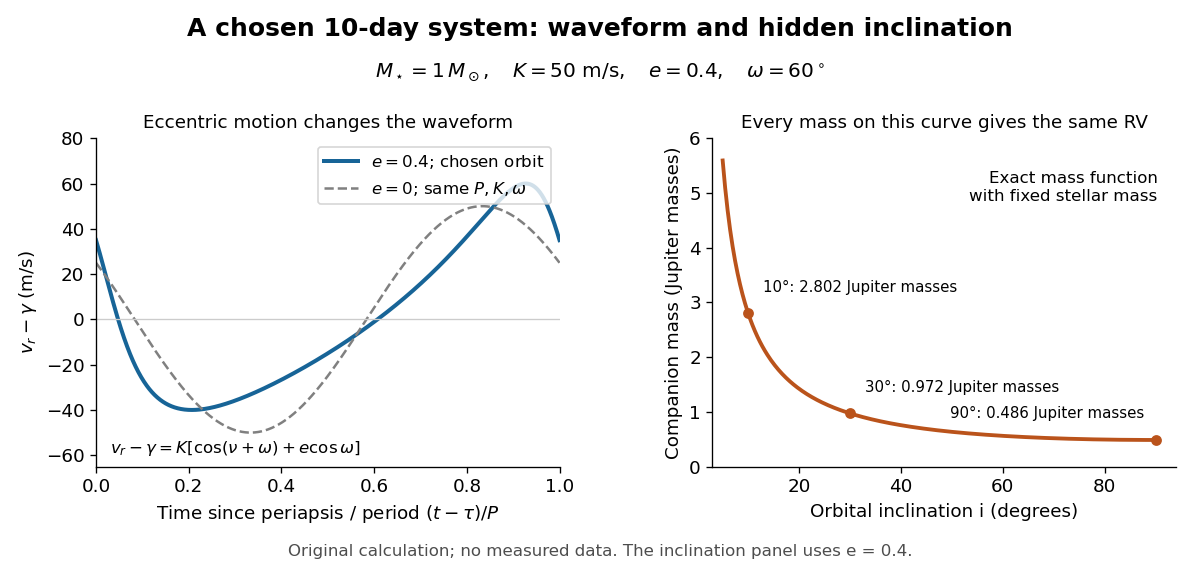
To derive the velocity law without guessing a sinusoid, write the stellar orbital coordinates as and . Project toDifferentiating and substituting the true anomaly identities givesThe constant term makes the time average of the orbital velocity zero: returns to its original value after one orbital period. For this reduces to a sinusoid with an arbitrary phase origin; periapsis itself is then undefined. For , the largest and smallest velocities are , so is still half the peak-to-peak range, although the extrema need not be symmetric about .
For an original worked example, choose , days, , and . Taking one day as and , the binary mass function is . Its units check directly: . With adopted solar mass and Jupiter mass , solving the exact binary mass function gives
| Orbital inclination | Companion mass |
|---|
All three systems have the same chosen and therefore the same Doppler spectroscopy time series, despite different true masses. Exactly what remains fixed is ; alone is only the small-companion approximation. The value is the minimum mass. For this example the extrema are and relative to , and the periapsis value is . This is a chosen eccentric system, not a reconstruction of 51 Pegasi b.

New to topics? Read the docs here!