Magnetic dipole torque
ID: magnetic-dipole-torque

An externally imposed magnetic field that is nearly uniform over a rigid current loop produces the torqueThe angle is measured between the magnetic dipole moment and the external magnetic field, not between the plane of the current loop and the magnetic field. The magnetic dipole potential energy uses a dot product, whereas the torque uses a cross product. The torque is largest when the magnetic dipole moment is perpendicular to the magnetic field; parallel alignment minimizes the potential energy.[ref]
11.5 Force and Torque on a Current Loop. §11.5, equations 11.22–11.23: vector torque and orientation energy
For the sign convention and , positive rotation increases andThus at the torque turns the magnetic dipole moment toward the external magnetic field. Both parallel and antiparallel alignment have zero torque, but they are respectively a stable equilibrium and an unstable equilibrium. With no damping, a freely released current loop can undergo oscillation around the stable equilibrium; settling requires damping.
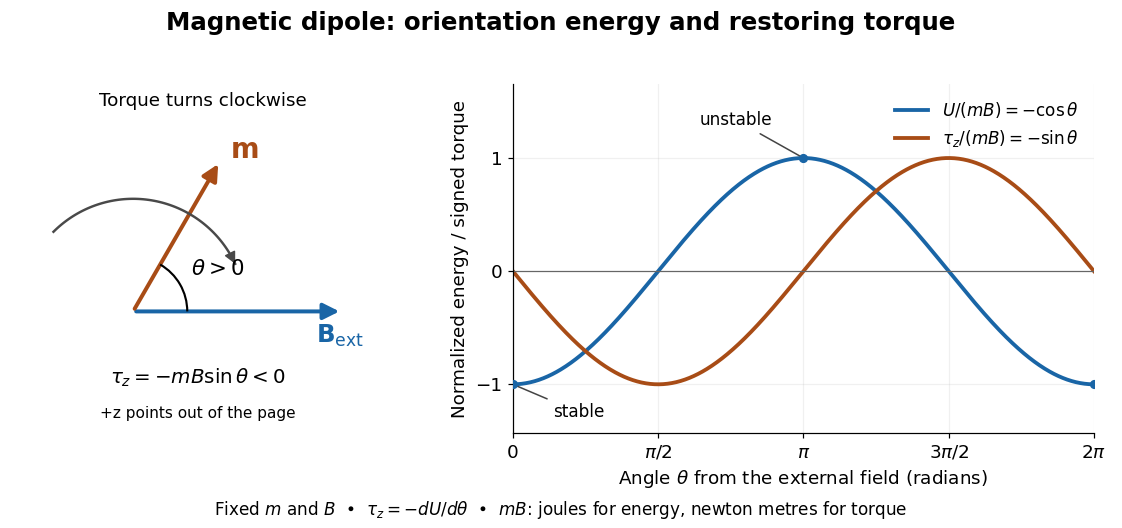

In the twelve-turn example, take and . The predicted torque is and the magnetic dipole potential energy is . The unit check is ; torque and energy have the same physical dimensions but different physical meanings.
A short derivation starts with the magnetic force on a current-carrying wire, . In an exactly uniform magnetic field, the net force is , but its torque need not vanish: opposite sides produce a turning couple. Integrating gives . Integrating at fixed and gives the orientation potential energy. This is the mechanical orientation potential energy for a maintained electric current, with the external source held fixed; the energy accounting for field and power supply is a separate problem. A varying external magnetic field requires corrections across a finite current loop, and can also give a net force.
New to topics? Read the docs here!