
For an -by- square matrix over a field, its matrix inverse is an -by- matrix satisfying both identitieswhere is the identity matrix. It exists exactly when is an invertible matrix, equivalently when its matrix rank is or its determinant is nonzero. It reverses the linear map: applying and then recovers the input, while applying and then recovers the output.[ref]
https://ocw.mit.edu/courses/18-06-linear-algebra-spring-2010/resources/lecture-3-multiplication-and-inverse-matrices/. Strang, MIT 18.06 Lecture 3: the two inverse identities
The matrix inverse is unique. If and both satisfy the identities, then . Although the definition is two-sided, for finite square matrices either identity alone suffices: forces a trivial kernel, whereas forces surjectivity; either makes an invertible matrix by the rank-nullity theorem. Rectangular matrices may have only one of these properties.
For a concrete example, takeDirect matrix multiplication givesConsequently the vector follows a reversible journey:The columns and are the images of the standard basis vectors. They turn the unit square into a parallelogram; the matrix inverse restores both the square and its surrounding grid. Since , this example changes shape while preserving area, illustrating that invertibility does not require preserving lengths or angles.
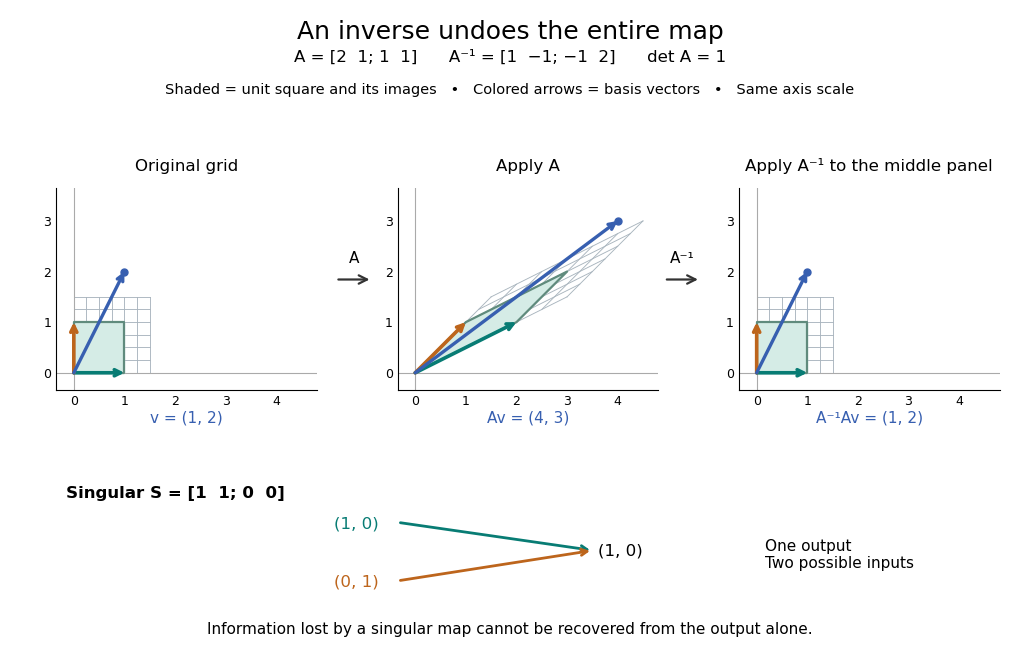
For comparison, the singular matrixcannot have a matrix inverse: the output cannot specify which of the two inputs occurred. Their difference belongs to its kernel. Indeed collapses the plane to a line, its matrix rank is one, and its determinant is zero. No subsequent function of the output alone can reconstruct every input.
An important use of the matrix inverse is describing the unique solution of a linear system:For , the preceding computation solves and , giving . In computation, usually solve the linear system using Gaussian elimination and a factorization such as an LU decomposition, rather than forming every entry of the matrix inverse. The inverse formula specifies the answer; a factorization provides a reusable way to compute it for each right-hand side.[ref]
https://www.mit.edu/~18.06/Spring17/final-sol.pdf. MIT 18.06, Spring 2017 final solutions, problem 5(b): solve with triangular factors rather than computing inverses
Here the LU decomposition is especially simple:Solve by forward substitution in a triangular system: and . Then solve by backward substitution in a triangular system: and . The same factors work when changes. If the whole matrix inverse is actually needed, its th column is the solution of , where is the th standard basis vector.
Reversing several operations means undoing the last one first. For invertible matrices of the same size,because , and the product in the other order is also . This is why a change-of-basis matrix uses its matrix inverse to reverse the direction of coordinate conversion.


New to topics? Read the docs here!