
For a discrete random variable with a finite or countable alphabet and probability mass function , define . Its min-entropy, using base-two logarithms, isThe unit is the bit. This is the smallest information content of any possible outcome: it records the easiest outcome to predict, whereas Shannon entropy averages information content over all outcomes. A normalized countable probability mass function has an attained positive maximum, so is finite even when Shannon entropy is infinite. Outcomes of zero probability cannot minimize the surprise and are omitted from the minimum; including extra impossible symbols changes neither quantity.[ref]
https://www.cs.cornell.edu/courses/cs6830/2009fa/lecnotes.pdf. Pass and shelat, A Course in Cryptography, Section 8.3.2, Definition 148.1
Suppose someone knows the probability mass function but receives no observation correlated with , and must name exactly one outcome. Naming succeeds with probability , so naming a most likely outcome is optimal:Tied maxima give equally good guesses. Randomizing independently among guesses cannot improve success: if the guess has probability mass function , its success probability is . This is the simplest instance of maximum a posteriori decoding. The identity gives min-entropy an operational meaning: bits means every single guess succeeds with probability at most , under these information assumptions.[ref]
https://arxiv.org/html/0807.1338. König, Renner and Schaffner, The operational meaning of min- and max-entropy, Section I.3.1, equation (18) and the no-side-information case
For an exact analytical example on symbols , compare the two probability mass functionsUnder , each possible outcome has information content bits; under , has information content bit and each other outcome has bits. Consequently their Shannon entropies agree exactly,but and bits. A best single guess therefore succeeds with probability under and under . The same average surprise can hide a factor of two in immediate predictability. The zero entry in contributes zero to Shannon entropy, using .
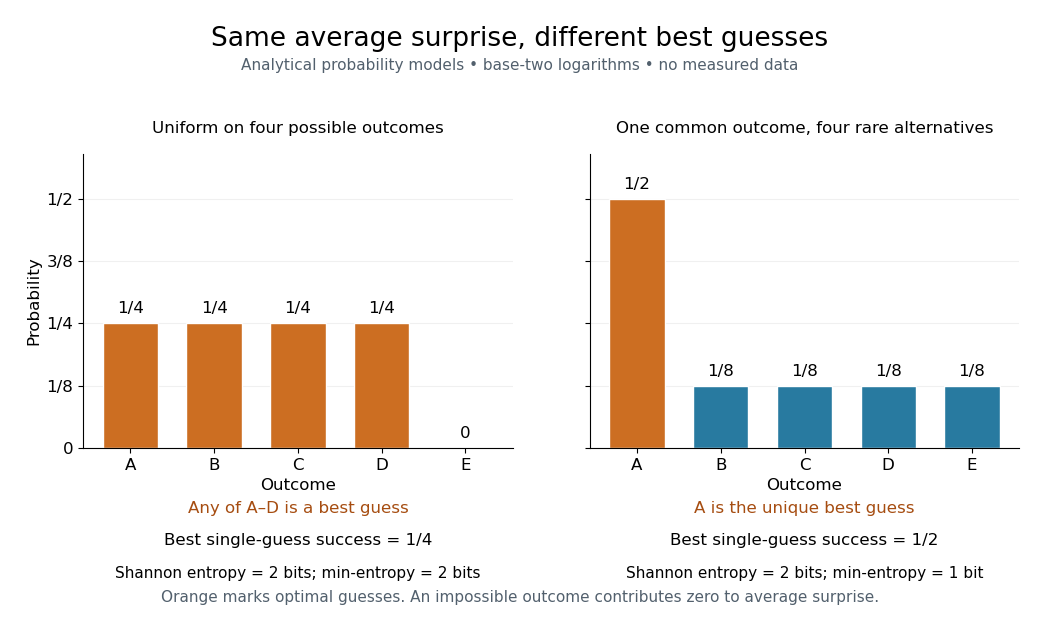

For the discrete uniform distribution on possible outcomes, bits and the best single guess succeeds with probability . A certain outcome has and success probability one. Thus min-entropy is useful when a common outcome could defeat an attempt to make outputs unpredictable, even if rare alternatives raise Shannon entropy.
For cryptography, this unconditional calculation alone does not certify security: an observer might know already. If a report reveals a uniform four-outcome source, its unconditional min-entropy remains bits but guessing after the report succeeds with probability one. For finite classical reports, the appropriate success calculation uses conditional probabilities and maximum a posteriori decoding:The conditional entropy instead averages remaining surprise. A security argument must specify the observer's information and the protocol's required guarantee; neither unconditional min-entropy nor Shannon entropy supplies those assumptions.
New to topics? Read the docs here!