
Mixing calorimetry determines heat capacities by bringing bodies at different temperatures into thermal contact. The striking feature is that the final temperature is a weighted arithmetic mean with heat capacities as weights, rather than weights given by mass. The vessel participates in the exchange even though it is not the sample being studied.
For a hot nonreacting sample of mass , initial temperature and unknown specific heat capacity at constant pressure , let receiving water have mass , initial temperature and known specific heat capacity at constant pressure . Let the vessel and immersed parts start at and have combined heat capacity , excluding that water. Assume a common final temperature , approximately constant pressure and heat capacities, no phase transition, no chemical reaction and negligible external nonexpansion work. For signed outward heat loss , the combined enthalpy balance isHenceThe loss is positive if the room receives net heat, negative if the room supplies it. If the vessel starts at a different temperature , replace its warming term by ; do not assume the vessel shared the water's initial temperature. For variable material properties, replace each by the corresponding integral and each vessel term by . The inferred constant then represents an average over the sample's cooling interval.[ref]
For a synthetic no-loss example, mix of hot water at with of cold water at in a vessel initially at . Stipulate and . The enthalpy balance givesThe hot water releases : the cold water receives and the vessel . Omitting the vessel predicts , despite perfect insulation. These are computed numbers from stipulated properties, not laboratory observations.
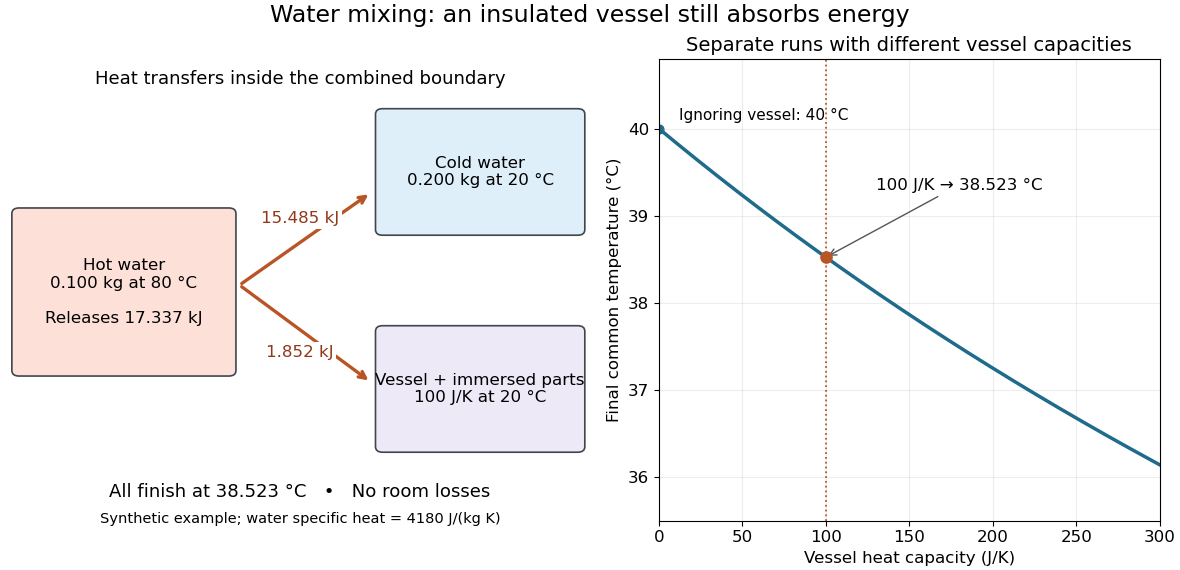
The vessel changes the mixing temperature by sharing the heat transfer
. Original computed no-loss water example. Left: transfers sum to the hot portion's released heat. Right: increasing the initially cold vessel's heat capacity lowers the common final temperature; the marked point uses . Each vessel setting is a separate modeled experiment. Details.
For an unknown-sample example using the same cold water and vessel, stipulate , and . With no loss, . Inverting the full balance returns ; ignoring vessel storage returns about . With a positive outward loss, ignoring that loss also biases the inferred downward under these hot-sample conditions. A small water temperature rise makes sensor offsets and loss estimates relatively influential; propagation of uncertainty must include the measured temperatures, masses and calibrated vessel term.
New to topics? Read the docs here!