NACA four-digit airfoil
ID: naca-four-digit-airfoil

A NACA four-digit airfoil encodes three quantities: maximum airfoil camber in hundredths of the airfoil chord, its position in tenths of the airfoil chord, and nominal maximum airfoil thickness-to-chord ratio in hundredths. Thus NACA 2412 means , and ; NACA 0012 has zero airfoil camber and the same nominal thickness ratio.[ref]
With , the airfoil mean camber line isFor a symmetric airfoil, take directly; do not divide by the zero position parameter. The half-thickness follows the polynomial in trailing edge. If , the upper/lower coordinates areThickness is placed along a normal vector to the mean line, rather than simply added vertically.[ref]
For an original NACA 2412 calculation at , the mean-line slope is zero, and the standard finite-edge polynomial gives . Hence the surface points are approximately and in chord-normalized coordinates. A 12-percent designation does not mean the section is 12 percent thick at every chordwise position.
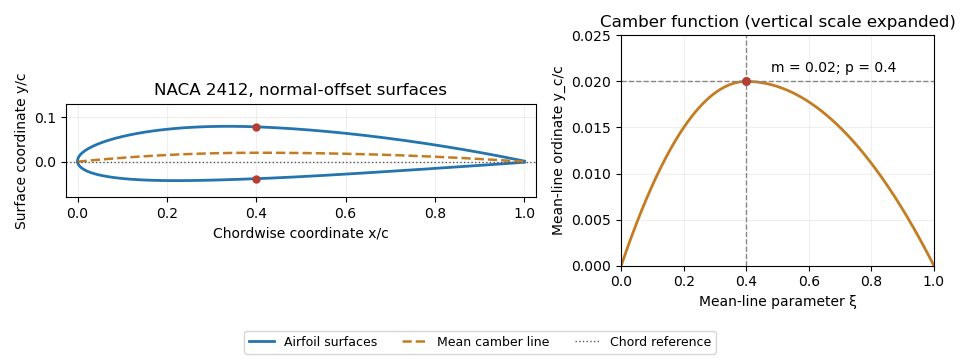
NACA 2412 mean camber line and surfaces constructed by normal offsets. Original evaluation of the stated four-digit equations.
Details. 
The trailing-edge convention must also be specified. The usual coefficient leaves a small finite thickness; the modified closes the endpoint. With a sloping mean line, the upper and lower endpoint coordinates can differ in both components, so directional measurement of trailing-edge thickness must state which separation it reports. These constructions define geometry, not a universal aerodynamic performance curve.
New to topics? Read the docs here!