Noisy parity total correlation
ID: noisy-parity-total-correlation

Keep as independent fair bits, introduce an independent Bernoulli random variable with , and set . The extra bit flips the integer parity rule with probability . For each even-integer parity triple the probability is ; for each odd-integer parity triple it is .
Every coordinate remains fair, and every pair remains independent for every . For example, after fixing , the fair independent makes fair regardless of . A pair's joint probability distribution therefore does not change as noise destroys the three-way relation.
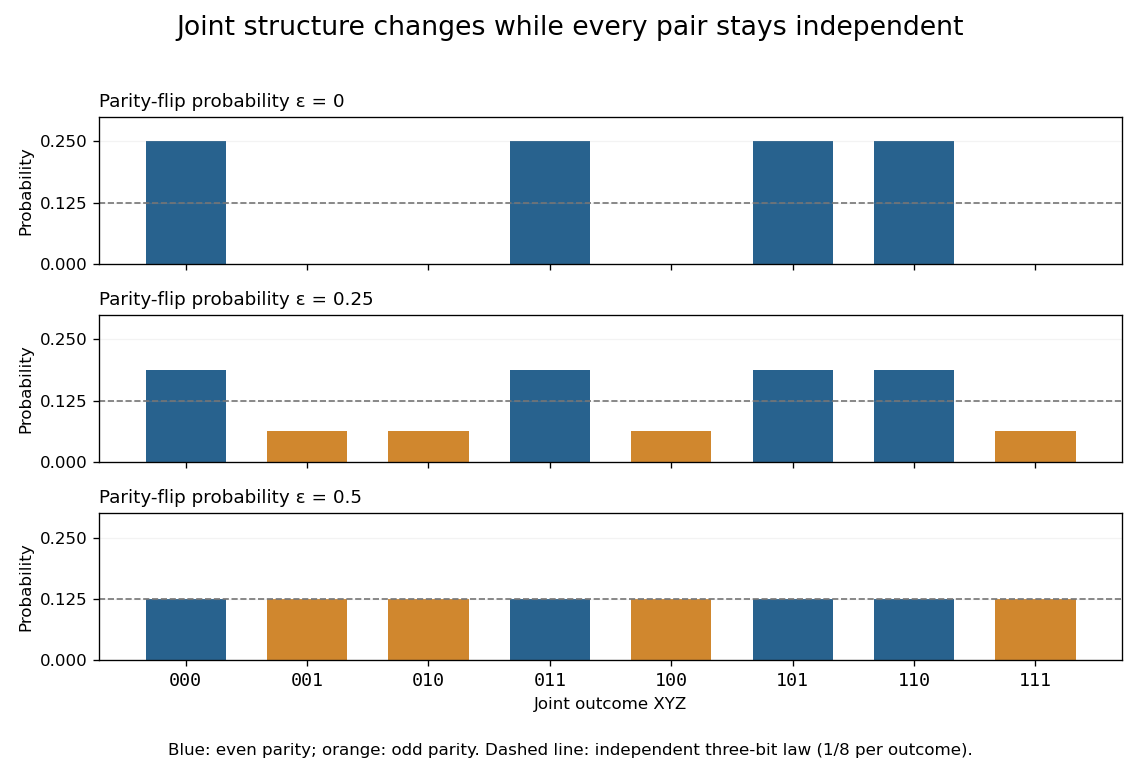

Knowing , uncertainty in is exactly the uncertainty in . The chain rule for information entropy giveswhere is binary entropy. HenceAt , the result is approximately bits, although all three pairwise mutual informations are zero. At , all eight triples have probability , giving joint independence and zero total correlation. At , the complementary integer parity rule is deterministic again, so total correlation returns to one bit.
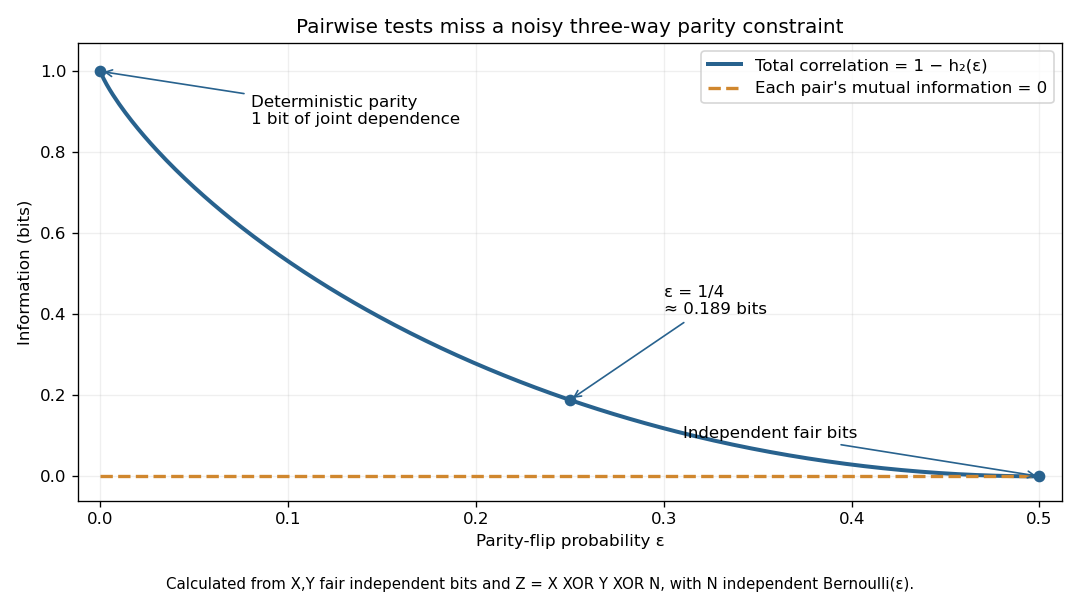

The example distinguishes "there is a dependence" from "a pair reveals it." Once are known together, is predictable at zero noise; knowing either one alone leaves a fair bit. Total correlation detects the joint departure from independence, but does not by itself specify which variables cause which others.
New to topics? Read the docs here!