Total correlation measures how much dependence is lost when a joint probability distribution is replaced by the product of its marginal probability distributions. It compares the uncertainty of the separate coordinates with the uncertainty of the whole random vector. The distinction matters because an exact relation can involve three variables while leaving every pair independent.
For random variables with finite alphabets, defineHere is information entropy, the entropy of the full random vector is joint entropy, and is relative entropy. Base-two logarithms give bits; natural logarithms give nats. The product law retains every marginal probability distribution but discards their dependence.[ref]
Information Theoretical Analysis of Multivariate Correlation by Satosi Watanabe. Abstract, printed p. 66: total correlation for the partition into individual variables
A positive joint probability guarantees positive marginal probabilities at that outcome, so the displayed relative entropy is finite in this finite-alphabet setting.For two variables, total correlation is exactly mutual information. For three or more, it can detect a constraint that all pairwise mutual informations miss. Relative entropy nonnegativity gives , with equality exactly when the coordinates are jointly independent random variables.
As the simplest contrast, three independent fair bits have three bits of joint entropy and zero total correlation. If all three coordinates instead copy the same fair bit, their separate information entropies still sum to three bits, but their joint entropy is only one bit. Their total correlation is therefore two bits. The separate uncertainties count the same underlying choice three times.
Let be independent fair bits and set , their exclusive or. The four possible triples are , each with probability . Every coordinate is fair, and every pair has all four outcomes with equal probability. Thus each pair's mutual information is zero, as in pairwise independence does not imply joint independence.
The full random vector has joint entropy bits, while the marginal information entropies sum to three bits. ConsequentlyThe product of the marginals predicts probability for every triple, including the four impossible ones. On each possible triple, the ratio of true to product probability is ; averaging its base-two logarithm gives the same one bit of relative entropy.
The example gives a concrete use for joint information measures. A lossless source coding scheme that treats the three coordinates separately needs three bits here. If the decoder knows the integer parity rule, the encoder can send just and let the decoder reconstruct exactly. Pairwise independence does not reveal that saving. This is a stipulated source law and an explicit two-bit code, rather than a promise that arbitrary data can be shortened.
Keep as independent fair bits, introduce an independent Bernoulli random variable with , and set . The extra bit flips the integer parity rule with probability . For each even-integer parity triple the probability is ; for each odd-integer parity triple it is .
Every coordinate remains fair, and every pair remains independent for every . For example, after fixing , the fair independent makes fair regardless of . A pair's joint probability distribution therefore does not change as noise destroys the three-way relation.
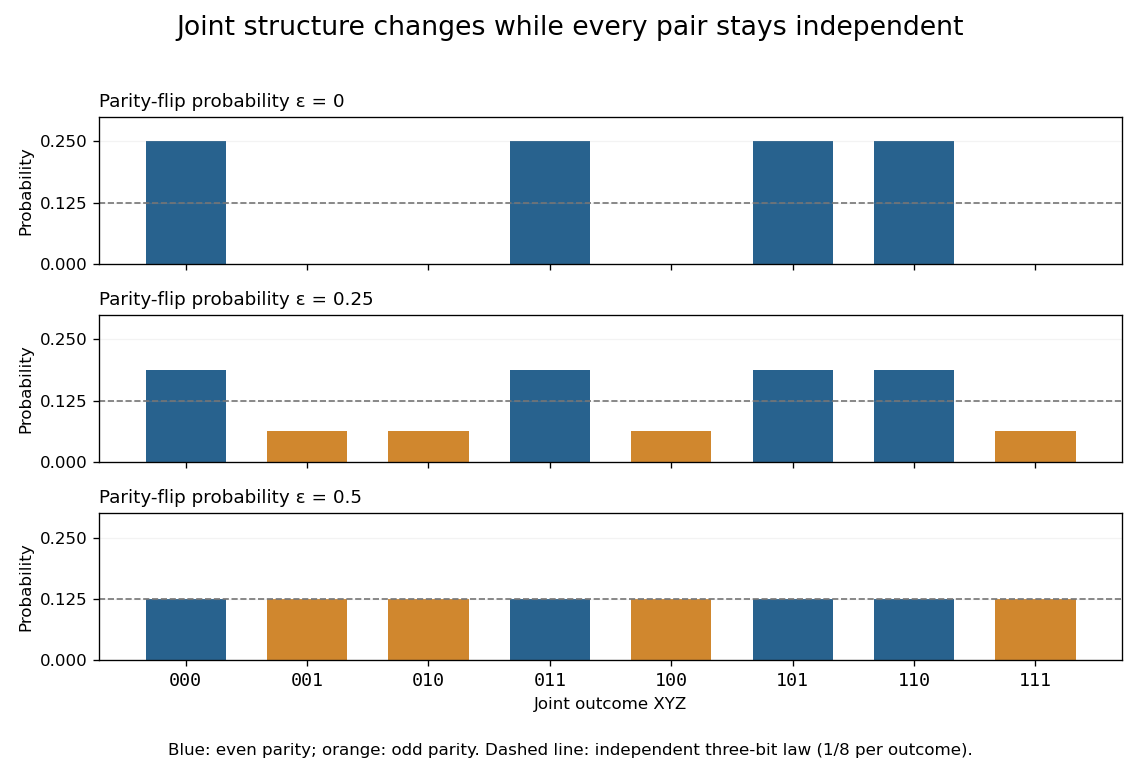
Knowing , uncertainty in is exactly the uncertainty in . The chain rule for information entropy giveswhere is binary entropy. HenceAt , the result is approximately bits, although all three pairwise mutual informations are zero. At , all eight triples have probability , giving joint independence and zero total correlation. At , the complementary integer parity rule is deterministic again, so total correlation returns to one bit.
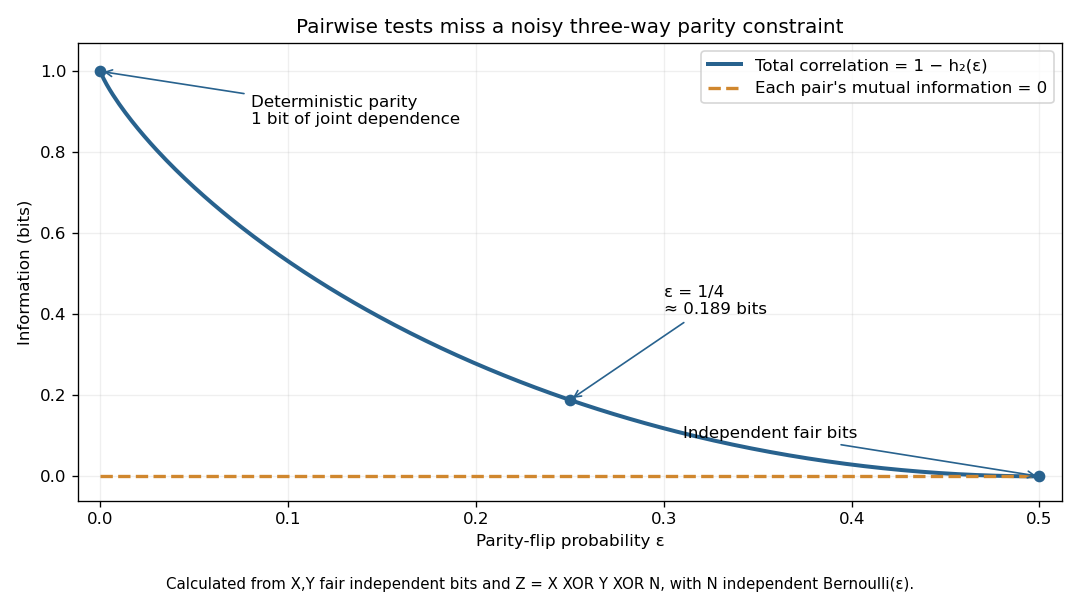
The example distinguishes "there is a dependence" from "a pair reveals it." Once are known together, is predictable at zero noise; knowing either one alone leaves a fair bit. Total correlation detects the joint departure from independence, but does not by itself specify which variables cause which others.
For finite alphabets, expanding joint entropy with the chain rule for information entropy givesEach term is mutual information with an entire preceding block, rather than necessarily with one preceding variable. Changing the order changes these individual terms but leaves their sum unchanged.
For the noiseless parity constraint and total correlation, and bit. The conditional block term supplies exactly the dependence that the pairwise comparisons missed. For three identical copies of a fair bit, the two block terms are both one bit. Thus total correlation counts total departure from the product law, not merely the presence of a single irreducible multiway relation.
Let be a joint probability distribution on a finite product alphabet, with marginals . Compare it with a product model , assuming wherever . Adding and subtracting the logarithm of givesThe first term is the unavoidable error from discarding dependence; the other terms are errors in the individual marginal probability distributions. Averaging a term that depends only on under is the same as averaging it under , which proves the identity directly.
Among product laws, the choice minimizes this relative entropy, leaving exactly total correlation. The related cross-entropy equals entropy plus relative entropy identity interprets this as extra average logarithmic loss from using the independent model. It is a statement about a specified joint law and loss function, not a claim that fitting a finite sample automatically recovers that law.
For finite alphabets, , soFor identical copies of one fair bit, the upper bound is attained and total correlation is bits. Adding another copy increases the result without introducing a new underlying random choice. The choice of coordinates and their grouping therefore matters when comparing systems of different sizes.
For more general random variables, the relative entropy against the product of the marginals supplies a definition of total correlation that may be infinite. Subtracting differential entropies is justified only when those quantities are finite and the entropy identity is valid; an undefined difference of infinities is not a definition. The finite-alphabet examples above avoid that problem entirely.
The abstract of Information Theoretical Analysis of Multivariate Correlation by Satosi Watanabe (1960, printed p. 66) names the sum of individual information entropies minus joint entropy "total correlation." It presents this as the finest grouping of the variables and identifies applications to geometric pattern recognition and shuffling cards marked zero or one. The name therefore connects the uncertainty of a system with the structure linking its parts; the worked integer parity and noisy-integer parity models here are separate examples calculated from their stated laws.
Articles by others on the same topic



Total correlation is a concept from information theory and statistics that measures the amount of dependence or shared information among a set of random variables. Unlike mutual information, which quantifies the shared information between two variables, total correlation extends this idea to multiple variables.