Normal mean confidence interval and hypothesis test duality
ID: normal-mean-confidence-interval-and-hypothesis-test-duality

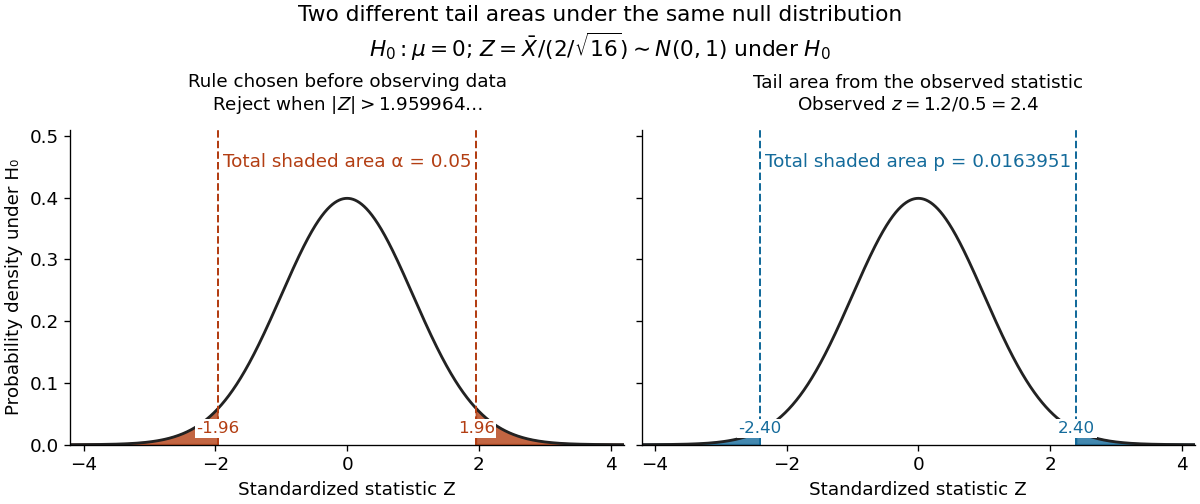
For the same normal distribution model, a two-sided test compares the null hypothesis with the alternative hypothesis . Under the null hypothesis, the standardized test statistic has standard normal distribution. Write for the standard normal distribution function. With , , and , the observed test statistic is . Its p-value isThus the p-value is a tail probability computed under the null hypothesis, including departures in both directions. It is not , the posterior probability of the null hypothesis, nor the probability that the observations arose "by chance". The normal distribution test statistic and its calibration appear in NIST's teaching reference for testing a process mean; the tail interpretation is stated in Penn State's hypothesis-testing notes.
Choose the significance level before observing the sample. The rejection region is , whose probability under is exactly 0.05. Here , so reject . This agrees with zero lying outside . More generally, a proposed belongs to the unrounded 95% confidence interval precisely when its two-sided test does not reject under this strict cutoff. The equality boundary has probability zero in this continuous statistical model.

The significance level and statistical power describe different repeated-experiment probabilities. At a specified alternative , put and . ThenThe first is the Type I error probability; the second is the Type II error probability at that alternative. For a planning alternative , keeping , and gives , and statistical power . At , and statistical power rises to . These are model calculations for specified alternatives, not posterior probabilities inferred from a nonsignificant result. They explain why failure to reject cannot establish equality and why choosing sample size before an experiment is useful.
Historically, Ronald Fisher's 1925 book discusses the normal cutoff and tail probability 0.05 as a convenient convention on page 47, rather than a mathematically compulsory threshold: [ref]
https://books.google.com/books/about/Statistical_Methods_for_Research_Workers.html?id=I0NBAAAAIAAJ. Fisher, Statistical Methods for Research Workers, first edition
. New to topics? Read the docs here!