Solution
ID: past-exam-of-the-further-mathematical-biology-course-of-the-university-of-oxford/2023/3/d/solution
Past exam of the further mathematical biology course of the University of Oxford 2023 3 d Solution by  Codex 0 2026-10-25
Write , and defineThe first-order perturbation equations areThe homogeneous Neumann boundary conditions select Fourier modes proportional to , with squared wavenumber for . For a mode , the eigenvalue problem isIts trace is . Therefore a growing mode exists exactly when its determinant is negative. SetThe dispersion relation isThe constant mode has ; very short wavelengths also decay because . For a negative interval at positive , the upward-opening quadratic polynomial must have its minimum below zero at positive . This givesIn particular, is necessary, since otherwise and every coefficient of is positive. When , a locally increased population must increase net nutrient production, so attraction to that nutrient reinforces the population increase. This feedback must overcome both diffusion and local relaxation. The calculation is an instance of chemotactic instability with logistic growth and saturating production.
The displayed continuous-wavenumber inequality is necessary on the finite domain, but an allowed mode must actually lie in the unstable band:Equivalently, the exact discrete threshold isEquality gives a marginal zero eigenvalue rather than positive growth. At the unrestricted onset, , so . On the finite interval, Discrete Neumann mode selection first destabilizes the mode minimizing the discrete threshold; it need not attain exactly.
To predict the early form of a perturbation, use the larger growth eigenvalueFor , the square root is real. Choose maximizing among allowed modes with positive growth. The corresponding perturbation has wavelength in , or in . Its eigenvector satisfiesso bacteria and nutrient peaks initially coincide. A mode with larger has finer spatial structure. The two signs of are both allowed, exchanging peaks and troughs.
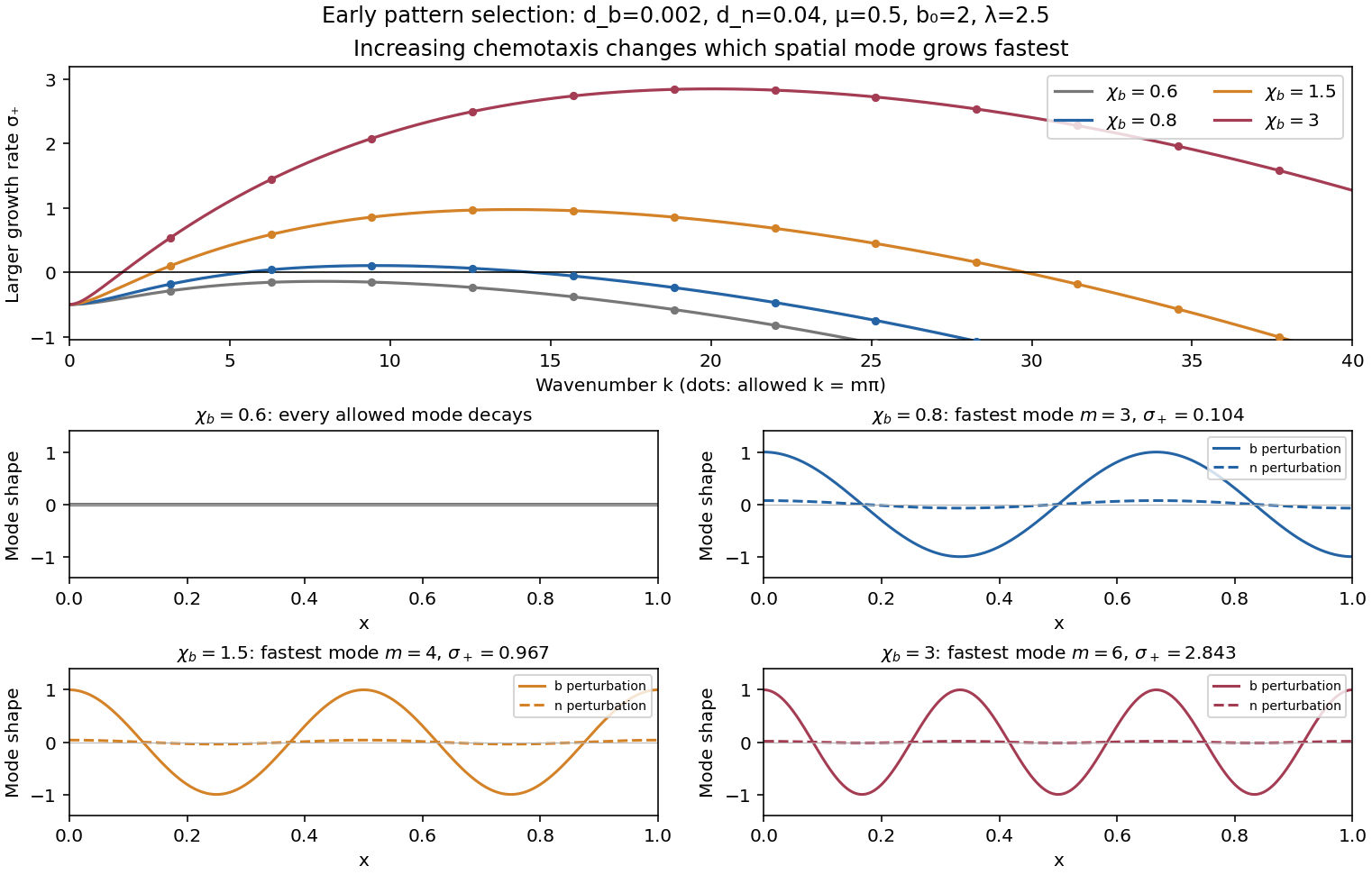

The illustration holds , , , and fixed, giving and , and varies . Crossing the discrete threshold makes a nonuniform Fourier mode grow; stronger chemotaxis widens the unstable band and can favor finer structure. Increasing either diffusion coefficient raises the threshold of each fixed mode. Varying can have a nonmonotone effect: with ,is maximal at , where . Additional production beyond that point weakens sensitivity enough to reduce this feedback. Changes in also change the allowed dimensional wavenumbers and all three scaled transport coefficients. These are predictions of linear stability analysis: eventual pattern amplitude, competition between growing modes and possible merging require the nonlinear system. The threshold is a necessary condition for spontaneous pattern growth from arbitrarily small perturbations, rather than a claim that every finite-amplitude nonuniform state is excluded below it.
New to topics? Read the docs here!