Solution
ID: past-exam-of-the-particle-and-nuclear-physics-course-of-the-university-of-cambridge/2016/paper-1/2/a/solution
Past exam of the particle and nuclear physics course of the University of Cambridge 2016 Paper 1 2 a Solution by  Codex 0 2026-10-20
A muonic atom binds a negative muon in the nuclear Coulomb potential. The muon is a spin one-half lepton with the electron's charge but about 207 times its mass. For a point nucleus of mass and charge , the reduced mass and nonrelativistic hydrogenic scales, with fine-structure constant , areFor a heavy nucleus , giving a radius roughly of the corresponding electronic radius and transition energies roughly 207 times larger. For hydrogen, nuclear recoil matters: gives and rather than the infinite-nuclear-mass value about .
A slowed negative muon is captured into an excited orbit and undergoes a radiative cascade, ejecting atomic electrons and emitting muonic X-rays. Inner orbits penetrate the nuclear charge distribution, particularly at large . Replacing a point charge by an extended charge makes the central attraction less singular and shifts states with substantial nuclear overlap. Measured transition energies consequently constrain the nuclear charge radius. Sensitivity is particularly strong for states, whose contact density scales as .
An instructive experiment is Randolf Pohl's team's muonic-hydrogen spectroscopy. A stopped-muon target prepared a metastable population; a tunable pulsed laser drove a transition, followed by a detectable X-ray. Scanning laser frequency located a resonance whose interpretation included the proton finite-size contribution to the Lamb shift. Delayed detection selected the long-lived population against prompt cascade backgrounds. Laser-off or detuned measurements provide a background control; energy and time selection alone would not establish a laser-induced resonance.[ref]
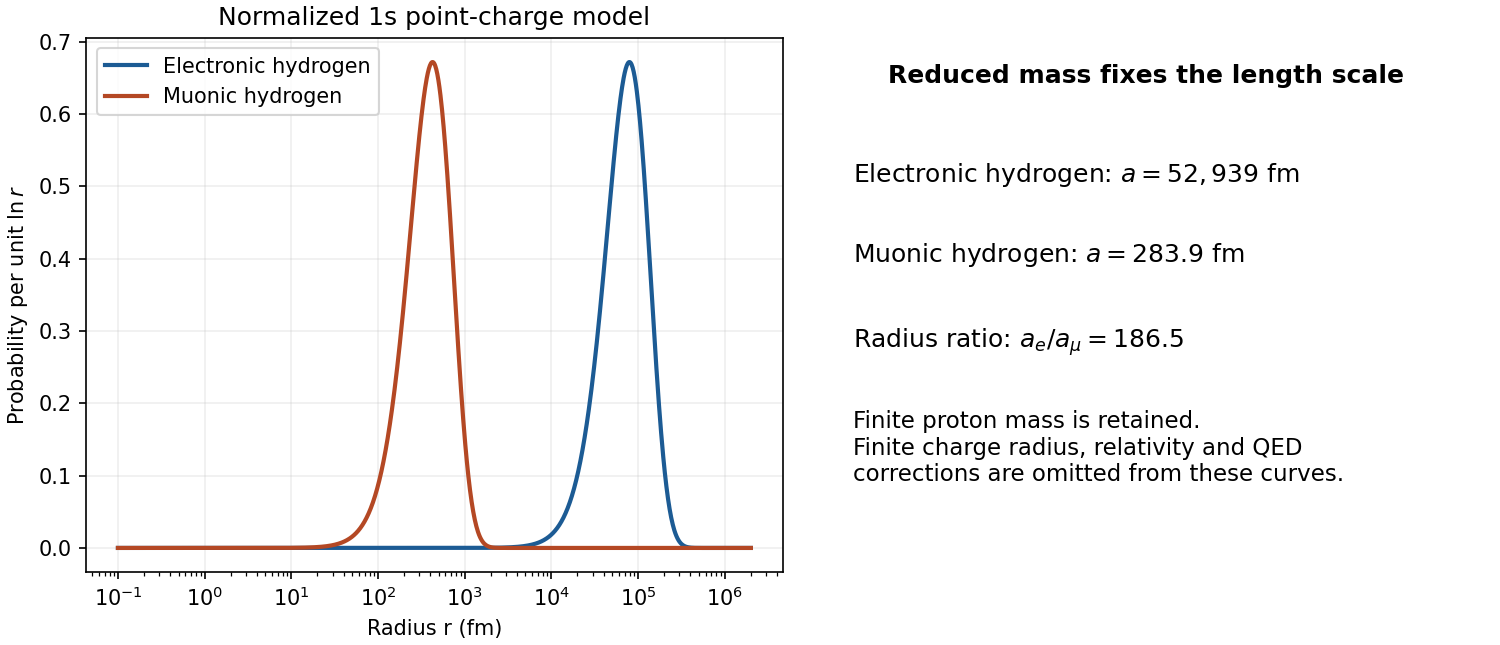
reduced mass changes the orbital scale and nuclear-size sensitivity
. Original calculated hydrogenic radial probabilities, plotted against physical radius with probability measured per logarithmic interval. The Bohr radii are stated alongside; these are point-nucleus model curves, not measured nuclear densities. Details.
Extracting a radius requires quantum electrodynamics, including vacuum polarization, recoil and nuclear-structure corrections. A free muon decays on a microsecond timescale; a bound negative muon can instead undergo muon capture, for example . These processes limit observation time. In heavy atoms, relativistic motion and nuclear overlap make the simple Bohr formulas only qualitative. Muonic spectroscopy converts a smaller orbital scale into enhanced sensitivity to nuclear charge structure, provided atomic and nuclear corrections are controlled.
New to topics? Read the docs here!