Solution
ID: past-exam-of-the-physics-course-of-the-year-1-of-the-natural-sciences-course-of-the-university-of-cambridge/2013/paper-1/section-b/b7/solution
Past exam of the physics course of the year 1 of the natural sciences course of the University of Cambridge 2013 Paper 1 Section B B7 Solution by  Codex 0 2026-10-20
In the centre-of-momentum frame the two equal masses have opposite velocities. Conservation of kinetic energy in an elastic collision fixes their common speed, so scattering changes their directions only. For incoming laboratory velocities and , the frame velocity is and the incoming relative velocities are . If the outgoing relative velocities are , then and the laboratory velocities are . Their dot product is zero: nonzero outgoing laboratory velocities are perpendicular.
For this smooth equal-disc oblique collision, let point from A to B at contact. The impulse acts only along ; the tangential velocity of A is unchanged. With , equal masses exchange their normal velocity components:ThereforeNo rotation about a disc centre is generated by these central impulses. At exactly head-on impact A stops, so its outgoing direction is undefined; the angle formula then denotes a limiting direction.
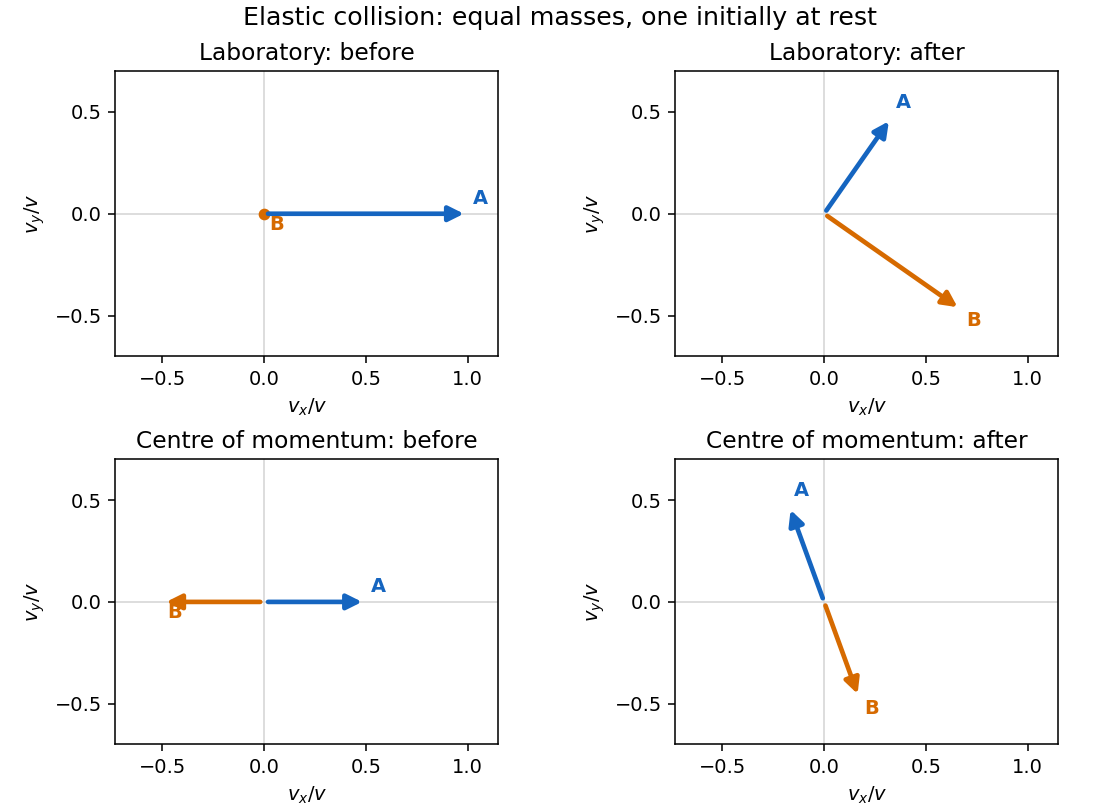
Original velocity-vector construction for an equal-mass elastic collision, before and after impact in the laboratory and centre-of-momentum frames
. Details. 
For this adhesive collision of two equal discs, use the parallel axis theorem about the midpoint of the touching centres:Its magnitude is . Linear and angular momentum conservation giveThe rotation has the sign of , clockwise for the printed geometry. The energy loss is . After impact the midpoint translates uniformly and the rigid pair rotates uniformly about it: there are no external horizontal forces or axial torques.
Rough unglued edges can transmit a tangential impulse and generate angular momentum about the individual disc centres. The centre-of-mass velocity and total angular momentum still have the values above, but individual translational speeds, angular velocities and energy loss require a friction/contact law and normal restitution. Roughness alone does not imply permanent sticking or the adhesive result.
New to topics? Read the docs here!