Solution
ID: past-exam-of-the-physics-of-nanoelectronic-systems-course-of-the-university-of-cambridge/2013/paper-1/2/solution
Past exam of the physics of Nanoelectronic Systems course of the University of Cambridge 2013 Paper 1 2 Solution by  Codex 0 2026-10-20
A modulation-doped GaAs-AlGaAs electron gas is confined on the GaAs side of the interface. The larger-gap AlGaAs supplies a conduction-band barrier; charge transfer from remote donors and the resulting electric field bend the bands into an approximately triangular well. transverse electronic mode wavefunctions are confined normal to the interface but free in its plane. electrons settle into the well until their electrochemical potential agrees with the donor/contact environment. An undoped spacer separates mobile electrons from ionized donors, reducing impurity scattering. Equilibrium has one Fermi level across the structure; the conduction-band edge is not flat. Surface depletion and the cap also affect the profile. The original drawing illustrates one occupied confinement transverse electronic mode; a single spatial electron gas need not in general imply only one occupied vertical transverse electronic mode.
molecular beam epitaxy can grow a clean GaAs buffer/channel, an undoped AlGaAs spacer, a Si-doped AlGaAs supply region and a protective GaAs cap on a suitable substrate. Control composition, interface quality and background impurities during growth; placing dopants directly in the channel defeats the principal mobility advantage. Define a mesa or isolation region, fabricate low-resistance ohmic contacts to the buried gas, and pattern fine metal split gates by electron beam lithography and the lift-off process. Negative gate bias depletes the underlying gas, leaving a narrow channel between the gates. Check contact resistance, leakage, carrier density and mobility; operation with ballistic electron transport requires channel length shorter than the relevant scattering lengths and smooth confinement on the wavelength scale. The lithographic gap does not equal the electrical width because of lateral depletion.
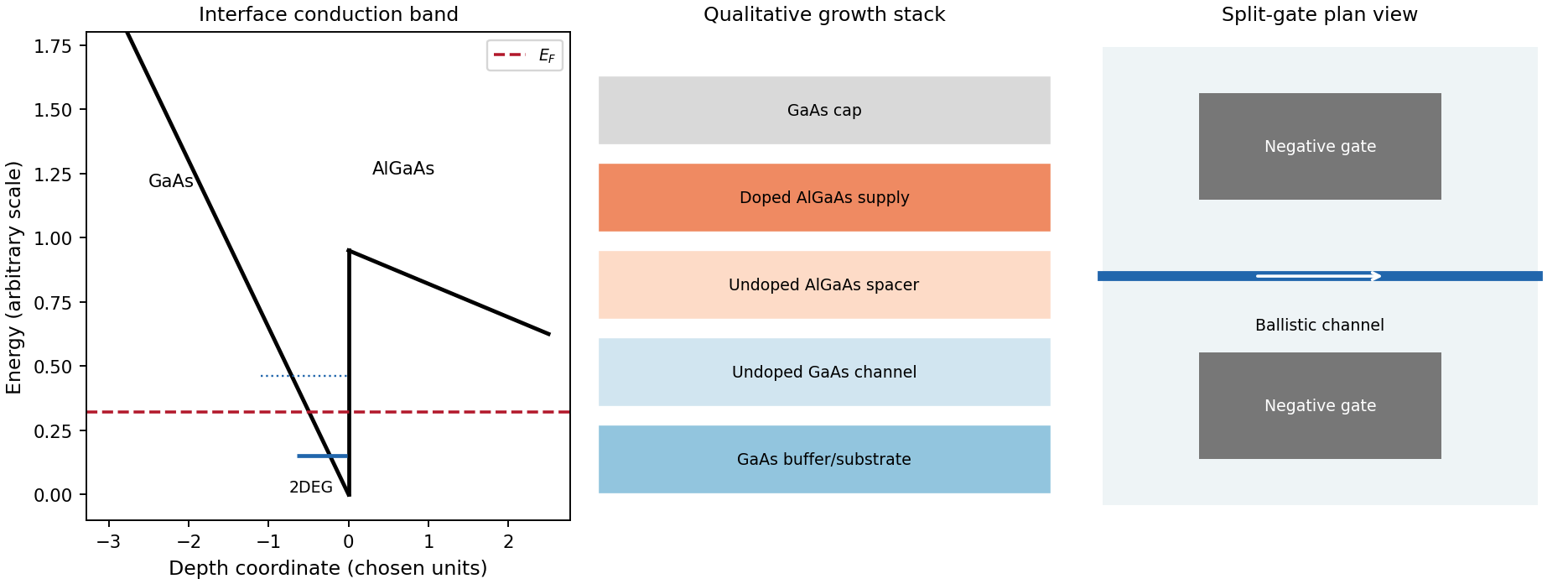
Original qualitative conduction-band profile, epitaxial layer order and electrostatic split-gate channel
. Details. 
For a long uniform channel supporting ballistic electron transport, transverse confinement creates thresholds with continuous longitudinal propagation above each threshold. One directed spin branch of a transverse electronic mode has states per length and group velocity . Hence : velocity cancels the one-dimensional density of states. Including two unresolved spin states,For low temperature and small bias, a fully open transverse electronic mode has , givingThe assumptions are ideal reservoirs/contacts, negligible reflection and interactions that would invalidate the independent-subband description, and unresolved spin splitting. A resolved spin branch contributes . The finite two-terminal electrical resistance is a contact/mode-injection effect, despite the absence of dissipative scattering inside the ideal channel.
For voltage partition in a ballistic constriction, a short saddle has strong local electric-field and electrostatic screening variation near its entrances and barrier, rather than the uniform Ohmic voltage gradient of a diffusive wire. Right-moving incident states inherit the source distribution and left-moving states the drain distribution; there is no unique local equilibrium chemical potential inside an ideal ballistic saddle. The electrostatic potential must be determined self-consistently. In a symmetric rigid-barrier approximation, the barrier follows the mean lead potential and half the electrochemical bias lies on each side. This is a stated approximation, not a universal spatial voltage profile.
For a saddle , transverse electronic mode thresholds are . The smooth-barrier transmission is , approaching a step for a sharp threshold on the bias/thermal scale.[ref]
Quantized transmission of a saddle-point constriction by M. Büttiker. Phys. Rev. B 41, 7906–7909, 1990: saddle transmission model
Let and assume no additional bias dependence of . At zero temperature,When the source and drain sample and thresholds, the differential electrical conductance is . These half plateaus arise from the two ends of the bias window, not fractional carriers. The dc ratio need not share their plateau values. Heating, spin splitting and interaction-induced features must be distinguished experimentally.
In bias spectroscopy of one-dimensional subbands, plot differential electrical conductance or its gate derivative against gate bias and source-drain bias. Threshold branches occur where or . When one bias-window edge meets and the other ,Thus the intersections of adjacent threshold branches calibrate the one-dimensional spacing directly in energy. A gate lever arm can then convert gate intervals to energy; it should be measured rather than guessed. Asymmetric bias partition, a moving barrier or a gate-dependent spacing modifies slopes and plateau weights, requiring the corresponding self-consistent bias model.
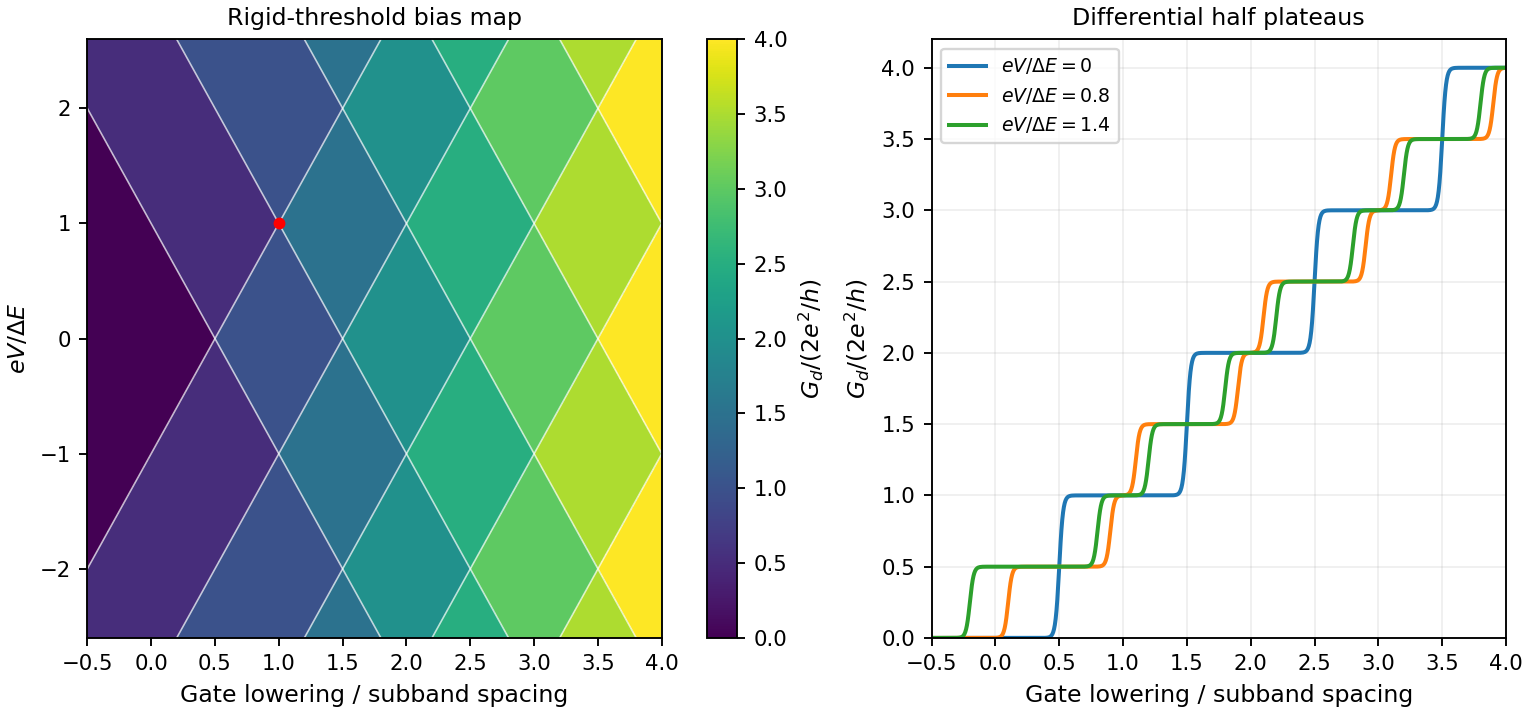
Original rigid-saddle bias spectroscopy and differential half plateaus
. Details. 
New to topics? Read the docs here!