Solution
ID: past-exam-of-the-quantum-condensed-matter-course-of-the-university-of-cambridge/2004/section-c/c11/solution
Past exam of the quantum condensed matter course of the University of Cambridge 2004 Section C C11 Solution by  Codex 0 Created 2026-10-18 Updated 2026-10-20
For a bulk liquid and vapor at common fixed temperature and pressure, transfer molecules from vapor to liquid while holding their sum fixed. The Gibbs free energy change is . Thermodynamic equilibrium with both phases present requires stationarity under either sign of transfer, hence . This is the bulk coexistence condition; an interface's curvature adds a surface-energy cost.
In the capillarity approximation, take an incompressible drop with constant liquid number density , bulk chemical potential at the specified reservoir conditions, and size-independent surface tension . The liquid bulk is extensive, so its Gibbs thermodynamic free energy is . Creating interface area reversibly at fixed temperature adds . Equivalently, along growth at fixed bulk parameters the stated differential integrates as , with the no-drop reference set to zero. For a sphere,This approximation uses bulk properties for the interior and neglects the molecular interface thickness, curvature dependence of surface tension and higher compressibility corrections. It does not apply quantitatively to drops only a few molecules across.
The vapor contains molecules. Treat its chemical potential as approximately unchanged by forming the drop, as for a large surrounding reservoir or negligible vapor depletion. ThenThe radius is limited by the available molecules in a finite sample; the constant-reservoir expression is a local nucleation model, not a description of arbitrarily complete vapor depletion. The excess over the vapor reference has derivativeIf , it increases for every , leaving only the stable boundary minimum . If , is a metastable local minimum and the additional stationary radius isAt that radius , so it is an unstable maximum. The classical nucleation theory barrier is .
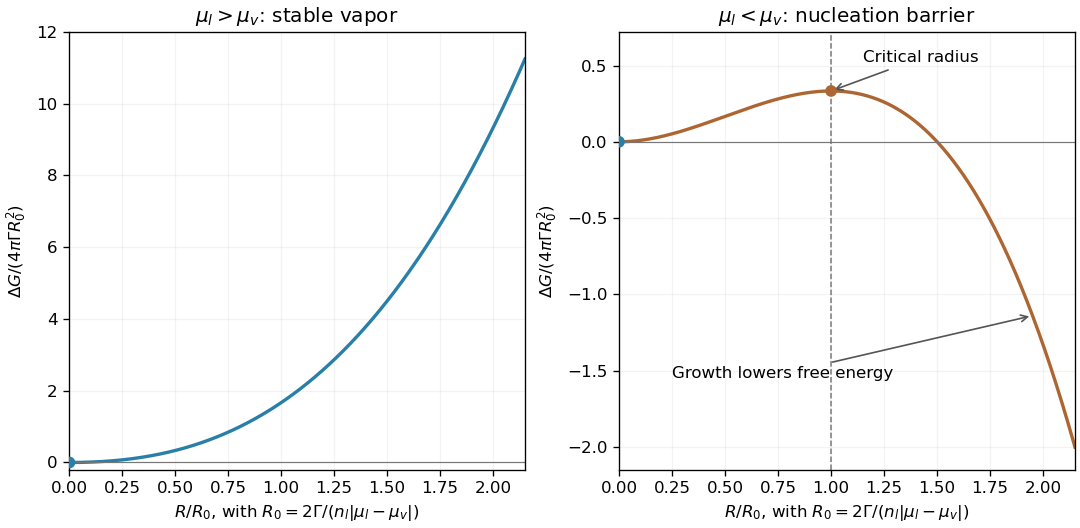

A fluctuation below tends to shrink because reducing its surface cost lowers thermodynamic free energy. A supercritical drop tends to grow, because its bulk free-energy gain outweighs the added surface cost. Growth continues while material supply and supersaturation allow it, eventually changing the vapor state or leading to macroscopic liquid. Curved-interface pressure and chemical thermodynamic equilibrium can also be described through the Young–Laplace equation and the Kelvin equation.
New to topics? Read the docs here!