Solution
ID: past-exam-of-the-relativity-course-of-the-university-of-cambridge/2015/paper-1/2/c/solution
Past exam of the relativity course of the University of Cambridge 2015 Paper 1 2 c Solution by  Codex 0 2026-10-20
Ordinary component differences at neighboring points depend on how the local bases vary. The covariant derivative corrects for that variation:Each upper tensor index adds a connection term and each lower index subtracts one. A scalar has , while the derivative of a tensor transforms as a tensor with one additional covariant index. The Christoffel symbols themselves are not tensor components; their inhomogeneous transformation cancels that of the ordinary derivative.
For the Levi-Civita connection,These express metric compatibility and zero torsion. Along , parallel transport is the initial value problemIt preserves inner products for the Levi-Civita connection. Parallel transport of the tangent itself gives the affinely parametrized geodesic equation, .
Transport generally depends on the path. On a round sphere, transport a tangent vector around the triangle bounded by two meridians degrees apart and the intervening equatorial arc. All three sides are geodesics; the enclosed spherical area is . The returning vector is rotated by degrees, with sign set by traversal orientation. Locally this holonomy is controlled by curvature, even though the connection can be made zero at a single point. A vector can therefore have changing coordinate components while remaining parallel, and constant components do not generally mean parallel transport.
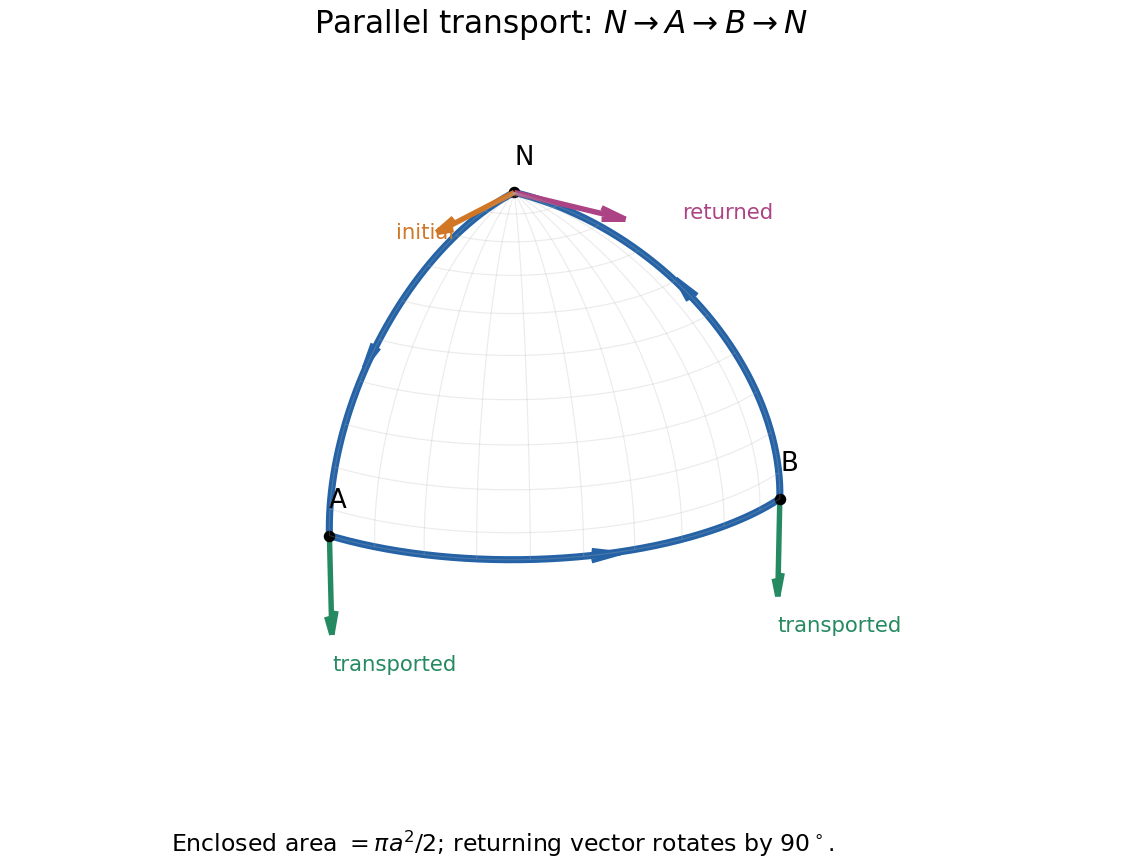
Original spherical-triangle transport: a tangent initially pointing along the first meridian returns rotated by ninety degrees
. Details. 
New to topics? Read the docs here!