Purity of a density operator
ID: purity-of-a-density-operator

The purity of a density operator is . It equals one exactly for a pure state; in finite dimension it lies between and . The minimum occurs exactly at the maximally mixed state .
A worked qubit family interpolates between the mixed state and the pure state , where :The eigenvectors are , with eigenvalues . Squaring and summing these eigenvalues givesHere is the Born rule probability of the positive outcome in an projective measurement. The Bloch vector is , since with one of the Pauli matrices. At the purity is ; at it is , with ; at it is one. Within this family, is a pure state and every is a mixed state. Extending the formula to produces a negative eigenvalue , so it ceases to be a density operator despite remaining Hermitian with trace one.
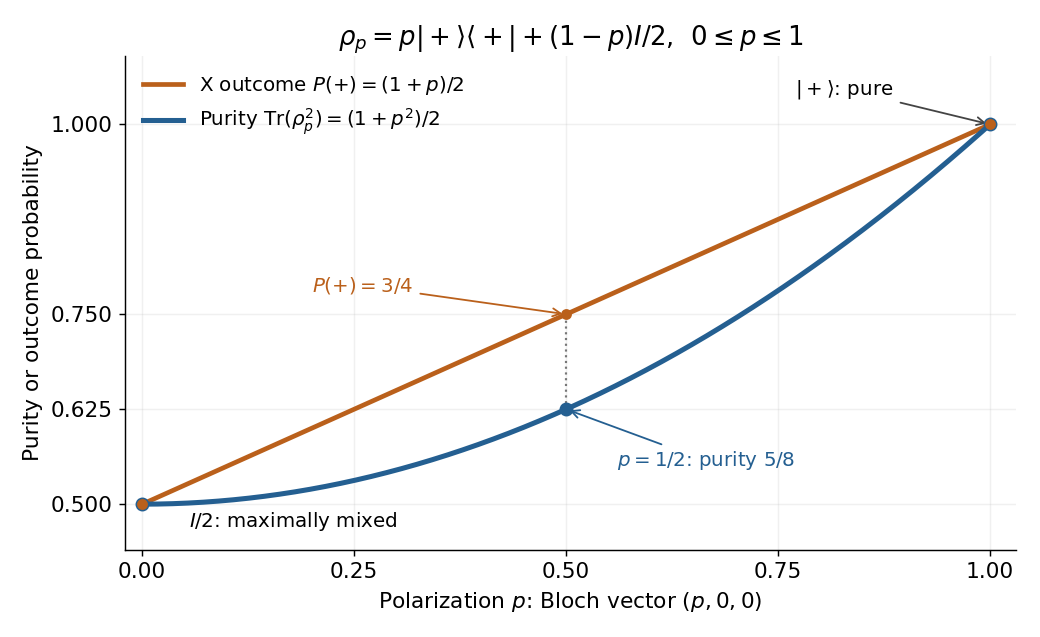

The Bloch vector length measures polarization: for any qubit density operator, . This connects the interior of the Bloch ball with mixed states and its boundary, the Bloch sphere, with pure states. [ref]
For a short proof of the general bound, use the spectral theorem: the nonnegative eigenvalues sum to one, so . ThenThe lower bound is attained only when all eigenvalues equal ; the upper bound is attained only when exactly one eigenvalue is nonzero, and hence equals one. Purity is therefore a simple quantitative test of mixedness, invariant under a unitary operator. It does not specify the entire density operator: even distinct pure states all have purity one. [ref]
New to topics? Read the docs here!