Radiation pressure of an isotropic photon gas
ID: radiation-pressure-of-an-isotropic-photon-gas

For radiation in vacuum with isotropy, energy is distributed equally per solid angle: write for energy density per unit solid angle. Let be the angle between a ray's path and the wall normal. Its normal velocity determines the arrival rate, while normal momentum per energy is . Their product is . For a perfectly reflecting cavity wall,The leading two is the normal momentum reversal; the incoming hemisphere contains half of the field's directional energy density. This is also the normal component of the bulk pressure tensor, . Isotropy makes all three diagonal components equal, while their sum is because the squared direction components sum to one. The factor one third therefore depends on three-dimensional angular geometry, not on the shape of the blackbody radiation spectrum.
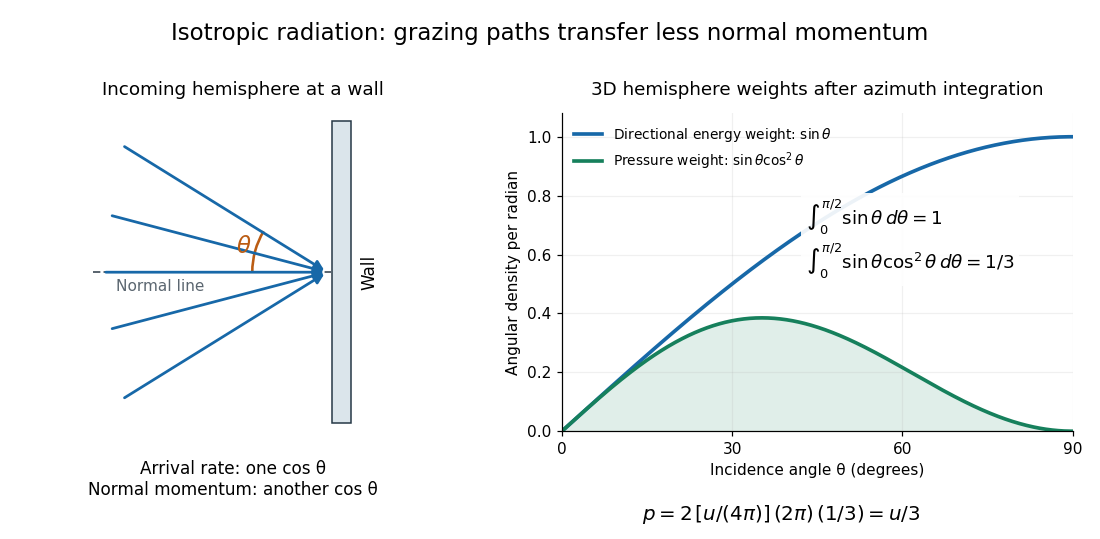

A perfectly absorbing wall exposed to this incoming hemisphere receives only from absorption. If it is in thermal equilibrium with the isotropic radiation, its outgoing emission supplies another of recoil, recovering . A cold absorber before equilibrium is a different boundary condition. Similarly, the one-way incident energy flux is , whereas the net energy flux across a plane in the undisturbed isotropic field is zero. Dividing by misses the extra normal-momentum projection and does not give the cavity pressure.
For a stipulated isotropic radiation energy density , the bulk pressure is regardless of its spectral shape. In thermal equilibrium, blackbody radiation supplies with radiation constant , so ; Stefan–Boltzmann law defines . The equilibrium photon gas derives this same equation of state from its free energy.[ref]
New to topics? Read the docs here!