
A ring laser is a laser whose optical cavity follows a closed circulating path through a laser gain medium. Mirrors can fold the path into a triangle or another polygon; guided structures can implement the same circulating feedback principle. A travelling optical wave can return to its starting position and direction after one full circuit. The laser threshold requires round-trip gain to balance the complete losses; a closed path alone is not enough to produce laser oscillation.[ref]
Fundamentals of Photonics and Quantum Electronics lecture notes by Franz X. Kärtner. Chapter7, printedpp.313–314, Figure7.19 and equations7.10–7.12
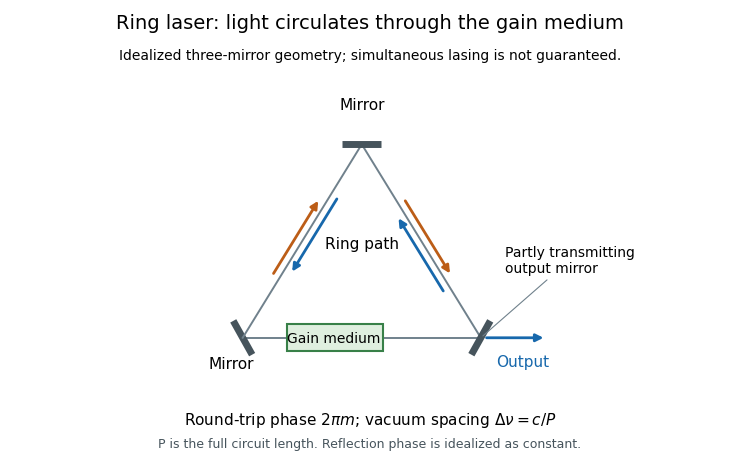
Original schematic of a three-mirror ring laser, a laser gain medium, two possible circulation directions and one output port
. Idealized optical-path diagram rather than a reconstruction of the McNamara experiment. The arrows indicate possible travelling waves; their simultaneous stable lasing is not assumed. Details.
The phase condition explains the allowed normal modes. Neglect dispersion and take a constant round-trip reflection phase . If the circuit's optical path length is , resonance requiresSubtracting the equations for consecutive modes gives the free spectral rangeMore generally the spacing is approximately the inverse round-trip group delay. A vacuum circuit of full geometric perimeter has a round-trip time about and mode spacing about . There is no additional factor of two: already counts the whole returning route.[ref]
Fundamentals of Photonics and Quantum Electronics lecture notes by Franz X. Kärtner. Chapter7, equations7.10–7.12: inverse round-trip-time spacing and distinction between linear and ring cavities
Gain and phase impose different conditions. In an original startup model let the three mirror intensity reflectivities be , and , and let the intensity gain accumulated during one complete circuit be , with other losses neglected. The round-trip intensity multiplier isThe modeled field can grow from a seed. Reducing to gives , so it decays. These are intensity quantities, not amplitude reflectivities. Saturation and competition between normal modes must determine real steady operation.
A reciprocal ideal ring supports possible clockwise and counterclockwise waves. Their simultaneous stable emission is a dynamical question because both can interact with the same laser gain medium. A ring laser gyroscope uses rotation-dependent differences between the two circulation directions through the Sagnac effect; ring geometry by itself does not guarantee a useful rotation measurement.
A different motivating experiment used the directional dynamics as a nonlinear sensor. In 1988 Bruce McNamara, Kurt Wiesenfeld and Rajarshi Roy periodically modulated the asymmetry between counter-rotating lasing modes and added controlled external noise. Their measured signal-to-noise ratio improved for injected noise relative to no external noise, demonstrating stochastic resonance. This observation concerns a particular modulated dynamical response, not a claim that adding noise improves every optical measurement.[ref]
Observation of Stochastic Resonance in a Ring Laser by Bruce McNamara and others. Publisher abstract, Physical Review Letters60, pp.2626–2629, 1988
New to topics? Read the docs here!