
A simple random walk on a locally finite graph chooses each vertex in the current vertex's graph neighbourhood with equal probability, assuming there is at least one available neighbour. On the integer line there are two choices, one unit left or right, so each has probability . This is the one-dimensional simple symmetric random walk. Terminology varies: a simple random walk on the integer line is also often allowed unequal step probabilities, with “symmetric” specifying the fair case.
For a simple symmetric random walk starting at , each increment has the Rademacher distribution, with expected value zero and variance one. Thus linearity of expectation and the variance of a sum of independent random variables giveFor example, after steps the expected value is zero, the variance is , and the standard deviation is . Doubling the typical distance scale takes four times as many steps. This square-root growth explains why a random walk can wander far even when there is no preferred direction.
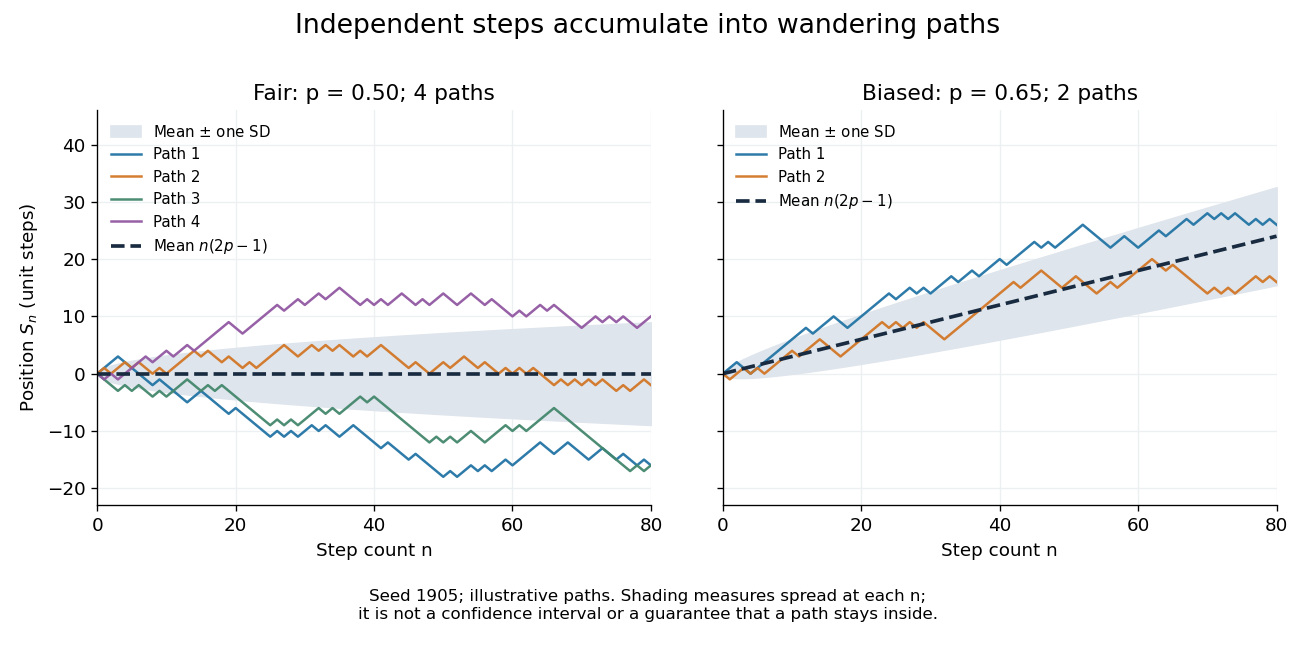
Four fair and two biased unit-step random-walk paths, with their expected values and bands one standard deviation wide on either side.
Details. 
The colored curves are illustrative sample paths, not averages over all possible walks. The dashed curves show the expected values; the shaded bands show the expected value plus or minus one standard deviation at each time. These bands are a scale of spread, not confidence intervals, and give no guarantee that an entire sample path stays inside them.
Zero expected value does not make this a stationary process: its one-time probability distribution changes with , as the increasing variance already proves. It does have stationary increments and independent increments, because blocks of fresh steps have the same probability distribution at any starting time and disjoint blocks use independent random variables. This separation of position from increment is one reason the random walk is such a useful first example of a stochastic process.
New to topics? Read the docs here!