Sliding acceleration on an inclined plane
ID: sliding-acceleration-on-an-inclined-plane

First test rest. With no other tangential forces, the required uphill static friction is . Its maximum is , where is the coefficient of static friction. ThusThe tangent function is increasing on this angle range, and its inverse tangent determines the last permitted resting angle . At equality, the ideal model still permits limiting rest; a larger angle excludes it. Below the threshold, setting would incorrectly impose the maximum static friction even when less is required. Static friction on an inclined plane and inclined-plane measurement of static friction develop this onset criterion further.
For a block already sliding downhill, uphill kinetic friction has magnitude , where is the coefficient of kinetic friction. Taking downhill as positive, Newton's second law becomesEvery term in the force balance scales with mass; division by removes it. Doubling mass doubles both gravitational weight and the contact forces, while leaving this acceleration unchanged if the coefficients remain unchanged. A mass-independent result is a prediction of these assumptions, rather than a universal property of every ramp.
For an original numerical model, stipulate , , and . The critical angle is . At , the normal force is ; rest requires of uphill static friction, below its bound. A resting block can stay there. If it is already sliding downhill, however, the kinetic friction is only , giving downhill acceleration . Specifying the initial state matters.
At , the downhill component of gravitational weight is , while and the static friction bound is only . Rest is impossible. During downhill sliding,Released from rest on a sufficiently long ramp, this ideal block covers its first in , reaching speed . As an independent energy calculation, the lost gravitational potential energy is and kinetic friction removes of mechanical energy. The remaining equals by the work-energy theorem.
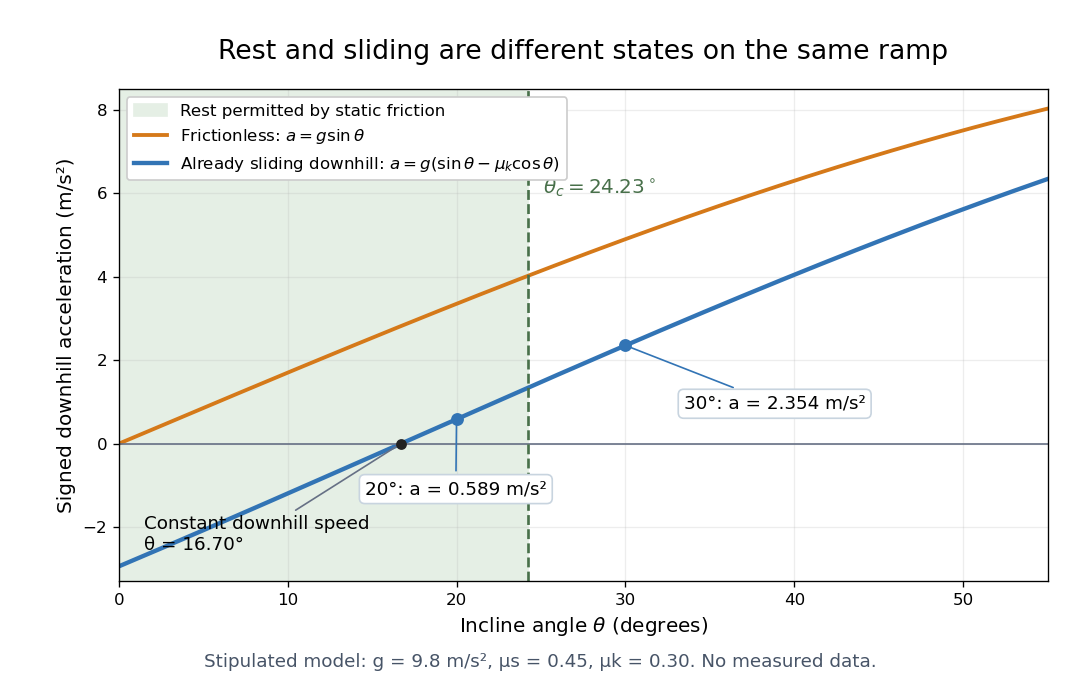

At , downhill sliding has zero acceleration and therefore constant velocity. Below that angle, a downhill-moving block slows; when it stops, test the static friction bound again. For uphill sliding, kinetic friction points downhill, so the signed downhill acceleration instead is . The sign follows contact slip, and the downhill formula cannot be used unchanged after a reversal.
New to topics? Read the docs here!