
A chemical solution is a homogeneous mixture in which designated solutes are distributed in a solvent. Representative equal-volume samples have the same composition after mixing. Individual molecules and ions remain distinguishable. The solute/solvent labels describe their roles in this mixture.[ref]
A dissolved solute is dispersed as molecules, chemical atoms, or ions, rather than as the larger solid particles of a particle suspension. For example, sucrose retains its molecular formula during dissolution in water; a chemical reaction is not required. Dissolved sodium chloride supplies sodium cations and chloride anions, surrounded by water molecules through solvation. Dissolved does not mean chemically destroyed or converted into water.[ref]
11.1 The Dissolution Process. Chemistry 2e, §11.1, opening molecular and ionic examples and defining traits of solutions
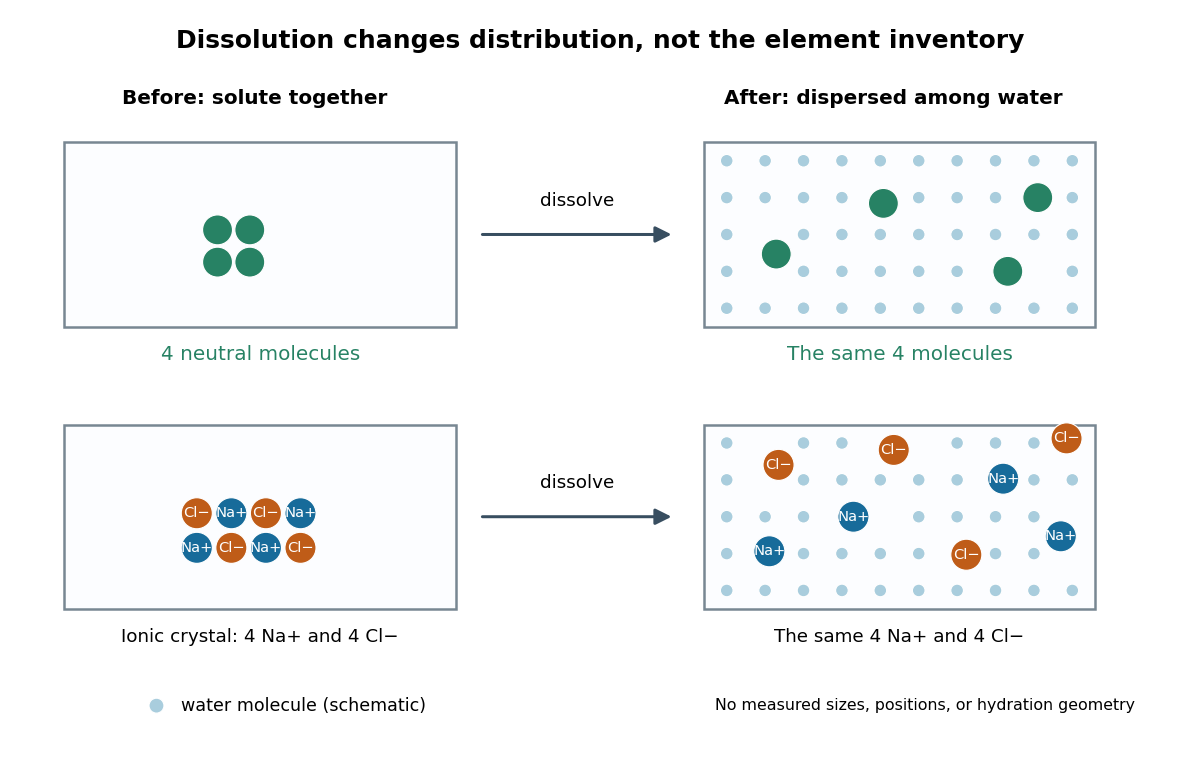
Dissolution disperses particles while preserving their chemical elements
. Original schematic with invented particle positions, not a microscopy image. Top: four generic neutral molecules retain their identity. Bottom: four sodium cations and four chloride anions separate from an ionic crystal. Pale dots represent water molecules; sizes, spacing, and counts are explanatory, not measured. Solvation surrounds each dissolved species; the diagram does not specify a hydration shell geometry. Details.This makes a useful connection between microscopic identity and laboratory sampling. If a chemical solution is well mixed, the amount of substance in a measured portion follows from its concentration and volume. A scoop from a poorly mixed particle suspension need not represent the whole vessel. Visual clarity alone cannot establish composition or exclude a fine dispersion; the quantitative claim needs representative sampling.


In chemistry, a solution is a homogeneous mixture composed of two or more substances. In a solution, one substance (the solute) is dissolved in another substance (the solvent). The solute can be a solid, liquid, or gas, while the solvent is typically a liquid, although it can also be a gas or solid in certain cases.
New to topics? Read the docs here!