Surface pressure integration for airfoil lift
ID: surface-pressure-integration-for-airfoil-lift

Surface pressure integration for airfoil lift reconstructs the pressure contribution to lift by summing the local surface pressure loads with their directions. With pointing from a two-dimensional body into the fluid, the force per unit span from its closed contour isThe uniform reference pressure cancels on the closed contour. This is a vector line integral, not the sum of positive pressure magnitudes.[ref]
Aerodynamic Forces by NASA Glenn Research Center. Variation in Pressure and Definitions of Lift and Drag
For upper and lower surfaces that are graphs over , their pressure contribution perpendicular to the chord isVertical end closures have no chord-normal pressure contribution. The pressure force parallel to the chord, , still matters when resolving flow-relative lift. With flow direction in aft/chord-normal axes, . Equating with lift needs a suitable angle of attack approximation. Pressure integration also omits the viscous stress contribution.
Finite pressure tappings require numerical integration. A composite trapezoidal rule integrates the linearly interpolated samples exactly; it need not integrate the actual unsampled distribution exactly. For an original example, let and place taps at . A second invented profile agrees at every tap but has an additional on and zero addition elsewhere. Both reconstructions give , while the second true integral is .
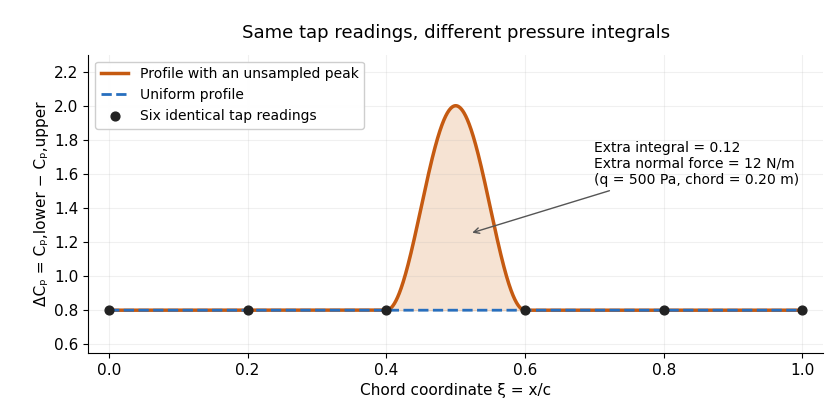
Two invented pressure-difference profiles agree at every tap but have different chord integrals. Equal readings alone do not bound an unsampled peak.
Details. 
At and , the two stipulated normal pressure forces are and , although the six samples are identical. This quadrature ambiguity of pressure-tap data is an instance of how finite samples do not certify quadrature accuracy. Additional geometric or regularity information is needed to bound the missed contribution.
A motivating experimental comparison uses a force balance independently of the pressure reconstruction. Robert M. Pinkerton's 54-orifice distribution measurements provide a historical example of resolving the shape of a pressure field.[ref]
Calculated and Measured Pressure Distributions over the Midspan Section of the NACA 4412 Airfoil by Robert M. Pinkerton. Abstract, apparatus and measured/theoretical distributions
A modern proposed test repeats both readings at controlled Reynolds number and angle of attack, checks tap coordinates and pressure-channel response, and refines sampling near sharp features. Agreement in a single integrated load does not prove agreement in the entire pressure distribution or pitching moment. New to topics? Read the docs here!