Transport and magnetic tests of superconducting ceramics
ID: transport-and-magnetic-tests-of-superconducting-ceramics

Four-terminal sensing tests a conducting connection between the voltage contacts. A magnetometer instead tests the sample's magnetic response. These measurements provide complementary constraints: the first is sensitive to a continuous path, while the second also depends on screening geometry and preparation history.
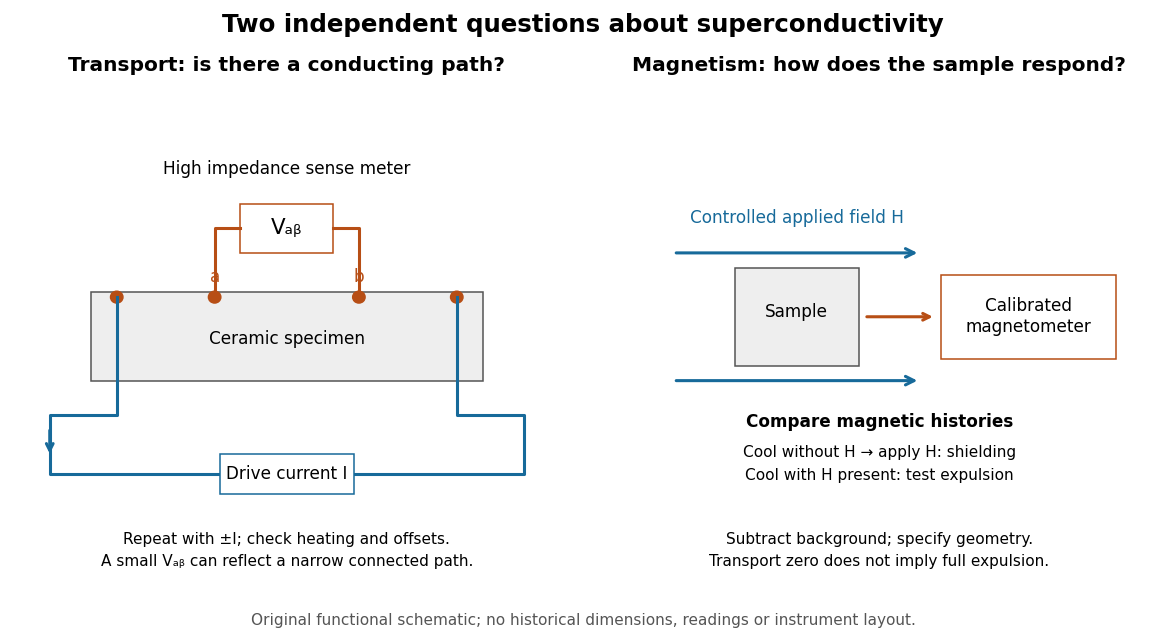

For transport, define between the inner contacts and use the reversed-electric current estimator from four-terminal sensing. Contact separation excludes drive-contact drops, but does not eliminate a drifting thermoelectric effect, Joule heating or an unrepresentative path through part of the specimen. Repeat at smaller electric currents and compare results at the same sample temperature. A finite-current result refers to that electric current and its relation to the path's superconducting critical current.
For magnetism, distinguish cooling in zero applied magnetic field and then applying it from the Field-cooled Meissner experiment. Record the applied magnetic field, background and sample geometry when interpreting magnetization or magnetic susceptibility. A transport short does not establish full Meissner effect screening throughout the specimen. Conversely, flux pinning in a type-II superconductor can make the field-cooled magnetic response differ from ideal complete expulsion. Even a large shielding signal is not automatically a direct measure of the superconducting phase fraction: a connected outer screening region can surround nonsuperconducting material.
New to topics? Read the docs here!