Phenomena involving magnetic fields, including those produced by electric currents and magnetic moments.
A small total magnetic moment can hide extensive magnetic order. Compare three questions: are the individual magnetic moments nonzero, how are their directions correlated, and what is their vector sum? Ferromagnetism, antiferromagnetism, and ferrimagnetism answer the second question differently. The third question alone cannot identify the order.
A magnet is a material object or current arrangement that produces a magnetic field. Permanent magnets retain magnetization, while electromagnets use a supplied electric current in a winding.
A permanent magnet retains magnetization after the applied magnetizing magnetic field is removed. Its working magnetic field persists without a driving electric current in a winding.
Magnetic anisotropy is a directional dependence of a material's magnetic properties. A preferred direction must be distinguished from an externally imposed magnetic field.
Magnetic shielding reduces an unwanted magnetic field in a specified region. Residual fields and fields generated inside the shield still need to be assessed in a magnetometer experiment.
Diamagnetism is a magnetic response in which the induced magnetization opposes the applied magnetic field intensity. In a linear isotropic description, with negative magnetic susceptibility .
Landau diamagnetism is the orbital response of mobile Electrons to an applied magnetic field, arising from quantization of their transverse motion. For a noninteracting three-dimensional isotropic Electron gas with quadratic dispersion, electron spin with and magnetic fields weak enough for the smooth-response limit, its susceptibility is , where is the Pauli paramagnetism susceptibility. Band effective masses, interactions, dimensionality and resolved magnetic quantum oscillations can change this simple relation.
A magnetometer measures a magnetic field or a specimen's magnetic dipole moment. A vibrating-sample magnetometer determines the latter from the electromotive force induced in pickup coils by specimen motion.
A fluxgate magnetometer uses a periodically driven magnetic core and pickup coils to measure a magnetic field.
Magnetic order is a reproducible spatial organization of microscopic magnetic moments. A net magnetization describes their sum; a staggered magnetization describes an alternating pattern. These are different order parameters. For example, an alternating row of equal up and down arrows has zero sum but a definite pattern, whereas randomly oriented arrows can have a small sum without that pattern.
A magnetic sublattice groups sites with a common ordered magnetic moment in a description of magnetic order. In the simplest two-sublattice description, assign magnetizations and per total specimen volume, so thatHere is one normalization of the staggered magnetization; conventions may include a factor . Using the same total volume for both contributions is essential. Equal magnetic moment per site does not imply equal sublattice contributions if the site populations differ.
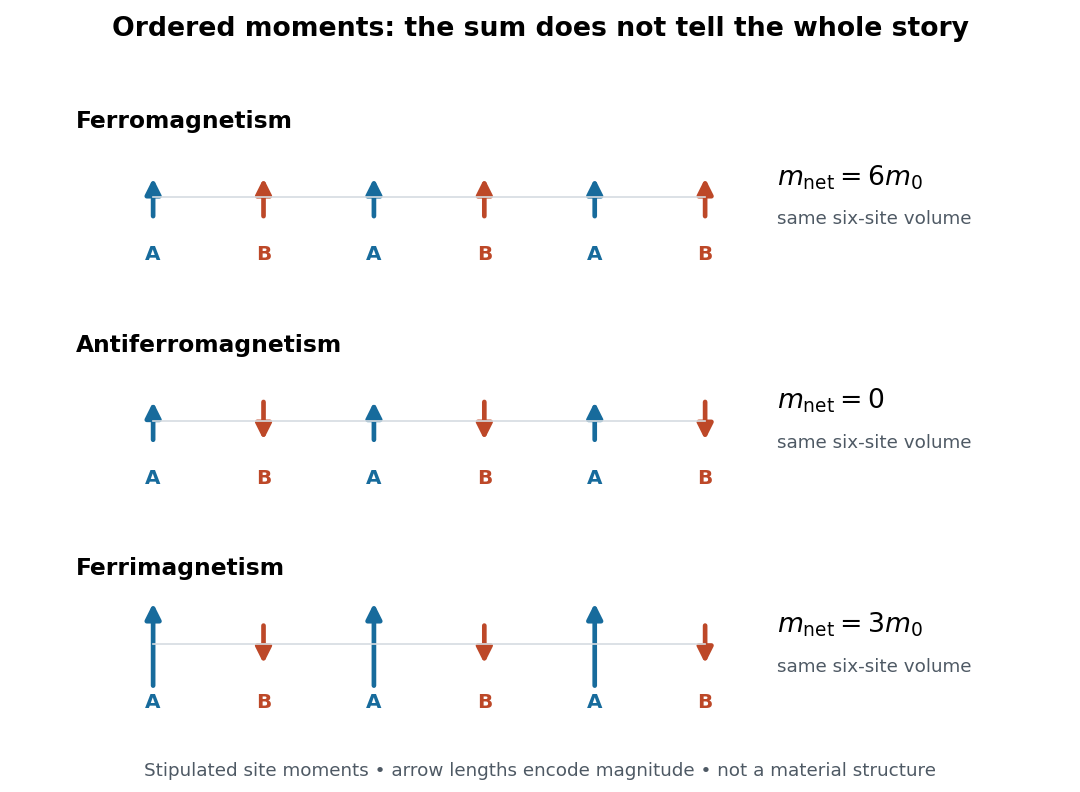
In this six-site example, three A sites and three B sites give total magnetic moments , , and , respectively, along the chosen axis. The antiferromagnetic case has but . Cancellation of the sum leaves the alternating information intact.
Magnetic neutron diffraction uses scattering of neutrons by ordered magnetic moments to infer magnetic order. Neutrons also scatter from atomic nuclei, so a pattern can contain nuclear and magnetic contributions. A Bragg scattering peak encodes periodicity; it is not a photograph of an individual spin.
A minimal original calculation makes the extra periodicity visible. Consider identical nuclear scatterers at positions , with equal neighboring separation , and ordered magnetic moments alternating between and . A two-site repeating block of length has nuclear and magnetic scattering amplitudes, apart from common geometric factors,Here is the common nuclear scattering coefficient and the component of the scattering wave vector along the row. The magnetic expression assumes equally scattering point magnetic moments perpendicular to the scattering wave vector; real magnetic scattering measures the perpendicular component and has a momentum-dependent amplitude. This one-dimensional calculation is a periodicity illustration, not a finite-temperature solution for a chain.
For even , and . For odd , and . Thus equivalent opposing magnetic sublattices, , cancel in forward scattering but reinforce at the odd positions of the doubled period. The intensity is proportional to the squared magnitude of the scattering amplitude, so changing an amplitude's sign does not make a negative intensity.
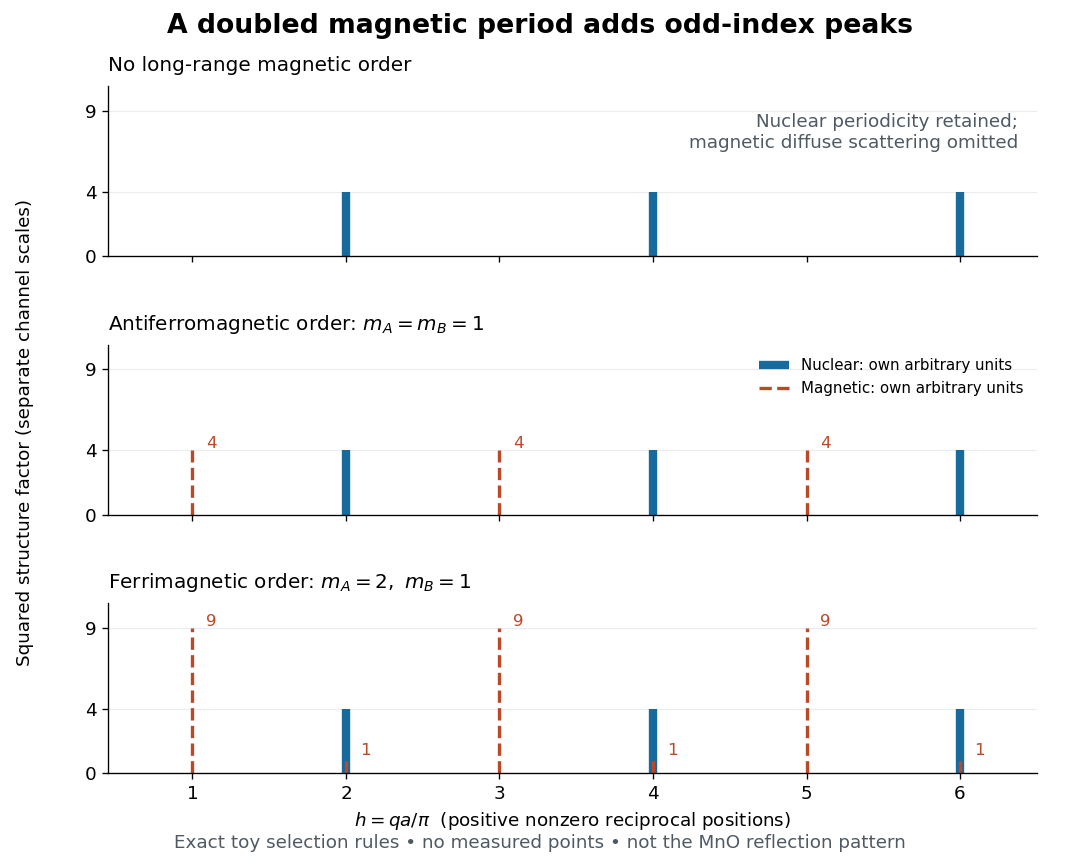
This calculation also exposes a useful difference between antiferromagnetism and ferrimagnetism: with and , magnetic squared amplitudes are at even and at odd . Extra magnetic peaks can therefore occur in a ferrimagnet too. Identifying a real magnetic structure needs the full crystal basis structure factor, multiple reflections, and the allowed moment orientations, rather than a single extra peak.
In 1949, Clifford Shull and J. Samuel Smart compared powdered manganese(II) oxide at room temperature and . Powder preparation supplies many crystal orientations. Their Fig. 1 records scattered-neutron intensity versus counter angle. Nuclear reflections remained, while the cold pattern gained strong reflections forbidden by the chemical unit cell. They indexed these with a magnetic unit cell having twice the chemical cell edge. The warm pattern already contained diffuse magnetic scattering: loss of sharp magnetic peaks does not mean loss of individual magnetic moments.[ref]
Detection of Antiferromagnetism by Neutron Diffraction by Clifford Glenwood Shull and J. Samuel Smart. Shull and Smart, Detection of Antiferromagnetism by Neutron Diffraction (1949), Fig. 1 and accompanying paragraphs; original reprint inspected at Carnegie Mellon University
The source was Oak Ridge's graphite-moderated reactor. In Early Development of Neutron Scattering (1994), Clifford Shull describes how the early two-axis instruments used a monochromating crystal to select the incident-neutron wavelength; a shielded neutron counter rotated around the specimen to record angular intensity. This specifies the source–monochromator–sample–counter path, without identifying which instrument revision produced the MnO trace.[ref]
Early Development of Neutron Scattering by Clifford Glenwood Shull. Early Development of Neutron Scattering (1994), pp. 99–103, Figs. 2–4, and p. 106, Fig. 8; inspected CMU reprint pp. 99–106
The control was the same compound above and below magnetic ordering, with retained nuclear peaks identifying the underlying chemical periodicity. The original paper labels an aluminium impurity peak and defers a complete magnetic-structure account. It supplies neither a chemical synthesis recipe nor detailed cold-stage construction. The inference is periodic magnetic order, rather than a claim that every possible structural change was excluded at arbitrary resolution.[ref]
Detection of Antiferromagnetism by Neutron Diffraction by Clifford Glenwood Shull and J. Samuel Smart. Fig. 1: aluminium impurity label, nuclear/magnetic indexing and room-temperature/80 K comparison; final paragraph before conclusion
The connection to the measured angle is the elastic Bragg scattering condition. If the incident and outgoing wave vectors have equal magnitude and make an angle , their difference has magnitudeA longer real-space period supplies additional, smaller reciprocal lattice spacings, which can put magnetic reflections at new counter angles. In the one-dimensional toy model above, doubling the period changes the allowed spacing from to . The actual MnO indexing is three-dimensional; the toy row does not assert its reflection positions or relative peak strengths.
Louis Néel supplied the ordering theory; the 1949 diffraction work was a later experimental test. His 1970 Nobel Prize in Physics recognized antiferromagnetism and ferrimagnetism. Clifford Shull's neutron-diffraction award followed in 1994.[ref]
The Nobel Prizes in Physics 1901–2000 by NobelPrize.org. sections on neutron diffraction and magnetic ordering: Néel 1970 and Shull 1994
The exchange interaction is an effective interaction between spins originating in the quantum mechanics of Electrons. Its sign convention must accompany any formula. For the illustrative classical fixed-length spin pair used here, writeWith this plus-sign convention, favors antiparallel spins: , compared with . The energy difference is . If instead the Hamiltonian is written with an overall minus sign, the same physical preference has a negative coupling. This prevents a sign convention in the Ising model from being mistaken for a disagreement about the ordering.
Let be distinct orthonormal spatial orbitals occupied by two identical spin one-half particles, with a weak repulsive Coulomb interaction. The symmetric and antisymmetric spatial combinations have first-order energy shifts and , where is the direct Coulomb integral andThe Coulomb kernel has positive Fourier transform , so . Fermionic exchange symmetry pairs the symmetric spatial function with the spin-one-half singlet state and the antisymmetric one with the spin-one-half triplet state. For these fixed orbitals the triplet lies lower by when . This does not compare arbitrary singlets and triplets with different orbital occupations; for negligible orbital overlap the splitting can vanish.
Superexchange couples localized moments through virtual hopping via intermediate, often nonmagnetic, ligand orbitals. Half-filled orbitals sharing an effective hopping amplitude give an antiferromagnetic scale in the repulsive one-band limit. Ligand geometry, orbital occupation and exchange within intermediate states can change the balance and allow ferromagnetic coupling. Real charge motion can remain gapped while these virtual processes couple an insulating magnet's spins.
Direct exchange comes from Coulomb matrix elements between overlapping localized electronic orbitals together with the antisymmetry required by the Pauli exclusion principle. It produces a spin-dependent energy without being a classical dipole interaction. Its competition with kinetic processes and orbital occupation helps determine whether neighbouring moments prefer parallel or antiparallel alignment.
Antiferromagnetism is ordered compensation of magnetic moments. In the collinear two-sublattice model, : net magnetization vanishes but staggered magnetization remains. Louis Néel developed this possibility.[ref]
Magnetism and the local molecular field by Louis Néel. §5, pp.324–326: opposing ordered sublattices
For an original local energy check, perturb the antiparallel pair in exchange interaction by writing . ThenFor , a small relative rotation costs positive energy. This verifies a pair's preference; it does not prove a bulk ordering temperature. A whole crystal must satisfy many bonds simultaneously, and thermal fluctuations and quantum effects matter. The Heisenberg antiferromagnet and antiferromagnetic Ising model specify different assumptions about those collective degrees of freedom.
Why is the distinction useful? A measurement of zero magnetization cannot decide between an ordered alternating arrangement, a disordered ensemble, and oppositely magnetized magnetic domains. A spatial probe such as magnetic neutron diffraction tests the pattern directly. The manganese monoxide neutron diffraction experiment is a particularly clear example: the order adds a new periodic scattering signal even though the net magnetic moment cancels.
The Néel temperature marks loss of long-range antiferromagnetism. A Curie temperature concerns ferromagnetism or ferrimagnetism; magnetic compensation temperature instead denotes cancellation within an ordered ferrimagnet.[ref]
Magnetism and the local molecular field by Louis Néel. §5, pp.324–326; §§8,11–12: ordering versus compensation
In the simple collinear description, compare across , rather than expecting to switch from nonzero to zero. Zero-field magnetization may be zero on both sides. A nonzero magnetic susceptibility is also compatible with antiferromagnetism: an applied magnetic field can disturb the cancellation. The uniform response of a two-sublattice Ising antiferromagnet provides a model calculation.
Ferrimagnetism has opposing, generally unequal ordered magnetic sublattices, with net magnetization in a collinear model. Louis Néel used it to explain magnetic oxides.[ref]
Magnetism and the local molecular field by Louis Néel. §8, pp.328–330: unequal sublattice contributions
The counting example in magnetic sublattice gives . Unequal populations also suffice: four sites carrying and two carrying give , even with identical individual magnitudes. Thus one must compare total sublattice contributions per common volume, rather than merely asking whether two atomic species carry different magnetic moments.
Both ferromagnetism and ferrimagnetism can produce a macroscopic magnet. Their internal organization differs: the latter retains opposing contributions. This makes ferrimagnetism a useful bridge between net magnetization and microscopic magnetic order: reducing one opposing contribution can increase the net sum, even though the total sum of moment magnitudes decreases.
At a magnetic compensation temperature, : an ordered ferrimagnet has zero net magnetization. Such cancellation need not occur in every material.[ref]
Magnetism and the local molecular field by Louis Néel. §8, Fig.7; §§11–12, pp.335–338: cancellation within an ordered phase
For an original stipulated example, let , with , and prescribe sublattice magnitudes per common volume byTake A along and B along , retaining a fixed sublattice orientation convention. These are toy functions, not measured curves or a self-consistent mean-field approximation. Their difference factors exactly:At , . At , both magnitudes equal and : this is compensation with finite order. At , . At , both magnitudes vanish: that endpoint represents the stipulated Curie temperature, not another compensation point. For stipulate both ordered magnitudes zero; do not extrapolate the polynomials into negative sublattice magnitudes.
The sign change refers to the net component relative to the fixed A direction. A freely reorienting specimen in an applied magnetic field need not display this signed branch directly. The example isolates the cancellation mechanism; it predicts neither a material's transition temperature nor its response to magnetic domains or an applied magnetic field.


