Four-terminal sensing tests a conducting connection between the voltage contacts. A magnetometer instead tests the sample's magnetic response. These measurements provide complementary constraints: the first is sensitive to a continuous path, while the second also depends on screening geometry and preparation history.
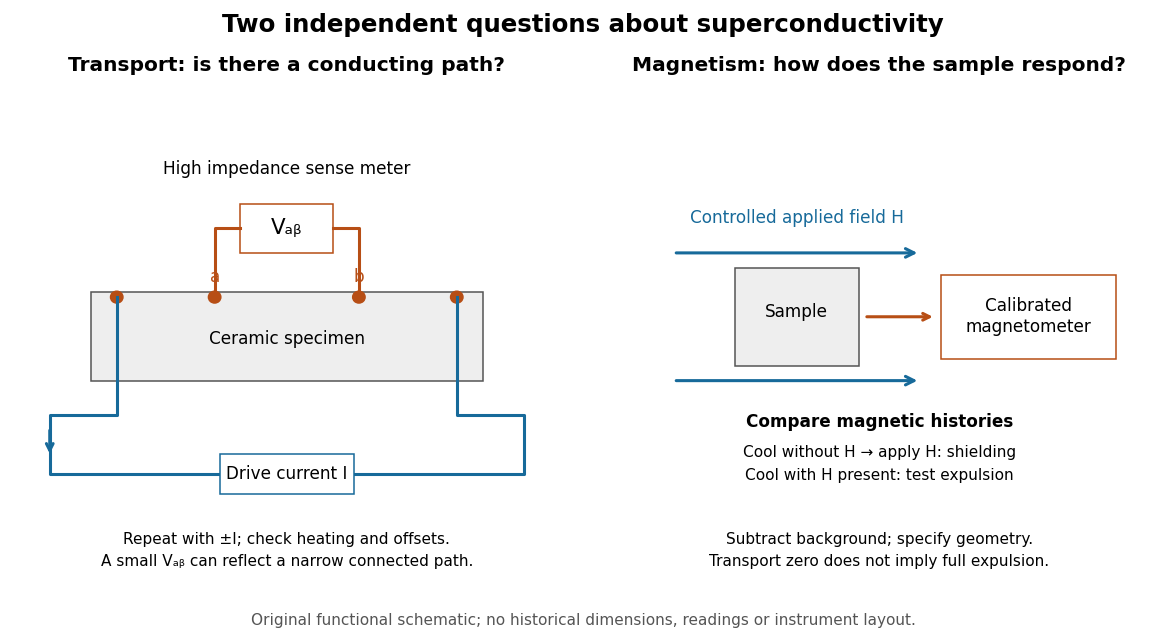

For transport, define between the inner contacts and use the reversed-electric current estimator from four-terminal sensing. Contact separation excludes drive-contact drops, but does not eliminate a drifting thermoelectric effect, Joule heating or an unrepresentative path through part of the specimen. Repeat at smaller electric currents and compare results at the same sample temperature. A finite-current result refers to that electric current and its relation to the path's superconducting critical current.
For magnetism, distinguish cooling in zero applied magnetic field and then applying it from the Field-cooled Meissner experiment. Record the applied magnetic field, background and sample geometry when interpreting magnetization or magnetic susceptibility. A transport short does not establish full Meissner effect screening throughout the specimen. Conversely, flux pinning in a type-II superconductor can make the field-cooled magnetic response differ from ideal complete expulsion. Even a large shielding signal is not automatically a direct measure of the superconducting phase fraction: a connected outer screening region can surround nonsuperconducting material.
Consider an original electrical circuit model between two equipotential cross-sections. A normal path has electrical resistance . Let indicate whether an additional path connects those same cross-sections; when connected it has electrical resistance . Ideal voltage contacts measure those cross-sections. This collapses a spatial network to two parallel branches; it is not a fit to the Bednorz-Müller experiment.
For , both branches have the same electric potential difference . Ohm's law and the Kirchhoff node law give , henceThe last case follows directly from the ideal short's constraint , provided it can carry the imposed electric current below its superconducting critical current. It does not follow by substituting into . A normal bridge in series with otherwise superconducting pieces belongs in ; superconducting grains alone need not short the measured interval.
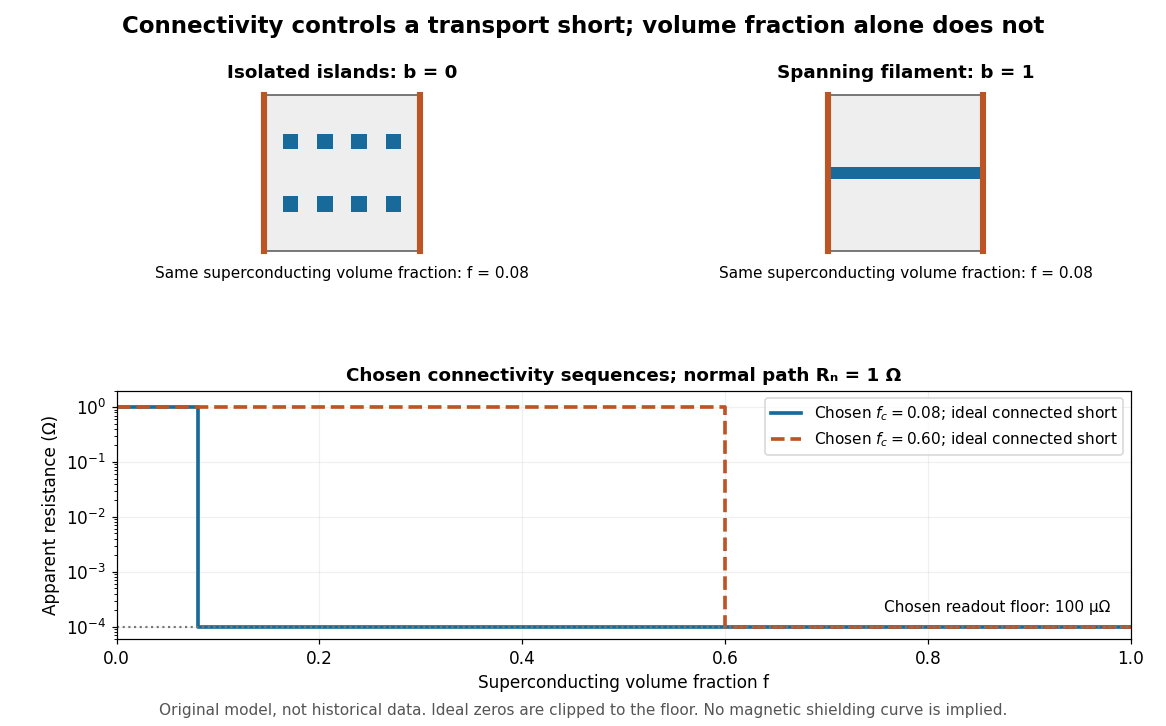
Equal superconducting volume fractions can have different transport connectivity
. Original chosen geometry and circuit example, not measured data or a historical fit. Top: blue superconducting regions between orange equipotential ends, taken uniform through the thickness, have superconducting phase fraction . Bottom: two stipulated connectivity thresholds, and , produce different apparent electrical resistance drops. Ideal zero values are displayed at a chosen instrument floor; these curves predict neither magnetic susceptibility nor a universal percolation threshold. Details.
Choose . A connected bridge with gives , almost a hundredfold drop despite finite electrical resistance. An ideal connected superconducting filament instead gives zero in this model even when its volume is a small part of the specimen. Isolated superconducting islands can have the same superconducting phase fraction while leaving . For the illustrative disconnected geometry we stipulate that the normal conducting network retains .
To plot a chosen connectivity sequence, set for and for , with on the connected branch. The two displayed values of describe different chosen architectures. A real percolation calculation would need an explicit network and spatial distribution; the scalar phase fraction does not determine by itself.
An instrument with unresolved electric potential difference bounded by reports only . For chosen and this floor is , assuming offsets and noise are included in the bound. The figure clips smaller model values to that floor. Increasing improves this formal bound only while Joule heating and the path's superconducting critical current remain controlled. None of these transport statements determines the superconducting phase fraction or establishes complete Meissner effect shielding.
Articles by others on the same topic
There are currently no matching articles.