Two-state ion-channel gating
ID: two-state-ion-channel-gating

Two-state ion-channel gating models an individual gate as a random switch between closed and open states. Write for its open probability; this is the in the header equation. An individual gate's state is always closed or open, rather than partly open. A population of identical gates can have a fraction open near , and averaging repeated identically prepared trials estimates the same probability. A finite population's observed fraction fluctuates. See Purves and colleagues, Neuroscience, 2nd edition (2001): Ion Channels Underlying Action Potentials for single-channel steps and their population averages.
At fixed membrane potential , let constant rates govern closed-to-open and open-to-closed transitions respectively, in . This is a two-state continuous-time Markov chain. Over a short interval , an initially closed gate opens with probability , and an initially open gate closes with probability . Gain minus loss gives the deterministic ordinary differential equation for the probability:Here is the fixed-voltage limiting open probability, and is a time constant. The ratio of the rates fixes the limit, while their sum fixes the speed. With initial probability ,For a short derivation, subtract : the deviation obeys , yielding the exponential function. After one time constant, of the initial deviation remains. The solution stays between and , so it remains a valid probability. The rate and time constant formulations are described in Gerstner and colleagues, Neuronal Dynamics, §2.2.2: transition rates and channel kinetics.
For a worked toy condition A, choose and . Then , , andIn a separately prepared condition B, choose , and the same . Now , , and . Condition B approaches a higher limit more quickly. These are two stipulated constant-rate conditions with held fixed in each experiment, not an empirical function relating rates to voltage or a sequential switch between conditions. The initial need not be the limiting probability at the newly imposed voltage.
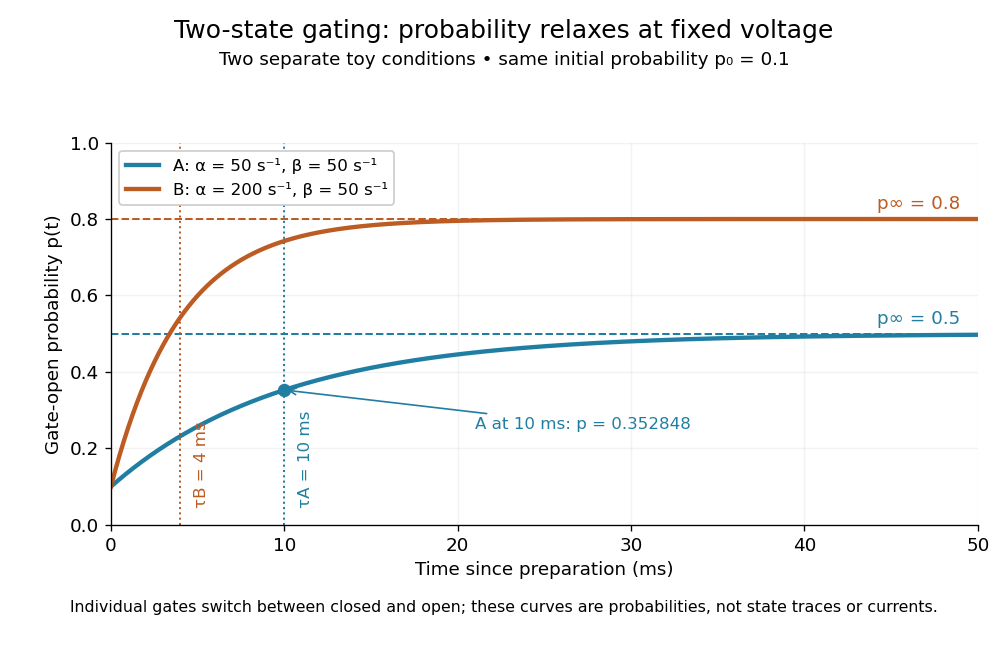
Two-state ion-channel gating: two constant-rate relaxation conditions
. Original computed probability curves, both starting at . Dashed lines show the limiting open probabilities and ; dotted lines mark time constants and . The dot marks condition A at , where . Smooth curves represent open probability or population averages, not an individual gate's random state trace or an ionic electric current. Details.
In the Hodgkin-Huxley model, the rates depend on membrane potential: and . Its is the limit for voltage held at that . During an action potential, changing changes the rates and gates feed back onto through ionic electric currents; substituting the present voltage into the constant-rate solution does not solve that coupled system. Gating describes availability of a conducting pathway. Even an open ion channel carries zero net ionic electric current at its reversal potential.
The useful bridge is from abrupt random molecular events to a smooth population prediction. A channel requiring several independent permissive gates in an ion channel has an open probability equal to their product; this can make channel availability much smaller than each gate's availability. The Hodgkin-Huxley model uses and for sodium and potassium electrical conductances, respectively.
New to topics? Read the docs here!