A reversal potential is a membrane potential at which a specified open ion channel, or specified combination of ion channels, carries zero net electric current, with the surrounding conditions fixed; the electric current changes sign across that voltage. Specifying which current matters: an individual ion contribution and a sum of several contributions can reverse at different voltages. Zero net electric current does not mean that all ions have stopped moving. See Purves et al., Neuroscience, 2nd edition (2001): reversal of a mixed-ion channel current.
Throughout these examples, membrane potential is , and conventional current is inward-positive. Positive electric current corresponds to net positive electric charge entering or net negative electric charge leaving. Negative electric current corresponds to the reverse charge transfer. A convenient Ohmic approximation iswhere is the available electrical conductance. For fixed , gives positive electric current, gives zero, and gives negative electric current; the line has slope . If , the modeled pathway carries zero electric current at every voltage: closing it does not locate its reversal potential. 3.1 Synapses (§3.1: conductance-based synaptic current) uses outward-positive ; the formula here reverses that sign to match this wiki's inward-positive convention.
For the stipulated single-pathway example from ion channel, and giveThe open ion channel carries zero net electric current at even though remains positive. Near that point a change of membrane potential changes the electric current, which is why zero current at one voltage does not make an open pathway electrically irrelevant; see shunting inhibition.
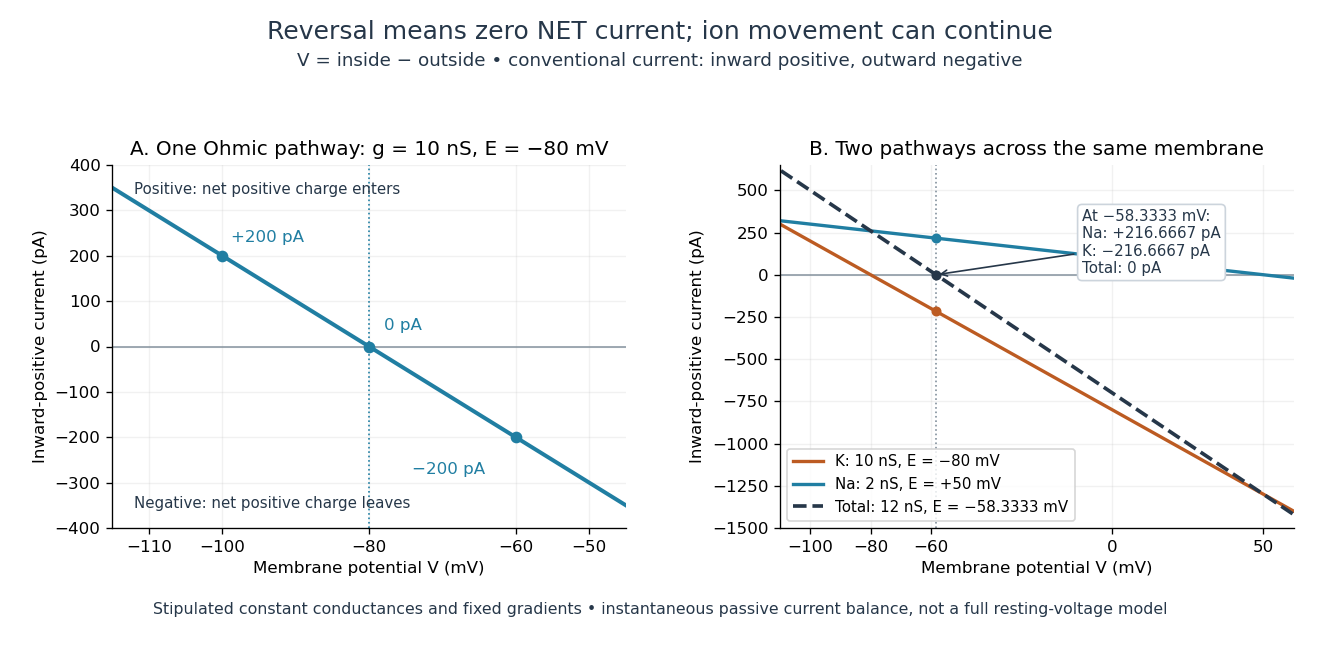
Inward-positive electric current: one reversal and two-channel cancellation
. Original computed curves for stipulated constant electrical conductances and fixed reversal potentials. Left: , . Right: a potassium pathway with , and a sodium pathway with , . Their net electric current vanishes at while both individual electric currents remain nonzero. These are model values, not empirical measurements. Details.For an ion channel passing only one ion species by passive transport, its reversal potential can equal that species' Nernst equilibrium potential, where the chemical and electrical contributions to electrochemical potential balance. At that thermodynamic equilibrium, passage in both directions can continue with no net transport. For an ion channel admitting several ion species, opposing contributions can cancel while each species continues to have net transport. Such a reversal potential is not generally any one species' Nernst equilibrium potential. See the Purves reference above.
To work out that cancellation explicitly, put two Ohmic ion channel populations across the same cell membrane. Stipulate constant electrical conductances and fixed reversal potentials:The potassium and sodium contributions add because both pathways experience the same membrane potential:Thus . This weighted mean follows simply by expanding and regrouping the two current terms; it assumes additive Ohmic contributions and a positive total electrical conductance. At , the inward-positive individual electric currents areThe potassium contribution is outward and the sodium contribution inward. Equal and opposite electric currents give ; neither pathway has stopped transporting its ions. The calculation treats two distinct pathways. Applying it to one mixed-species ion channel would additionally require a justified decomposition into independent Ohmic contributions; a general mixed-channel reversal potential cannot be obtained by assuming those hypotheses silently.
This is an instantaneous balance of the specified passive electric currents. It would be the stationary voltage of a passive capacitance model containing only these constant pathways and no applied electric current, but it is not a complete prediction of a living cell's resting membrane potential. Other electric currents, voltage-dependent gating, and pumps involved in active transport can matter. Pumps that transfer net electric charge are electrogenic and contribute their own electric current. See Purves et al.: functional properties of the sodium/potassium pump.
The toy model holds ion concentrations and therefore the stipulated reversal potentials fixed. Continuing inward sodium and outward potassium transport would change finite reservoirs unless active transport or external control maintained them. Transport can be a small fraction of the reservoir's ions over a short interval, making fixed concentrations a useful approximation; it is not a claim that the reservoirs never change. See Gerstner et al., Neuronal Dynamics (2014), §2.1: equilibrium potentials, channel currents and maintained gradients.
A reversal potential makes the effect of opening an ion channel predictable from the present membrane potential. The same open pathway can carry inward or outward electric current as crosses its reversal potential. The two-pathway example reveals a particularly useful distinction: zero net charge transfer can coexist with continuing exchange of different substances. That distinction connects membrane transport to electric current measurements without mistaking electrical balance for thermodynamic equilibrium.
Articles by others on the same topic


Reversal potential, also known as equilibrium potential, is a concept in electrochemistry and neuroscience that refers to the membrane potential at which the net flow of a specific ion across a cell membrane is zero. In other words, it is the voltage at which the chemical gradient (concentration difference) for that ion is exactly balanced by the electrical gradient (voltage difference) across the membrane, resulting in no net movement of the ion in or out of the cell.