The most important on in metabolism internals, everything else gets converted to it before being processed in the .
Articles by others on the same topic

Glucose is a monosaccharide with molecular formula . Its familiar biological form, D-glucose, is an aldohexose. In the open-chain Fischer projection, is at the top and at the bottom; the hydroxy groups at C2, C3, C4, and C5 point right, left, right, right. This full pattern distinguishes D-glucose from other six-carbon aldehyde sugars. See McMurry, Organic Chemistry, 25.4: configurations of the aldoses.
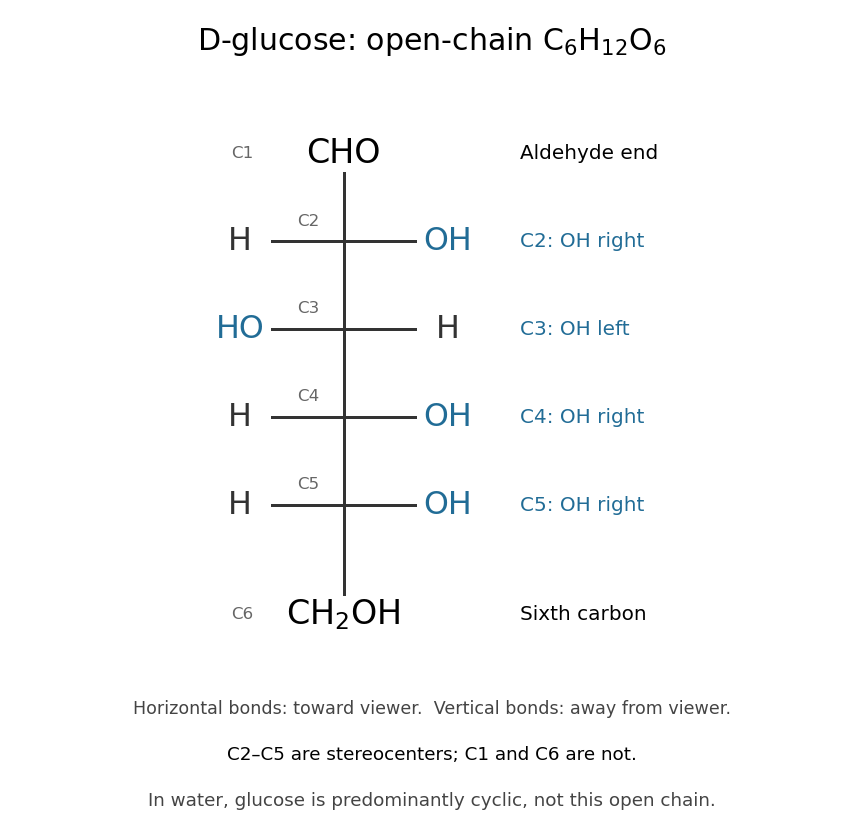

The molecular formula can be checked directly: one group, four groups, and one group give six carbon, twelve hydrogen, and six oxygen chemical atoms. All four interior carbon positions are stereocenters in this open-chain structure. Neither their orientations nor the arrangement of chemical bonds can be recovered from the molecular formula alone.
In water, glucose exists mainly in six-membered rings in chemical equilibrium with a small amount of open-chain glucose. Ring closure connects the hydroxy group at C5 to the aldehyde carbon at C1; the ring contains five carbon chemical atoms and one oxygen, with C6 outside it. No chemical atoms are lost, so the molecular formula remains . See McMurry, Organic Chemistry, 25.5: cyclic structures of monosaccharides.
Glucose is useful both as a substrate in cellular metabolism and as a building block of polysaccharides. Cellulose chains assembled from glucose units help support plant cell walls. The same small sugar thus connects chemical fuel to a structural material; its role depends on how it is transformed or linked. See Cooper, The Cell: A Molecular Approach, the molecular composition of cells.