The network of chemical reactions that maintains a living system, supplies energy and builds or processes its material. Gas emissions can arise as primary metabolic byproducts or secondary metabolic byproducts, with different implications for an atmospheric biosignature gas.
Enzymes make this network operate on biologically useful timescales. Following material through successive substrates and reaction products explains why a single fast enzyme need not make the entire network fast: another step may constrain the flow. Changing enzyme amounts or activity therefore changes which routes can carry material, connecting molecular chemical kinetics to the maintenance and growth of a biological cell. See Alberts et al., Molecular Biology of the Cell: multienzyme complexes and cell metabolism.
Use of inorganic electron donors as a source of metabolic free energy. It does not by itself specify the source of cellular carbon.
Formation and modification of phenazine metabolites. In Pseudomonas aeruginosa, two core phz loci generate precursors modified by additional enzymes.
A standardized minimum metabolic rate measured under stated resting, postabsorptive and thermal conditions; it is not interchangeable with maximum aerobic performance.
A route transferring cytosolic reducing equivalents through glycerol-phosphate dehydrogenases to mitochondrial electron transport. Its entry point differs from matrix NADH oxidation.
A coupled reaction and transport system transferring reducing equivalents between cytosol and mitochondrial matrix without transporting NADH itself across the inner membrane.
A growth pattern with successive utilization of substrates separated by an adaptation interval. Glucose followed by lactose is a classic example, but timing depends on culture conditions and transport regulation.
Production of metabolic heat sufficient to contribute substantially to body-temperature regulation. It is not synonymous with constant temperature, and similar thermophysiology does not by itself identify a clade.
Quantitative analysis of how local changes in reaction capacities alter steady-state metabolic fluxes and concentrations. Its sensitivities depend on the operating condition rather than identifying one invariant limiting step.
Under the scaling assumptions of metabolic control analysis, the complete set of independently scaled reaction-capacity flux control coefficients for one steady-state flux sums to one. Uniformly scaling all capacities scales the flux, and differentiation with respect to the scale factor gives the sum.
A local logarithmic sensitivity of a steady-state flux to a specified reaction capacity: . It is not the fraction of flux physically passing through that step; a zero value does not make an essential step dispensable.
Conversion of sulfate to activated derivatives used in subsequent metabolic reactions. Its compartmentalization in Entamoeba histolytica mitosomes demonstrates lineage-specific retention of organellar function.
Ethanol is the chemical compound produced by the alcoholic fermentation described under Saccharomyces cerevisiae. Its two carbon chemical atoms explain the product bookkeeping there. See NIST Chemistry WebBook: ethanol formula and identity; the Biology 2e section cited under Saccharomyces cerevisiae identifies ethanol as the alcohol product.
In its biochemical sense, fermentation is metabolism that obtains ATP from breakdown of organic substrates without a respiratory electron transport chain. The alcoholic route is one example; not every fermentation produces ethanol. See Clark, Douglas and Choi, Biology 2e, 7.5: fermentation versus anaerobic respiration.
Microbial digestion in enlarged caecal or colonic regions after the principal small-intestinal digestive region. Intake, particle sorting and retention affect its consequences for nutrition.
Reingestion of selected caecal material, allowing a later digestive passage to recover nutrients including microbial products. It is more specific than indiscriminate faeces consumption.
Microbial digestion in an enlarged compartment before the principal acid and enzymatic digestive regions. Independent specializations occur in ruminants, colobine monkeys and macropods.
Return of previously swallowed material to the mouth for further chewing, followed by reswallowing. It helps expose plant material to microbial attack.
Alcoholic fermentation produces ethanol and carbon dioxide from sugars through an enzyme-catalyzed pathway. See Saccharomyces cerevisiae for its ideal glucose balance and yeast for the distinction between living cells and active extracts.
Glycogen is a highly branched polysaccharide of glucose units, serving as a storage form of glucose in animals. Liver and muscle provide familiar examples. The classical second messenger experiments measured regulation of an enzyme involved in glycogen breakdown, glycogen phosphorylase. [ref]
https://openstax.org/books/biology-2e/pages/3-2-carbohydrates. Clark, Douglas and Choi, Biology 2e, 3.2: glycogen
Glycogenesis builds glycogen; glycogenolysis breaks it down. Their opposing directions matter in the insulin and glucagon circuit.
Gluconeogenesis synthesizes glucose from non-carbohydrate precursors. It is distinct from glycogenolysis, which mobilizes an existing glycogen store.
Photosynthesis captures light energy and transforms it into chemical forms that a biological cell can use. In plants, algae and cyanobacteria, this supports carbon fixation: incorporation of carbon from carbon dioxide into chemical compounds used to build living material. Capturing light and incorporating carbon are distinct processes coupled through metabolism. See OpenStax Biology 2e, 8.1: overview of photosynthesis.
For oxygenic photosynthesis, a simplified net equation writes a six-carbon sugar, glucose, as the representative product:This is net stoichiometry, not a one-step mechanism. A worked bookkeeping check counts six carbon chemical atoms, twelve hydrogen chemical atoms, and eighteen oxygen chemical atoms on each side: the product side has six oxygen chemical atoms in the sugar and twelve in molecular oxygen. The light label supplies energy, not additional chemical atoms.
Crucially, the released molecular oxygen comes from water, not carbon dioxide. Cancelling water made and consumed in different steps hides this distinction in the net equation. The Calvin cycle supplies a net three-carbon triose phosphate, such as glyceraldehyde 3-phosphate, for subsequent sugar synthesis; it does not directly export glucose. See OpenStax Biology 2e, 8.2: light-dependent reactions and OpenStax Biology 2e, 8.3: using light energy to make organic molecules.
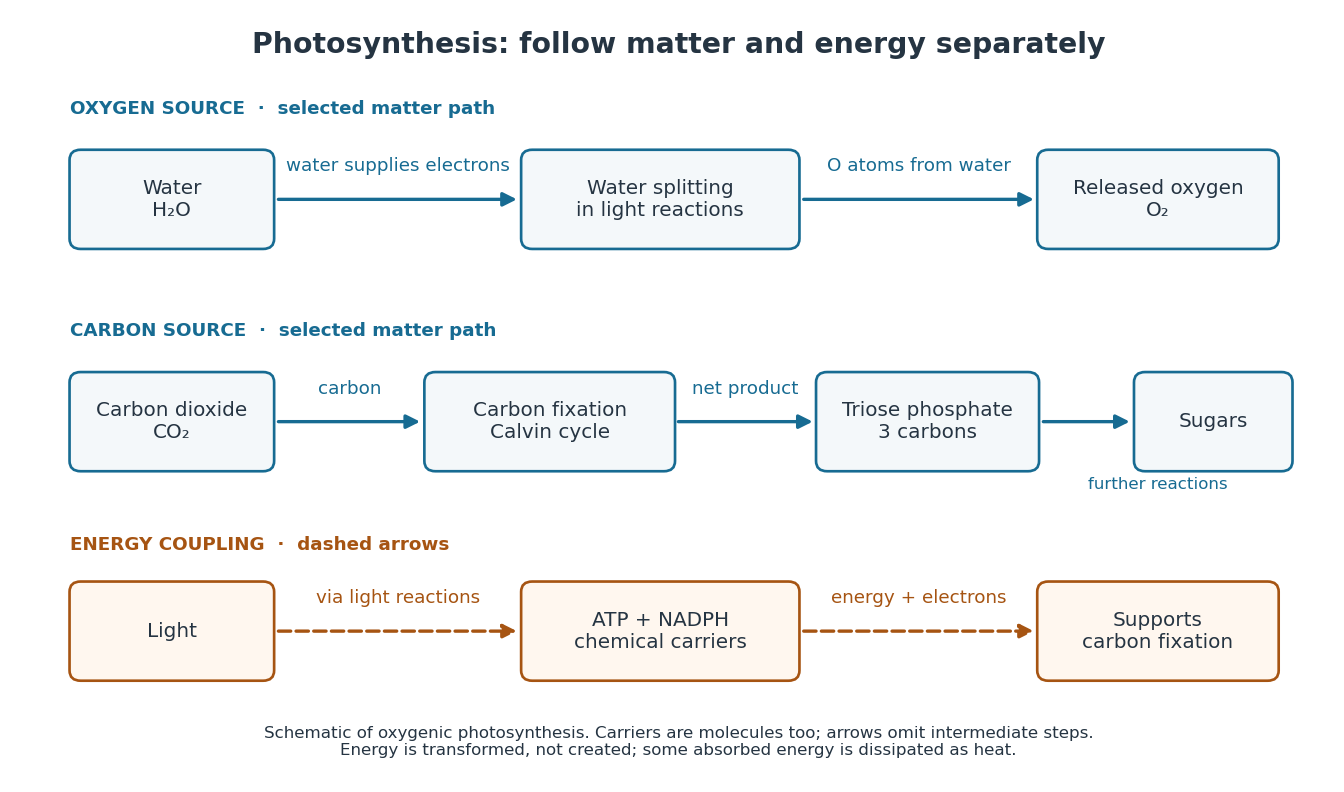
The useful achievement is connecting incoming light to both usable energy and new biological material. ATP is an immediate energy currency; NADPH supplies electrons for synthesis; carbon dioxide supplies the carbon incorporated into carbohydrates. These roles are complementary. Conservation of energy still holds: photosynthesis transforms energy, never creates it, and some absorbed energy is dissipated as heat. A plant also carries out cellular respiration, including in biological cells that perform photosynthesis. Gas exchange reflects both processes. Oxygenic photosynthesis remains central to interpreting terrestrial molecular oxygen as an atmospheric biosignature gas. See OpenStax Biology 2e, 8.3: photosynthesis and respiration.
Radiation in the approximate 400–700 nm interval conventionally counted for photosynthesis. Organisms differ in spectral use, so equal integrated light does not imply equal biological utility.
Adjustment of the composition, capacity or organization of photosynthetic machinery to prevailing conditions. It acts alongside faster regulation of existing components.
A light-associated reduction in photosynthetic capacity, often involving damage and recovery processes. It should be distinguished from rapidly reversible protective energy dissipation.
Processes limiting light-induced damage when absorbed excitation exceeds safe photochemical use. Energy dissipation, regulated electron flow and repair have complementary roles.
Light-dependent movement of chloroplasts within plant cells. Accumulation can increase interception under weak light, whereas avoidance can reduce exposure under strong light.
The pigment–protein machinery converting excitation into separated redox equivalents. Productive charge separation competes with decay of the excited state.
A pigment–protein assembly collecting light and transferring excitation towards a photosynthetic reaction centre. Excitation transfer between pigments differs from electron transfer after charge separation.
Conductance for gas exchange through stomata, influencing carbon uptake and water loss. Responses to carbon dioxide and atmospheric dryness can affect growth and water-use efficiency.
Total photosynthetic carbon uptake over the stated area and interval, before subtraction of producer respiration.
A measurable signal used to investigate the state of the photosynthetic machinery. Recovery after drying can be informative, but should be complemented by measurements of growth and reproductive success.
A photosynthetic state transition redistributes excitation between photosystems in response to their relative activity. In plants, regulated phosphorylation of a mobile LHCII fraction helps alter its functional association with the two photosystems.
Photorespiration is the metabolic route processing products of Rubisco oxygenation and recovering part of their carbon. It consumes energy and releases some carbon dioxide; under particular conditions it also provides a sink for energy and reducing power.
Cyclic electron flow around photosystem I returns photosystem-I-derived electrons to the intersystem electron-transport chain. It can support proton-gradient formation without net NADPH production, helping adjust ATP supply and photoprotection.
Photosynthetic control refers to regulation of electron flow, especially lumen-pH-dependent restriction at the cytochrome b6f complex. Slowing electron delivery can protect downstream acceptors from excessive reduction.
The xanthophyll cycle reversibly changes antenna-associated xanthophyll composition with light conditions. Lumen-acidification-dependent de-epoxidation towards zeaxanthin can support photoprotective quenching in plants.
Non-photochemical quenching describes pathways that reduce chlorophyll fluorescence through routes other than photochemical charge separation. Rapid protective components can dissipate excitation as heat, but a fluorescence decrease alone does not uniquely identify the pathway.
Oxygenic photosynthesis uses water as an electron source and releases molecular oxygen. Plants, algae and cyanobacteria provide examples. The defining distinction from anoxygenic photosynthesis is molecular oxygen release, not merely capture of light.
Anoxygenic photosynthesis captures light without producing molecular oxygen. It occurs in some bacteria and uses electron sources other than water. Whether carbon fixation accompanies this light capture depends on the organism and conditions; photosynthesis does not imply one universal carbon-assimilation pathway. See Alberts et al.: chloroplasts and photosynthetic bacteria.
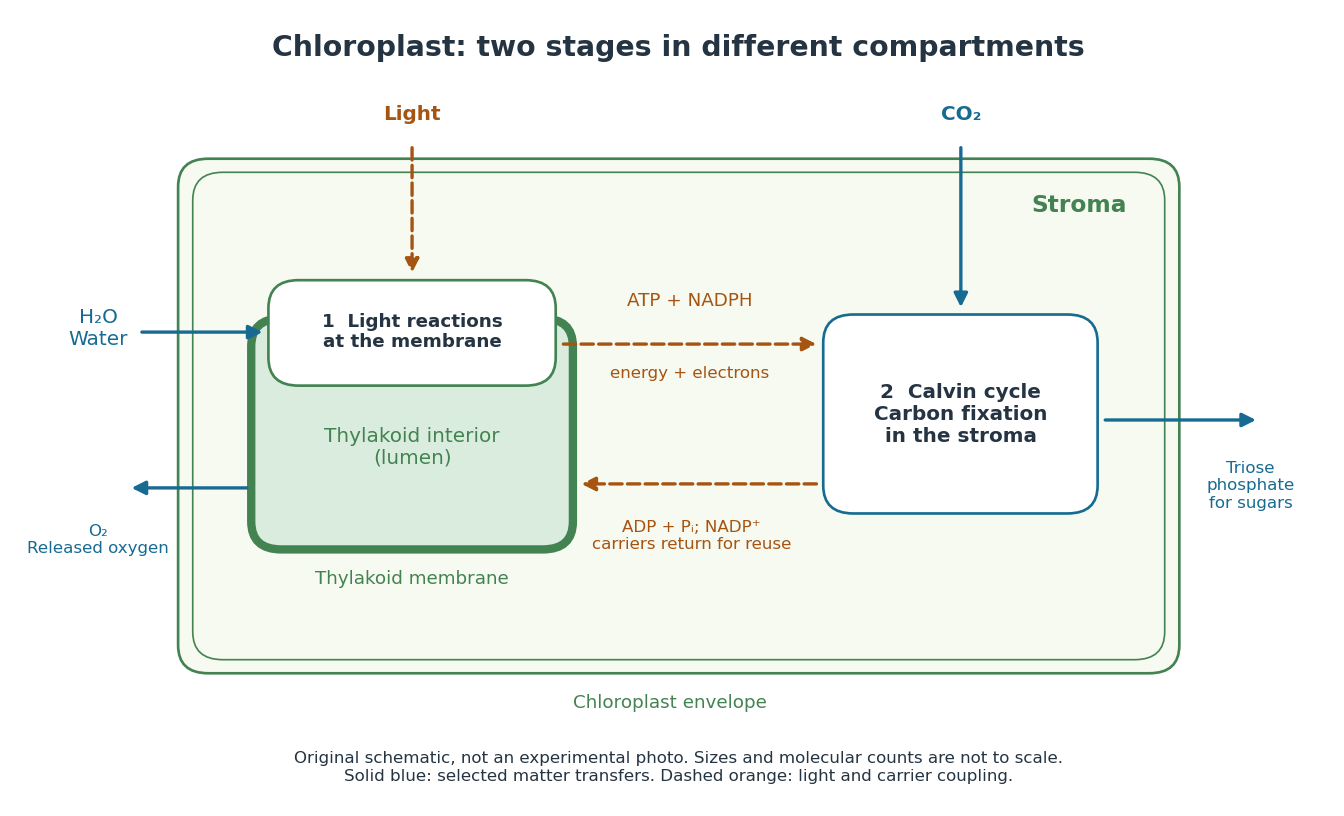
In a chloroplast, light-dependent reactions take place at thylakoid membranes. Chlorophyll captures light; electron transfer helps establish an electrochemical gradient across the thylakoid membrane, enabling formation of ATP. The oxygenic photosynthesis pathway also forms NADPH and releases molecular oxygen from water. ATP and NADPH become available in the chloroplast stroma for the Calvin cycle. See Alberts et al.: chloroplast light reactions.
An organized light-harvesting and reaction-center assembly supporting photosynthetic energy conversion.
Photosystem I is a light-driven reaction-centre complex in oxygenic photosynthesis. Excitation supports electron transfer to acceptors including ferredoxin; the balance between linear and cyclic routes affects reductant and ATP supply.
A photosystem involved in water oxidation during oxygenic photosynthesis. Its reaction-center components include D1 protein.
The manganese–calcium-containing catalytic machinery that extracts electrons from water in oxygenic photosynthesis. Four oxidizing equivalents permit formation of one oxygen molecule from two water molecules.
LHCII is a major light-harvesting antenna complex in plants. A regulated mobile fraction participates in photosynthetic state transitions; antenna redistribution is distinct from simply dissipating excitation.
PsbS participates in rapid proton-dependent regulation of photosynthetic antenna quenching in plants. Loss of PsbS-dependent quenching can be separated experimentally from loss of light-harvesting capacity.
Processes replacing damaged photosystem II components and restoring functional complexes. Regulated D1 protein synthesis is one part of this cycle.
A reaction-center protein of photosystem II, encoded by psbA messenger RNA in chloroplast expression systems. Damage creates demand for replacement during photosystem II repair.
Chlorophyll is a family of molecules that absorb light for photosynthesis. In chloroplasts, chlorophyll works with proteins in thylakoid membranes; absorbing light initiates energy capture rather than directly constructing a sugar. See OpenStax Biology 2e, 8.2: photosynthetic pigments.
A widespread photosynthetic pigment with prominent blue and red absorption bands. Its concentration is a useful index of phytoplankton biomass, but pigment per unit carbon varies with light acclimation and physiological condition.
Carbon fixation incorporates carbon from carbon dioxide into organic chemical compounds. It identifies a material transformation, rather than a particular source of energy: carbon fixation can be supported by photosynthesis or by other metabolism. The Calvin cycle is one pathway, not the definition of all carbon fixation.
The Calvin cycle couples carbon fixation to use of ATP and NADPH. In a chloroplast it takes place in the chloroplast stroma. Its chemical reactions incorporate carbon dioxide, use NADPH-supplied electrons, and regenerate the molecules that accept further carbon dioxide.
In the standard Calvin cycle bookkeeping, three carbon dioxide molecules require nine ATP and six NADPH for one net three-carbon triose phosphate. A six-carbon sugar equivalent therefore corresponds to six carbon dioxide, eighteen ATP and twelve NADPH; subsequent sugar synthesis is separate. These are pathway requirements, not a universal measured photosynthesis yield. See OpenStax Biology 2e, 8.3: Calvin cycle bookkeeping.
Calling the Calvin cycle light-independent means its individual chemical reactions do not directly capture light; it does not mean the Calvin cycle runs only at night or independently of the supplies from light-dependent reactions.
Ribulose-1,5-bisphosphate carboxylase/oxygenase, the enzyme catalysing carbon-dioxide addition to ribulose bisphosphate in the Calvin cycle. Its competing oxygenase reaction links carbon assimilation to photorespiration.
Cellular respiration transfers energy from chemical fuels into usable forms including ATP. Oxidation of the fuel is coupled to reduction of an electron acceptor; the energy transfer can support ATP synthesis. Plants carry out cellular respiration as well as photosynthesis. Their biological cells need usable energy in darkness too, and a seed can draw on stored fuel during germination.[ref]
Biology 2e by Mary Ann Clark and others. Biology 2e, §7.1, Electrons and Energy and ATP in Living Systems: redox and energy carriers
[ref]Follow three different accounts: carbon moving from fuel to products, electrons moving to an electron acceptor, and energy becoming available for cellular work. They are connected, but an oxygen uptake measurement alone does not identify the fuel or count the ATP made. The pea seed respirometry experiment makes this distinction visible with simple apparatus.
Respiratory carbon loss by organisms using organic matter produced by others. It includes important decomposer fluxes and must be distinguished from autotrophic respiration.
Respiratory carbon loss by primary producers. Subtracting it from gross primary production gives net primary production.
Aerobic respiration uses molecular oxygen as the final electron acceptor. For complete oxidation of glucose, the net material balance isThis records the overall conversion of glucose, molecular oxygen, carbon dioxide and water; it is not one enzyme-catalyzed step, and it omits the separate ATP accounting. For an original stoichiometry check, each side contains six carbon, twelve hydrogen and eighteen oxygen chemical atoms. If exactly of glucose undergoes this complete conversion, the equation requires of molecular oxygen and yields each of carbon dioxide and net water. This is an equation-based calculation, not an observed seed measurement.
The molecular oxygen is reduced to water, rather than being the source of the carbon dioxide's carbon. A formal redox electron balance, using acidic half-reaction notation, makes the roles explicit:Adding and cancelling gives the net equation above. Both half-reactions conserve chemical atoms and electric charge. The electrons balance a net transfer; they are carried through cellular intermediates, rather than released as a pool of free electrons. The final respiratory reduction can be written . These equations are bookkeeping, not a tracing experiment that assigns every product oxygen chemical atom to its original molecule.[ref]
Biology 2e by Mary Ann Clark and others. Biology 2e, §7.4, Electron Transport Chain, Figure 7.12: oxygen reduction to water
Glycolysis converts glucose into two pyruvate molecules, with a net two ATP and reduced NADH; it does not directly consume molecular oxygen. Pyruvate processing and the citric acid cycle, also called the TCA cycle, release carbon dioxide and supply reduced carriers. Thus releasing carbon dioxide and consuming molecular oxygen occur at different stages.[ref]
Biology 2e by Mary Ann Clark and others. Biology 2e, §7.2, Outcomes of Glycolysis; §7.3, Breakdown of Pyruvate and Citric Acid Cycle
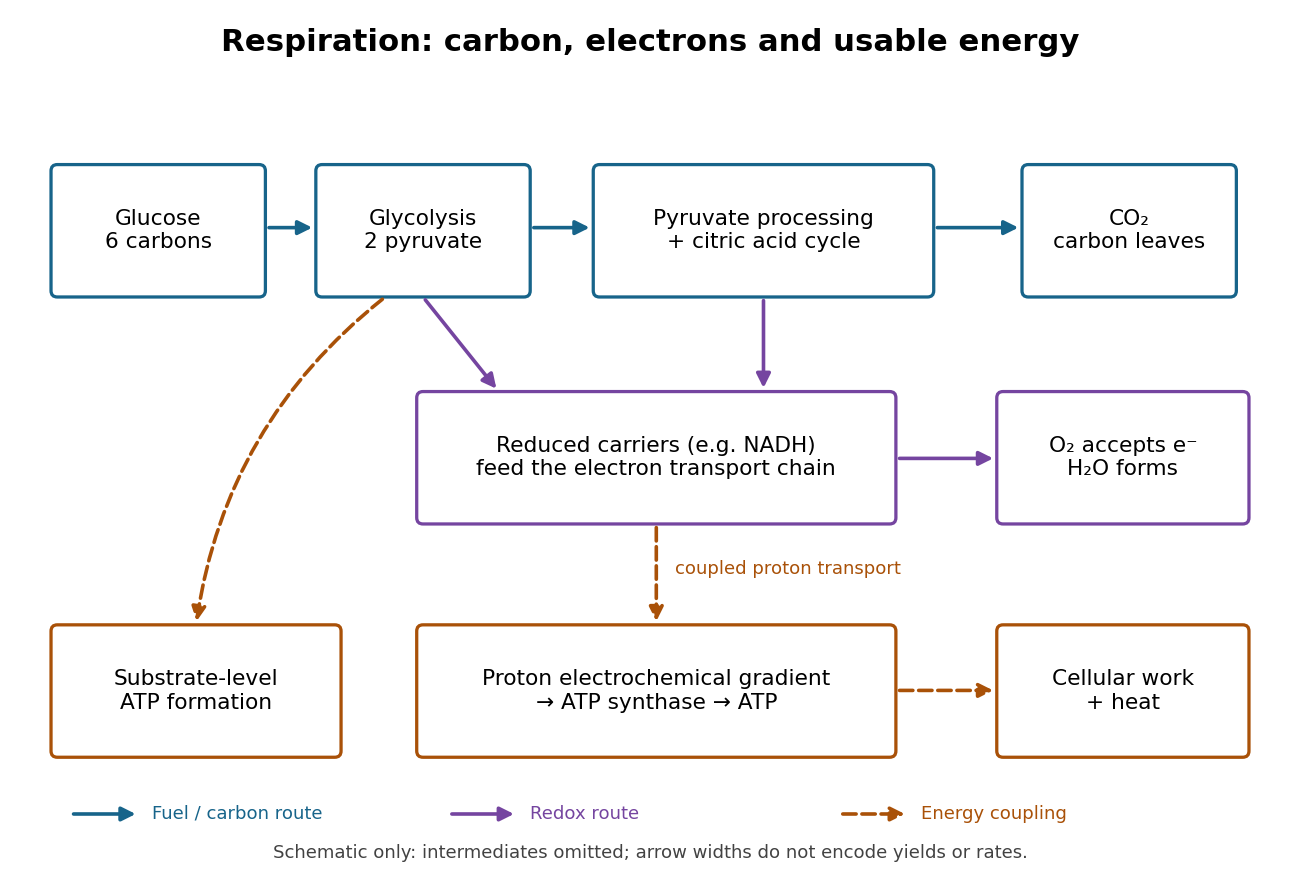
An electron transport chain reoxidizes carriers such as NADH. Coupling some of its redox steps to proton transport establishes an electrochemical gradient; ATP synthase can use that gradient to form ATP from adenosine diphosphate and inorganic phosphate. This is oxidative phosphorylation. A separate route, substrate-level phosphorylation, transfers a phosphate group from a reacting substrate to adenosine diphosphate. In typical eukaryotic biological cells, the respiratory chain occupies the inner membrane of a mitochondrion.[ref]
Biology 2e by Mary Ann Clark and others. Biology 2e, §7.1, Substrate Phosphorylation; §7.4, Electron Transport Chain and Chemiosmosis, Figures 7.12–7.14
The useful achievement is controlled transfer: fuel oxidation can replenish an ATP supply that supports active transport and synthesis. ATP is a reusable chemical carrier, not newly created energy; ATP hydrolysis and the coupled cellular process have their own net free energy balance. Some fuel energy is dissipated as heat.[ref]
Biology 2e by Mary Ann Clark and others. Biology 2e, §7.1, ATP in Living Systems and Energy from ATP; §7.4, ATP Yield
There is no universal yield of or ATP per glucose. Actual ATP recovery depends on carrier transfer routes, coupling and diversion of intermediates to other metabolism. In particular, an oxygen uptake rate cannot be converted into an ATP production rate by assuming one fixed multiplier.[ref]
Biology 2e by Mary Ann Clark and others. Biology 2e, §7.4, ATP Yield: shuttle differences and use of intermediates
Anaerobic respiration uses a respiratory electron transport chain with a final electron acceptor other than molecular oxygen. External acceptors can include sulfate, depending on the organism. “External” distinguishes a supplied terminal acceptor from the fuel-derived organic intermediates used in fermentation; it does not mean that the reduction must take place outside the biological cell. In fermentation, regeneration of carriers such as NADH to their oxidized form permits glycolysis to continue without a respiratory electron transport chain. Both routes can operate without molecular oxygen, but they are different mechanisms.[ref]
Biology 2e by Mary Ann Clark and others. Biology 2e, §7.5, opening distinction, Anaerobic Cellular Respiration and Figure 7.16
A respirometer measures gas changes associated with cellular respiration. In the absorber-based pea seed respirometry apparatus, the changing gas inventory is inferred from a liquid boundary's displacement. A respirometer is therefore a physical measurement coupled to a biological process, not a direct ATP counter.
The University of Oklahoma K20 Center's handout describes three sealed vial-and-pipette respirometers in each temperature bath: soaked, germinating peas; nongerminating peas plus inert plastic beads; and beads alone. Displaced water establishes equal occupied volumes. Absorbent cotton holds potassium hydroxide, which removes carbon dioxide; nonabsorbent cotton separates it from the peas. The source equilibrates the vials before submersion and again before the initial reading. Colored water makes the boundary visible in each calibrated pipette. Readers then record positions every five minutes for twenty minutes.[ref]
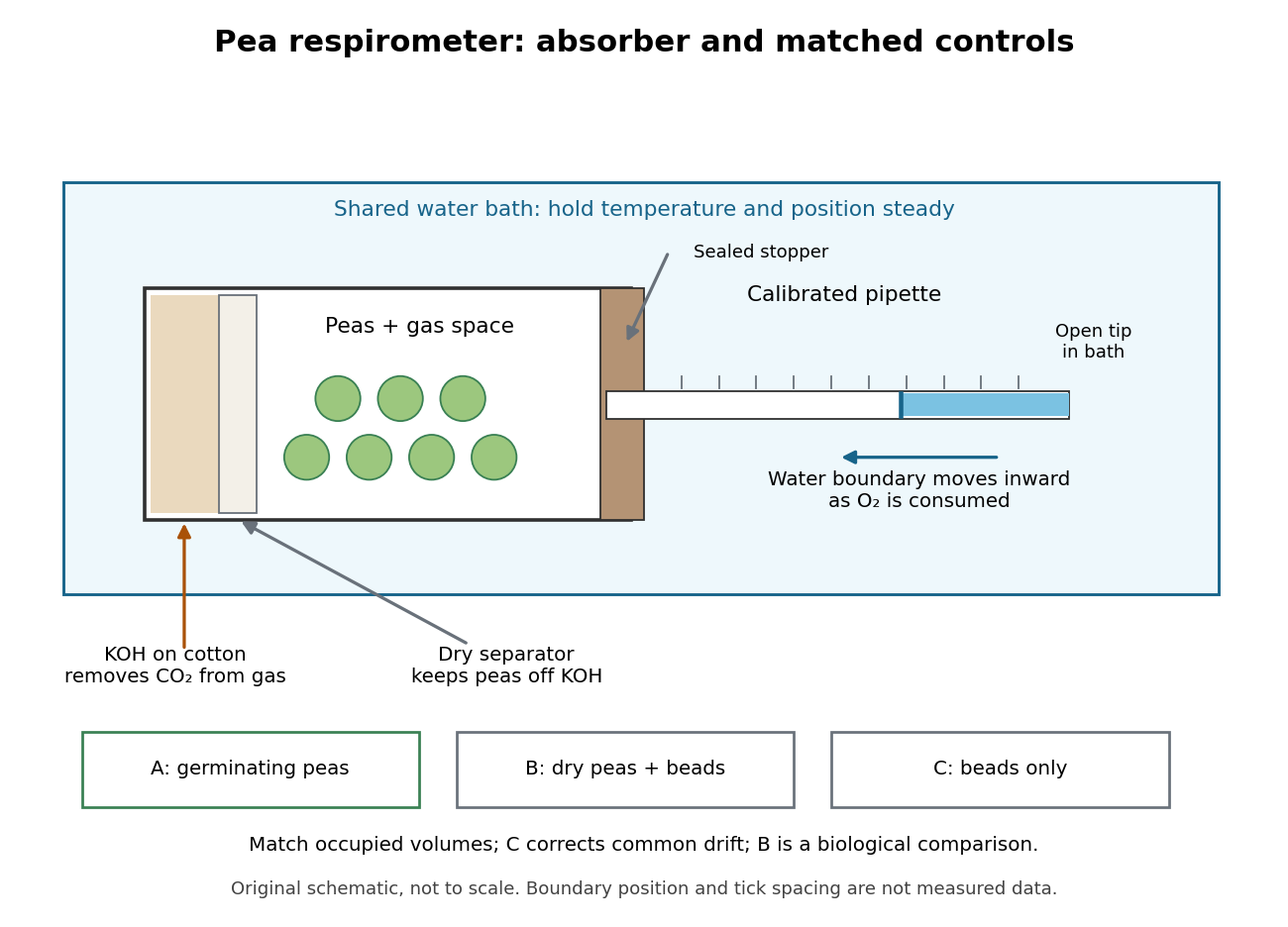
Bath temperature, vial position and seal integrity matter. The beads-only respirometer detects common temperature or atmospheric pressure drift; its change is subtracted from each pea reading. Nongerminating peas provide a biological comparison, not an assumption of zero cellular respiration. A larger corrected uptake slope for germinating peas would support greater molecular oxygen consumption by that sample under the tested conditions.[ref]
Cell Respiration by the K20 Center. Cell Respiration, pp. 1, 3–4 and 6: living dormant seeds, position/leaks, corrected differences and slope
Equal displaced volumes help match the gas spaces; they do not establish equal living mass or equal developmental state. Comparing uptake per seed and uptake per dry mass asks different questions. Leaks, incomplete carbon dioxide absorption, gas dissolution and changing water-vapour contributions can distort the respirometer inference. A blank correction cannot repair a sample-specific leak. These are consequences of the respirometer gas balance, rather than measurements reported in the handout.
For an original idealized mathematical model, let be the amount of substance of molecular oxygen consumed since the initial reading and the carbon dioxide produced. Suppose a fraction of that carbon dioxide is removed from the gas, all other gas inventories remain fixed, and temperature and gas pressure stay constant. The ideal gas law gives the positive gas contractionwhere is the molar gas constant and the gas volume. With complete absorption, , the contraction reflects molecular oxygen uptake regardless of the amount of carbon dioxide made. For a uniform pipette bore of area , an inward boundary displacement gives . A graduated pipette can instead supply the displaced volume directly.
Let denote sample contraction and the matched blank contraction. Define with both taken relative to their own initial readings. Under the preceding assumptions,The slope of corrected volume against time estimates uptake over the chosen interval. The approximate sign acknowledges that a liquid boundary also responds to hydrostatic and capillary pressure, while the gas can exchange water vapour. A fixed-volume apparatus would instead show a pressure decrease; its ideal conversion is after complete absorption and appropriate blank correction.
The ideal gas law also exposes drift without any biology: for fixed gas inventory, . A one-percent rise in absolute temperature at fixed pressure produces a one-percent expansion. Matching the initial gas spaces makes such common changes easier to subtract. Subtracting unmatched blanks can leave a physical signal that looks biological.
The respiratory quotient compares carbon dioxide production with molecular oxygen consumption over the same interval. Complete glucose oxidation in the net equation above gives . In the ideal respirometer gas balance with no absorber, , that conversion gives : substantial cellular respiration can occur without any net gas contraction. A zero contraction therefore does not by itself demonstrate zero metabolism.
Other fuels, incomplete conversion and concurrent synthesis can alter the ratio. Absorber-based respirometry isolates molecular oxygen uptake by deliberately removing the other gas signal; it cannot independently determine the respiratory quotient or identify glucose as the consumed fuel. Separate carbon dioxide measurement would supply the missing account.
A compound released through specialized functions such as signaling, defense or stress adaptation rather than the core reactions needed for energy and biomass. Dimethyl sulfide and chloromethane are examples discussed as atmospheric biosignatures. Their specialized origins may improve specificity while lowering the global emission flux.
A product released by reactions needed for energy acquisition, growth or biomass construction. Methane from energy-yielding microbial reactions and molecular oxygen from oxygenic photosynthesis are examples. Abiotic chemistry can make some of the same molecules, so production mechanism and environmental abundance matter.